Wondering when the deer rut will start in 2026? Will it stick to that early-to-mid date in November? One easy answer is that it will land when it always does because the whitetail rut is engineered around daylight. But, factors like weather, moon phase, and overall herd health might have micro-influences on when and how heavily deer are on the move during peak times. The core peak breeding window in your region, however, is something you can plan around right now, weeks before the first cold front.
The rut is not one date on a national calendar where every hunter can take the same holiday. It shifts by region, sometimes by county, and the gap between a Wisconsin ridge and South Texas brush country can run a matter of weeks. So instead of a single magic day, this year’s deer rut predictions break down by region, explain the biology behind the timing, and point you toward the deer movement times by zip code that matter for your specific spot.
When Will the Rut Start in 2026?
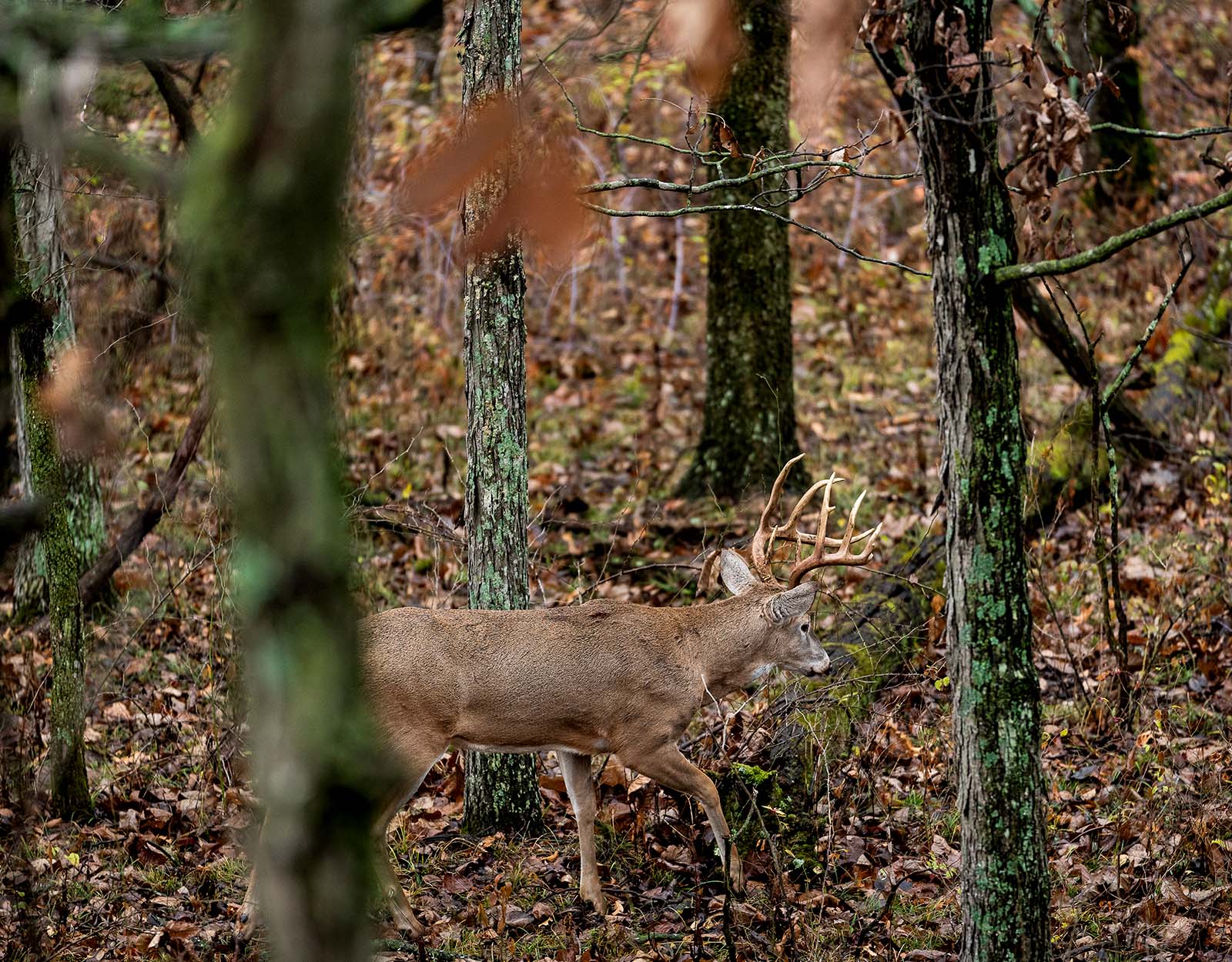
The whitetail rut is triggered by photoperiod, the shrinking amount of daylight as fall tips toward winter. As days get shorter, hormonal changes push does toward estrus, which is the short one- or two-day window when a doe is receptive to breeding. Because the calendar of daylight is fixed, peak breeding lands in a remarkably tight window year after year. Decades of deer-vehicle collision records and fetal-aging data from state wildlife agencies point to the same thing: even in unusually warm falls, the peak has not drifted.
What does change is how much rutting behavior you get to watch from the stand. A hard cold front can pack a week’s worth of daylight cruising into two mornings, while an 80-degree spell can keep bucks bedded and nocturnal. The breeding still happens on schedule. You just witness more or less of it.
This means the real question isn’t whether the rut shows up on time. It’s whether the rut is happening where you hunt when you hunt. Here’s how the timing breaks down across three broad regions.
Midwest Rut Timing
Peak breeding clusters in the first two weeks of November, and the datasets barely argue about it.
Across the Corn Belt—Illinois, Indiana, Iowa, Michigan, Ohio, and Wisconsin—the deer rut is about as predictable as it gets. Peak breeding clusters in the first two weeks of November, and the datasets barely argue about it. Fetal-aging records from northern Illinois land squarely in mid-November. Collision-based estimates out of Indiana point to the same stretch. Region-wide, the long-cited scientific median for breeding falls around November 13.
If you want a window to circle, target November 5-15. The seeking and chasing hunters love (i.e., bucks on their feet in daylight and cruising for the first receptive does) tends to fire up in the days just before that: roughly November 1 to 10.
Interestingly, there is one useful wrinkle from recent GPS-collar work: mid-aged bucks that are 2.5-year-olds often move more during the rut than the oldest bucks on the property, so don’t write off a morning just because the giant you’re after stays put.
Southern Rut Timing
Why so much variation? Milder Southern winters ease the pressure to breed in a tight, survival-driven window, so estrus is less synchronized than it is up north.
The South is where rut predictions get slippery, and where a regional visual like the Southern Rut Heat Map earns its keep. Instead of one tidy November peak, Southern breeding dates spread out and shift hard from one area to the next.
Look at the range. In Arkansas, state herd-health data centers the peak around mid-November, with a mean conception date near November 14 and the middle 80% of breeding falling between roughly November 1 and December 6. Move to Louisiana and the picture fractures: parish-level breeding dates run from late October in some areas all the way into January in others, one of the widest spreads in the country. Parts of South Texas famously don’t peak until December. Even Kentucky, straddling the line between Midwest and South, shows a three-week swing across its regions, from around November 9 in the Inner Bluegrass to late November in the southeastern mountains.
Why so much variation? Milder Southern winters ease the pressure to breed in a tight, survival-driven window, so estrus is less synchronized than it is up north. Local herd genetics and nutrition matter, too.
University research has documented neighboring populations less than 30 miles apart peaking weeks apart, and habitat improvements that moved a herd’s breeding date by more than a month in a single season. For the Southern hunter, that means your county’s timing is the only timing that counts, and the state next door tells you very little.
Northeast Rut Timing
For most Northeastern hunters, November 11-25 is the window to protect on the calendar.
The Northeast tracks close to the Midwest but leans a touch later, and it gets later as you move north. Across Pennsylvania and New York, peak breeding settles into mid-November. Maryland fetal data puts the peak in the November 12-19 range. In Connecticut, agency fawning studies back-calculate a peak rut around November 11-15. Push into northern New England, and it slides later still, with Vermont’s conception data peaking around November 21-25.
For most Northeastern hunters, November 11-25 is the window to protect on the calendar, with the seeking and chasing ramping up through the first week or two of November. If you hunt the northern edge, Vermont, New Hampshire, and Maine, give the back half of that window your best sits.
The Signals That Matter Most During the Rut
Knowing your region’s peak window gives you the shape of the season. Reading the right signals is what turns a window into a plan for a specific morning. Four signals matter most, and none of them works alone.
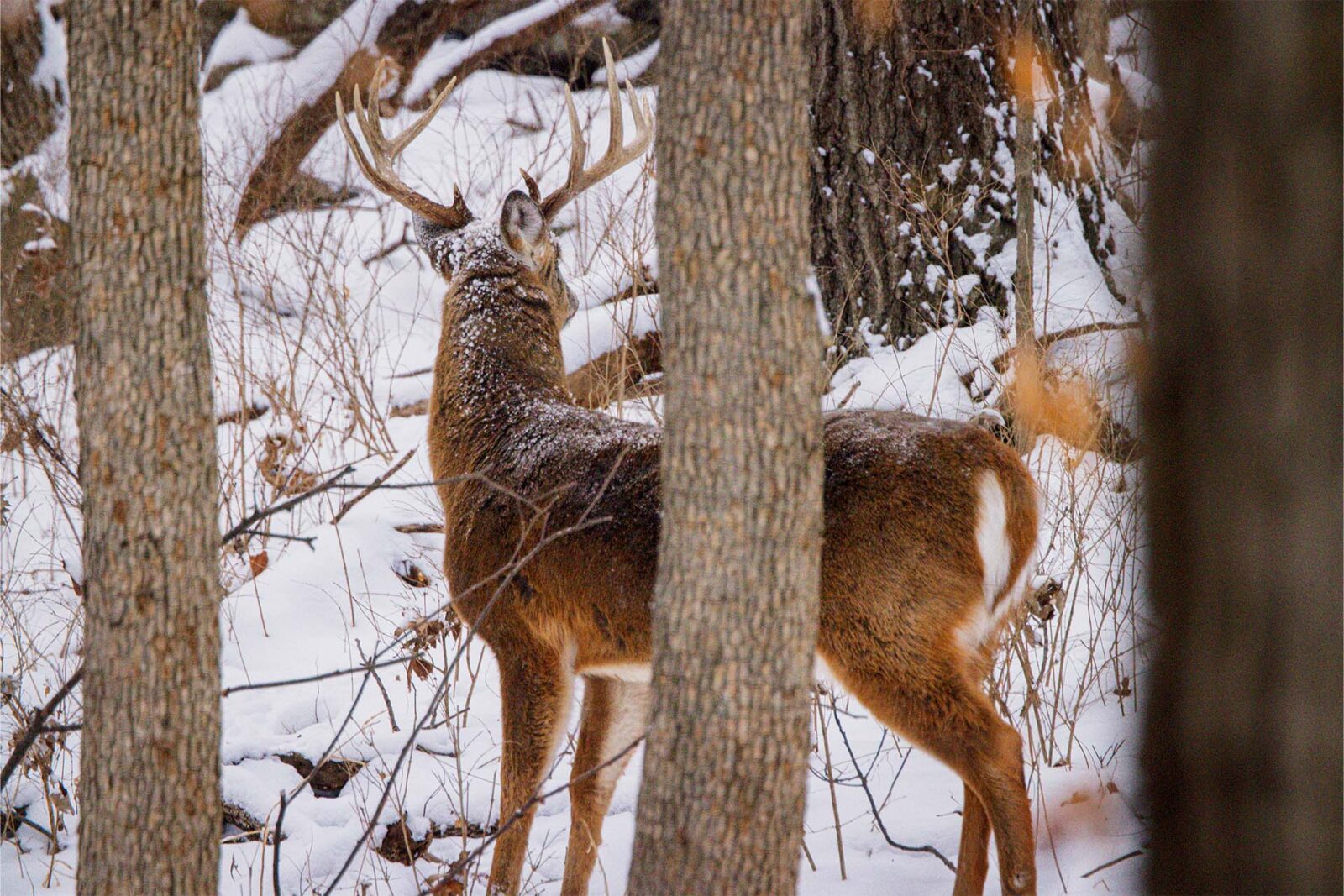
Rut Phase
Regional windows tell you when the rut peaks. They don’t tell you what the deer are doing week to week, and that’s where a lot of hunters get tripped up. The rut isn’t a single event. It’s a sequence: pre-rut, seeking, chasing, peak breeding, the stretch hunters call lockdown, and a post-rut lull before a smaller second rut. Each phase of the rut demands its own strategy (for a full breakdown of each phase and how to hunt it, read our guide to the deer rut phases).
Bucks tend to become more visible as they begin seeking and chasing receptive does. During peak breeding, they can become harder to pattern as they travel well beyond their home range in search of estrus does. In the post-rut, bucks may begin covering ground again in search of the last receptive does. Knowing the expected phase helps you understand the behavior you’re seeing and choose tactics that fit that point in the breeding cycle.
The new Rut Calendar in the onX Hunt App shows the expected rut phase for the location you’re viewing. It also explains the behavior you’re likely to encounter and highlights three tactics suited to that phase.
Deer Movement and Patterns
The rut rewrites a buck’s routine. GPS-collar studies have shown that even homebody bucks, the ones that spend all year on a small home range, take periodic excursions well outside it, and those trips spike during the breeding season. A buck vanishing from your cameras for a week doesn’t mean he’s gone for good.
Those changes make recent movement patterns especially important during the rut. Knowing when deer are more likely to move can help you decide whether to hunt now, wait for a stronger window, or adjust where you expect a buck to show up.
In the onX Hunt App, Deer Movement Forecast estimates the odds of increased deer activity for the point you choose on the map. The forecast draws from real-time data across more than 50 behavioral and environmental parameters.
Weather and Wind
Weather won’t move the breeding date, but it often dictates how much daylight movement you see. Cold fronts and falling temperatures pull deer onto their feet earlier in the day. Heat pins them down. Wind direction decides which stand is worth climbing into and which one just educates the buck you’re after.
Wind & Weather forecasts in the onX Hunt App let you check current and upcoming conditions against the stands and hunting locations you’re considering.
Trail Camera Intel
Your own trail cameras show you how the rut is unfolding. They tell you which bucks are still alive, when they’re moving, and whether the chase has started on your ground rather than the county’s. A new daylight photo, a buck returning after an absence, or several cameras showing activity at once can inform your plans.

Keep cams running into early summer too, since counting back roughly 201 days from the fawns you capture is the surest way to pin down your property’s true peak rut.]
Connect your trail cameras to the onX Hunt App to keep those observations alongside the rest of your hunt plan. Trail Camera Analysis surfaces movement patterns and the conditions that have correlated with your whitetail photos.
Check Deer Movement Times by Zip Code
Rut activity is never one signal on its own. A cold front three days into your region’s peak window, with a mature buck suddenly back on camera and the wind finally right for your best stand…that’s the morning you burn a vacation day on. To see that whole picture in one place, onX Hunt’s new Whitetail Insights pulls these signals together.
To check rut activity and deer movement times by ZIP code, or at any point on the map, tap or search a location in the onX Hunt App. Whitetail Insights anchors to that point and brings the full picture into one tab, helping you make a faster, better-informed call on when to hunt.
No forecast tells you exactly when or where to punch your tag. That’s still your call, your read, your morning. Whitetail Insights gives you a faster way to check the plan you’ve built against the signals that matter and adjust when a cold front, a new rut phase, or fresh camera activity changes the context.
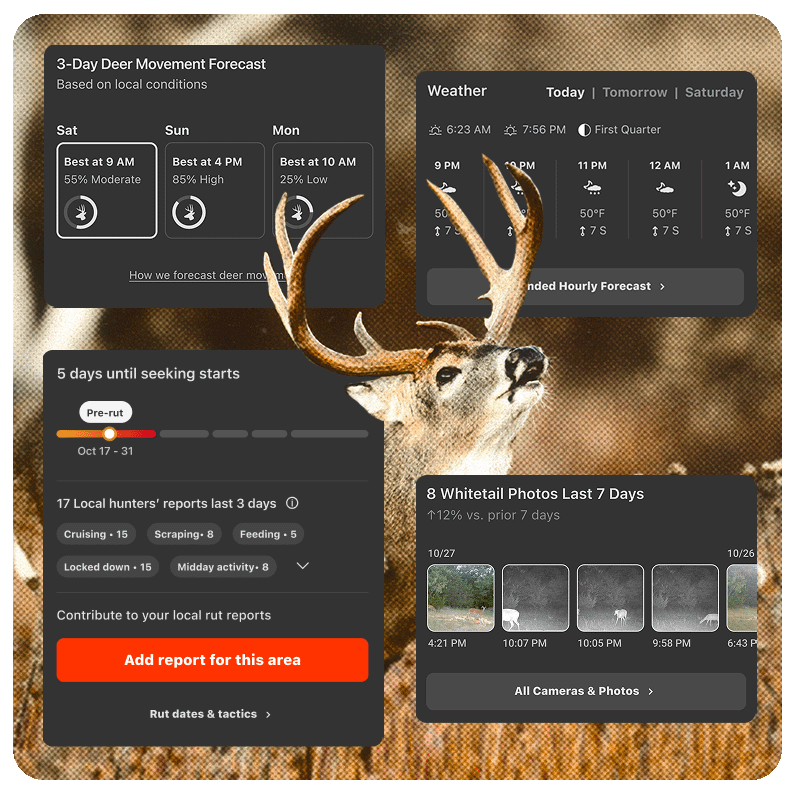

Whitetail Insights
See your Trail Cameras, Deer Movement Forecast, Rut Calendar, and Wind & Weather in one place for the land you hunt. Make a faster, better-informed call on when to hunt.
- Rut Calendar: Know how and when the rut is unfolding.
- Deer Movement Forecast: Predict the odds of increased deer activity on your hunt.
- Trail Cameras: Pattern deer with Trail Camera Analysis.
- Wind & Weather: Get hyper-local conditions and forecasts.
Final Thoughts
The rut will show up on schedule this year, same as always. Your job is to know your region’s window, read the signals as the season builds, and be in the tree when they line up. Good luck out there and let us know what you’re seeing in the field.
Frequently Asked Questions
For most of the country, pre-rut seeking ramps up in late October, and peak breeding follows in the first two weeks of November. The trigger is photoperiod, so the start holds steady from year to year. The Deep South is the exception, where breeding can run from late October into January depending on the area.
Across the Midwest and Northeast, it’s the first two weeks of November, with the long-cited breeding median around November 13. Northern New England skews a little later, toward November 21-25. Much of the South peaks mid-to-late November, though parts of Louisiana and South Texas don’t peak until December or January.
Not the timing. Breeding is set by daylight, and decades of data show it holding steady even in warm years. What weather changes is how much movement you see. Cold fronts spark daylight cruising, while heat keeps bucks bedded and nocturnal.
For visible, daylight action, target the seeking and chasing days just before peak breeding, roughly late October through November 10 in the North. Once does are locked down at peak breeding, bucks are paired off and harder to pattern. The pre-peak chase is your best odds.
Essentially, yes. Photoperiod doesn’t change, so peak breeding lands in the same tight window annually. Weather shifts how much rutting you witness day to day, but not when does come into estrus.