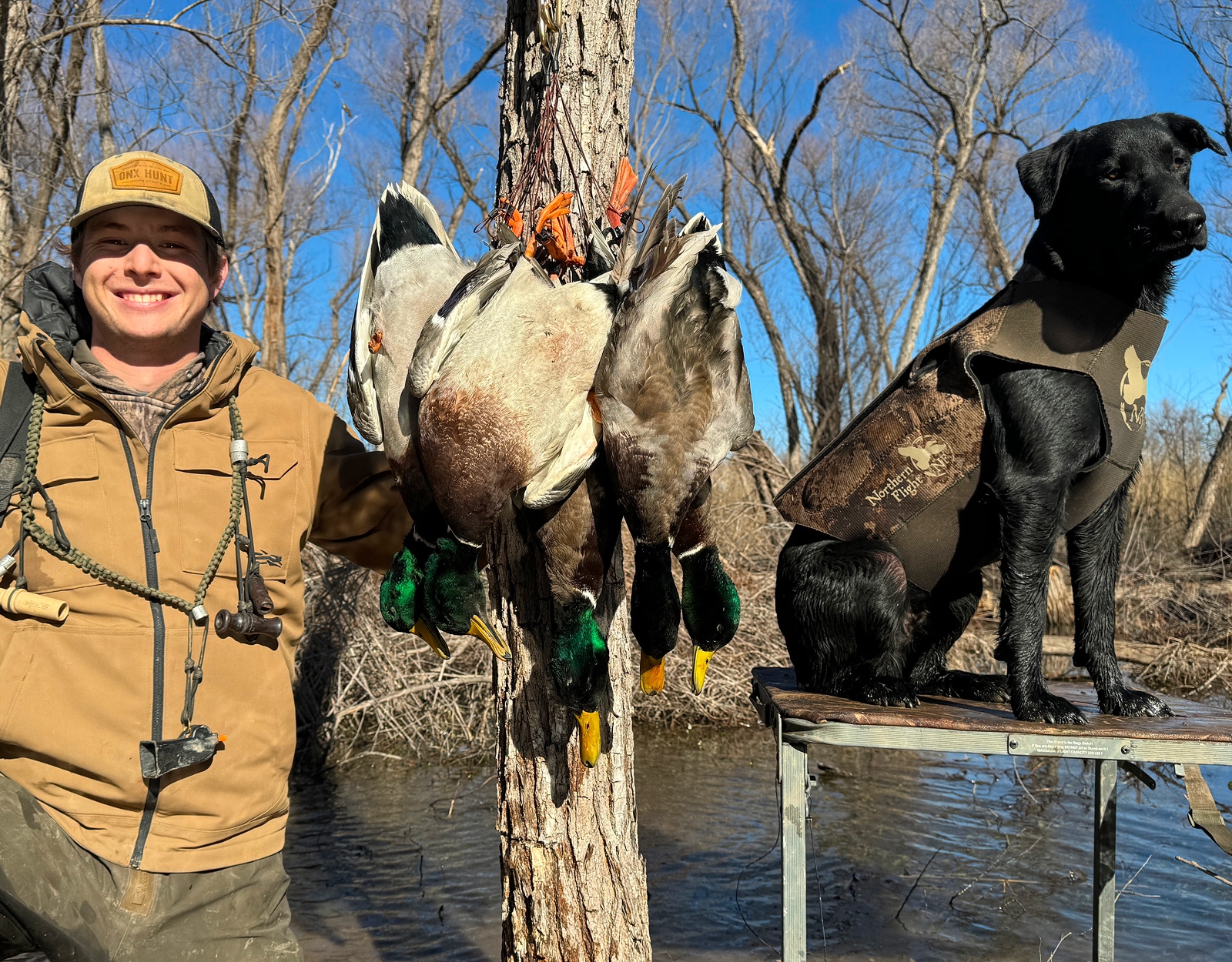
Thomas Hoke has lost a gun off his kayak, taken a ticket for a goose shot 15 minutes into the wrong window, and hauled three sleds of decoys 1.8 miles into a pothole he never should have overloaded. He’ll tell you about all three without blinking, because for a freelance duck hunter, mistakes like that are just tuition.
Freelance duck hunting means traveling from state to state and hunting water without a lease, a guide, or a permanent blind. You go where the birds are instead of waiting for them to come to you. It’s mostly a public land pursuit, though a good freelancer never rules out knocking on a door. Hoke has run this style of hunting from Virginia, where he grew up chasing American black ducks, through the upper Midwest and out West, building the planning system behind his brand, Hoke Outdoors, and the calls he builds for DRC Call Company.
Freelancing is more approachable than it looks from the outside. Here’s Hoke’s actual system: how he picks a destination, how he decides between field and water, what he packs and what he’s learned to leave home, and what he does the moment he steps into a spot he’s never hunted.
Hoke Outdoors’ Destination Decision Checklist
Before Hoke picks a state, he picks a Map Layer. “That’s something that’s pretty central to my philosophy,” he says of scouting for public land first on the onX Hunt App. He’s not afraid to ask a landowner for permission, but he wants real public acreage in the area before anything else, whether that’s a handful of scattered quarter sections or one or two large blocks.
Once the ground checks out, weather sets the timing, and the type of water tells him what to watch for. Creek and river systems mean waiting on a cold snap. Prairie pothole country means waiting on a strong front to push birds south.
Hoke plans tight. “The best duck trips are planned two to three days in advance if you have that flexibility,” he says, and pushes that out to about a week at most, since forecasts start to fall apart past that point. “Anything further than that, and you’re just kind of shooting in the dark.” Most hunters can’t clear their schedule on 48 hours’ notice, so Hoke’s rule of thumb for less flexible hunters is simple: get as close to departure as your schedule allows before locking in a destination.
His scouting inputs have shifted, too. A few years ago, he leaned on the U.S. Drought Monitor and reports from buddies. Now, Recent Imagery comes first, checking current water levels against crop progression and harvest timing. Farther south, he’s looking for ground that ran dry through spring and summer, then got a good fall rain to flood the vegetation that grew in while it was dry. Farther north, he wants water on the landscape year-round to hold the birds that bred there.
Pressure gets the same weight as habitat. Hoke steers away from anywhere he expects to be “crawling with duck hunters,” and his main tool for avoiding that isn’t a secret spot; it’s timing. He travels on weekends and hunts Monday through Friday, which lines up with a pattern he’s noticed repeatedly: “A lot of times I’ll see the best hunting will be on that Wednesday, Thursday, Friday,” after weekend crowds push birds out and fresh ones trickle back in. It’s a habit he picked up hunting a crowded East Coast as a kid, where getting away from other hunters meant outworking them. “I had to be willing to walk two miles, or paddle in three miles, a lot of times to get into areas that other guys weren’t willing to.”
Field or Water? Choosing Your Hunting Style
This is the decision that determines everything else you load into the truck, and Hoke has a clear preference. “I’m definitely choosing more water hunts over field hunts,” he says. “Field hunts all feel pretty similar, and water hunts feel, one hunt to the next, incredibly different.”
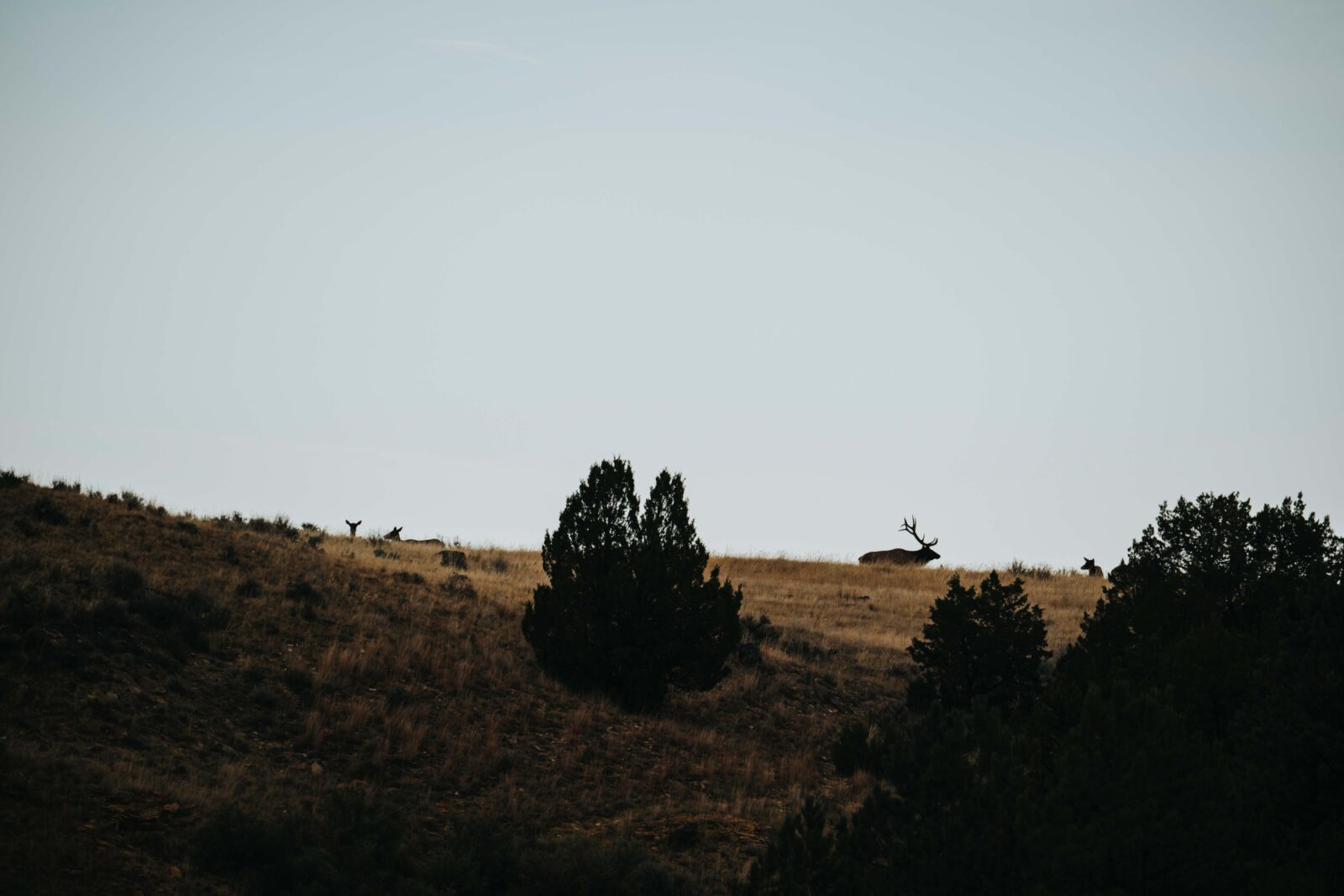
When he does have to choose on a given morning, the call usually comes down to the moon and the clouds. A few years back in South Dakota, coming off a full moon, Hoke’s group found a field the ducks were clearly using, but the birds weren’t committing until the last 10 to 15 minutes of shooting light. Rather than force a hunt with almost no window, they worked water for a couple of days and waited for cloud cover. On the first solid overcast day, they set up on the field by lunchtime and were into flocks by 2 p.m.
Hoke’s read on why: close to a full moon, ducks do most of their heavy feeding after dark, so only a small fraction show up in fields during shooting hours. The rest spend their mornings moving water to water, hunting aquatic food, before piling into fields in the afternoon. Once the moon fades and cloud cover moves in, that daytime field activity picks back up.
On the first solid overcast day, they set up on the field by lunchtime and were into flocks by 2 p.m.
Where the Kayak Fits In
A kayak isn’t automatically a third category for Hoke. Most of the time it’s a tool that supports a water hunt: chasing cripples, keeping gear dry, or repositioning quickly if birds shift across a pothole. It earns its own category specifically when he uses it as a mobile layout blind, a setup where a low-profile blind clips onto the kayak itself and becomes the hide.
Even so, the kayak rides along on nearly every trip. “I don’t think I can remember any trip in the last three years where I’ve gone freelance duck hunting and not brought a kayak with me,” Hoke says. “It’s the first thing on the packing list.”
A Freelancer’s Duck Hunting Gear List
Hoke breaks his rig down by hunt type rather than hauling one do-everything kit.
- Field: Spinning-wing decoys lead the list. He’d rather run two spinners with nothing else than put out five dozen full-bodies with no motion at all. “For field ducks, they just key in on that flash.”
- Water: A jerk rig is the priority item. Hoke has trusted a forecast, left the jerk rig home, and arrived to glass-flat water with no way to fake motion. “As long as you got the jerk cord, you can make ripples.”
- Kayak: A dry bag is the priority item, along with a floating gun case. Hoke lost a shotgun off his kayak in about 10 feet of water during his first season in Virginia and spent two days dragging a magnet across the bottom before he found it. His gun now stays clipped in a floating case (he runs gear from a friend’s brand, Shotty Gear) any time he’s on the water. Dry clothes and fire-starting supplies live in the dry bag whenever temperatures run 10 to 20 degrees.
One kayak-specific wrinkle on motion: Hoke leans on electronic water-motion decoys over a jerk rig when he’s in the kayak, since pulling a jerk cord from a low, unstable platform creates ripples right at the hide, which draws a duck’s eye straight to the hunter instead of away.
The Minimum Viable Spread
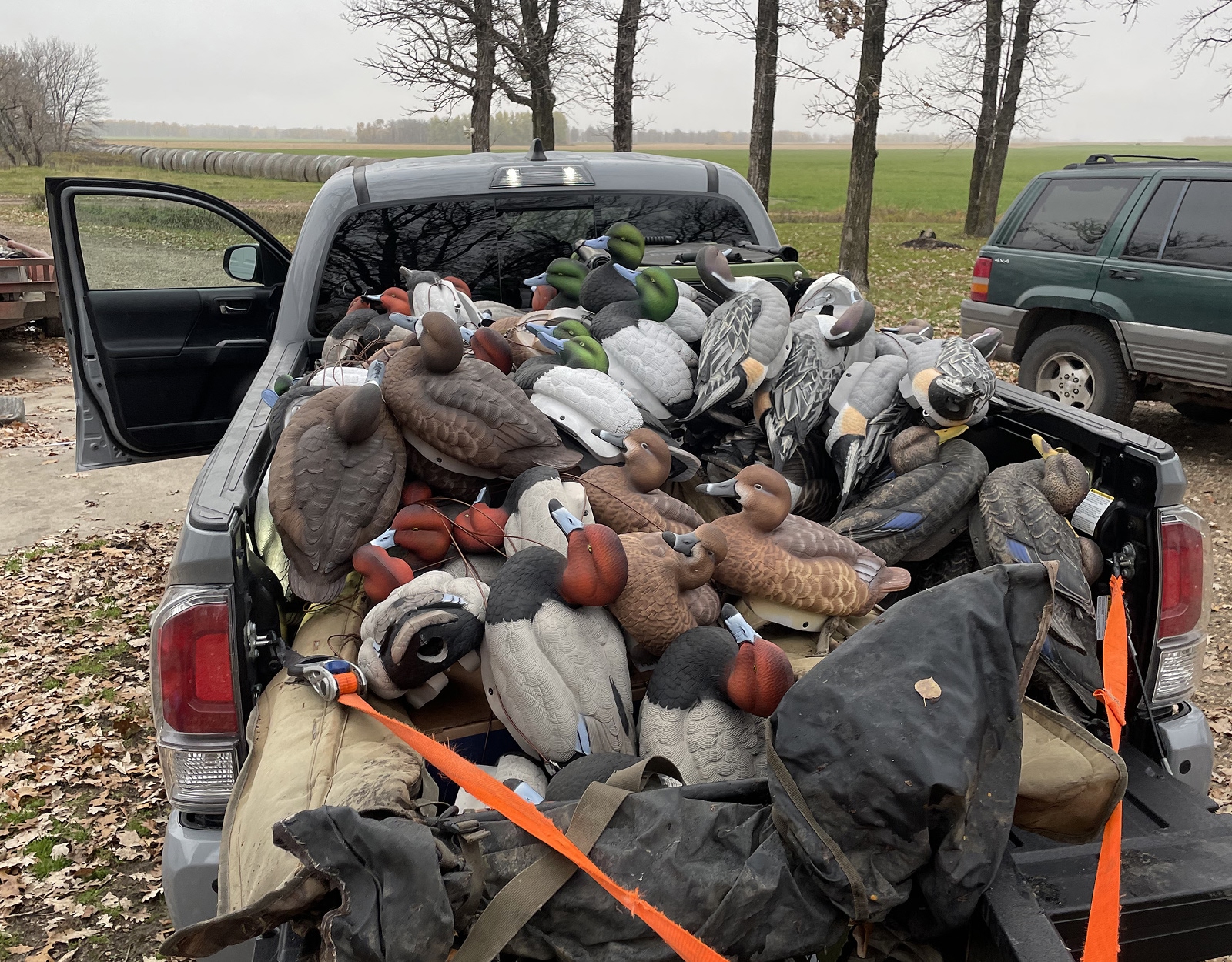
How many decoys Hoke brings depends entirely on what his scout told him, not a fixed number. When birds are already committing hard to a spot with no hesitation, he goes as light as four decoys on a jerk rig. His logic: crowding a confirmed spot with more decoys just draws more attention to the hunter’s position.
The opposite scenario calls for the opposite approach. Traffic hunting, working a stretch of river or field edge where birds are moving all day without committing to one spot, calls for as many decoys as he can reasonably bring, since the goal shifts from mimicking a couple of birds to advertising a big, safe, comfortable area. For field hunts, he’ll run as few as two spinners alone or scale up to a couple dozen full-bodies plus two spinners, or five dozen silhouettes plus two spinners.
When birds are already committing hard to a spot with no hesitation, he goes as light as four decoys on a jerk rig. His logic: crowding a confirmed spot with more decoys just draws more attention to the hunter’s position.
What To Leave Home
Hoke’s answer here is blunt: often it’s decoys. He calls himself a self-proclaimed decoy addict, and he’s got the story to prove it. On a trip out West, he’d already confirmed birds dumping into a pond 1.8 miles in on onX, mapped the distance, and still talked himself into hauling three jet sleds full of decoys on the walk in. He regretted it halfway there and regretted it more on the walk out, once the sleds were loaded down with birds, too. “Use the tools at your disposal, map out how far you’re going to go, and then make a rational decision based on that.”
Travel and Roadside Logistics
Every freelance trip that crosses a state line comes with paperwork attached. At minimum, that means a federal Duck Stamp (required for any hunter 16 or older), Harvest Information Program enrollment done once in your home state, and a separate state hunting license and waterfowl stamp for every state you hunt. Buy what you can before you leave home, and keep digital or printed copies on hand, since cell coverage on public land is never guaranteed.
Hoke reads the regulations book front to back before every trip now, a habit that started after a hard lesson in North Dakota. His group got pinned down early in a trip by a heavy front that pushed most of the fall migration through on their first night, leaving them scraping for birds the rest of the week. On the last day, hunting a diver spread, a lone goose came over the decoys around 2:15 p.m., and Hoke folded it without a second thought, not realizing North Dakota only allows goose hunting after 2 p.m. on Saturdays and Wednesdays. A competing group that wanted the same spot reported him to a game warden, and he was ticketed. “More states than not have at least one or two rules that I would consider kind of quirky and weird,” he says, compared to what he’s used to at home.

Hunting Regs Without the Hassle
Compliance shouldn’t be the hard part. FieldRegs is a free app from the team behind onX Hunt that helps you quickly find hunting regulations, seasons, and legal requirements without digging through agency websites and PDFs. No credit card required.


On birds crossing state lines, federal rule requires that one fully feathered wing (or a fully feathered head) stay attached during transport, so wardens can identify species and confirm bag limits. Hoke breasts birds out freely within the state he shot them in, but guts them and leaves a wing or head attached any time he’s crossing a state line with birds in the cooler. He tries to eat as many ducks as possible fresh during a trip rather than freezing them, since he considers duck at its best straight off the hunt.
For lodging, Hoke camps whenever the weather allows, especially early season, and otherwise looks for an Airbnb over a hotel. Space matters, but a heated garage or covered area matters more, since it means gear dries out overnight instead of thawing waders in a shower. “That’s just not a lot of fun,” he says of the hotel version of that routine.
When he’s traveling with a group, Hoke tries to build one or two scouting days into the schedule before anyone hunts. He genuinely enjoys that part of the trip, and it lets him meet a landowner or two and react faster once hunting starts. He’s quick to point out that most of his hunting buddies don’t have that kind of schedule flexibility and would rather hunt every day they’re on the road instead.
Scouting a New Spot Fast
Arriving somewhere brand new, Hoke spends his first couple of hours reading behavior more than anything else: are birds feeding, loafing, or just using the spot for shelter, and are they moving in one steady push at first light or trickling in through the morning? That pattern tells him how long the spot is worth sitting on.
What confirms or kills a spot, though, comes down to one thing before anything else. “It’s the hide,” Hoke says. “It boils down to the hide is number one, and the rest of them aren’t even really close.” He’s had a spot check every other box, birds working it, landowner permission secured, distance mapped, gear staged, and still fall apart because cattle had trampled the cover flat since his last scout. “My heart’s just gonna sink.”
That’s pushed him to pre-scout the hide itself on onX, not just bird activity. On a river, he’s looking for a stand of trees right on the bank he’s confident he can disappear into. In a field, he’s looking for a ditch or a tree line running through it. Late season with snow on the ground, he watches for contours and hilltops, since those are the first places snow burns off and the first places birds key in on.
What confirms or kills a spot, though, comes down to one thing before anything else. “It’s the hide,” Hoke says.
Inside the App, two habits do most of the organizing work. Hoke groups every pin for a given area into a single folder, which makes sharing the whole scout with a hunting group a one-step process instead of five. He then color-codes on top of that: one color for public land, one for private land he has permission on, one for private land he doesn’t, one for private land someone else is hunting, and one for refuge ground, so the group knows exactly what they’re looking at the moment they pull up.
Hoke typically keeps one or two backup areas in reserve and keeps them in the same state rather than planning to jump states mid-trip. Buying a second license for a maybe isn’t worth it, and out West especially, birds that aren’t at one spot are usually somewhere else close by. He tries to have both a warm-weather option and a cold-weather option scouted ahead of time, a habit that started after potholes he was counting on froze solid with no backup plan in place.
Sometimes the fix is bigger than a backup spot. On a West Coast trip that started too far south, Hoke ran into unseasonably warm, windless weather (highs in the mid-60s, lows in the 50s) with almost no daytime bird movement outside of first and last light. After a few slow days, he packed up and drove north into a system bringing colder temperatures and wind. His logic: calm, warm stretches let wintering birds settle into a pattern and get comfortable, and without a weather trigger to move them, a freelancer has almost nothing to react to.
Plan Like a Freelancer
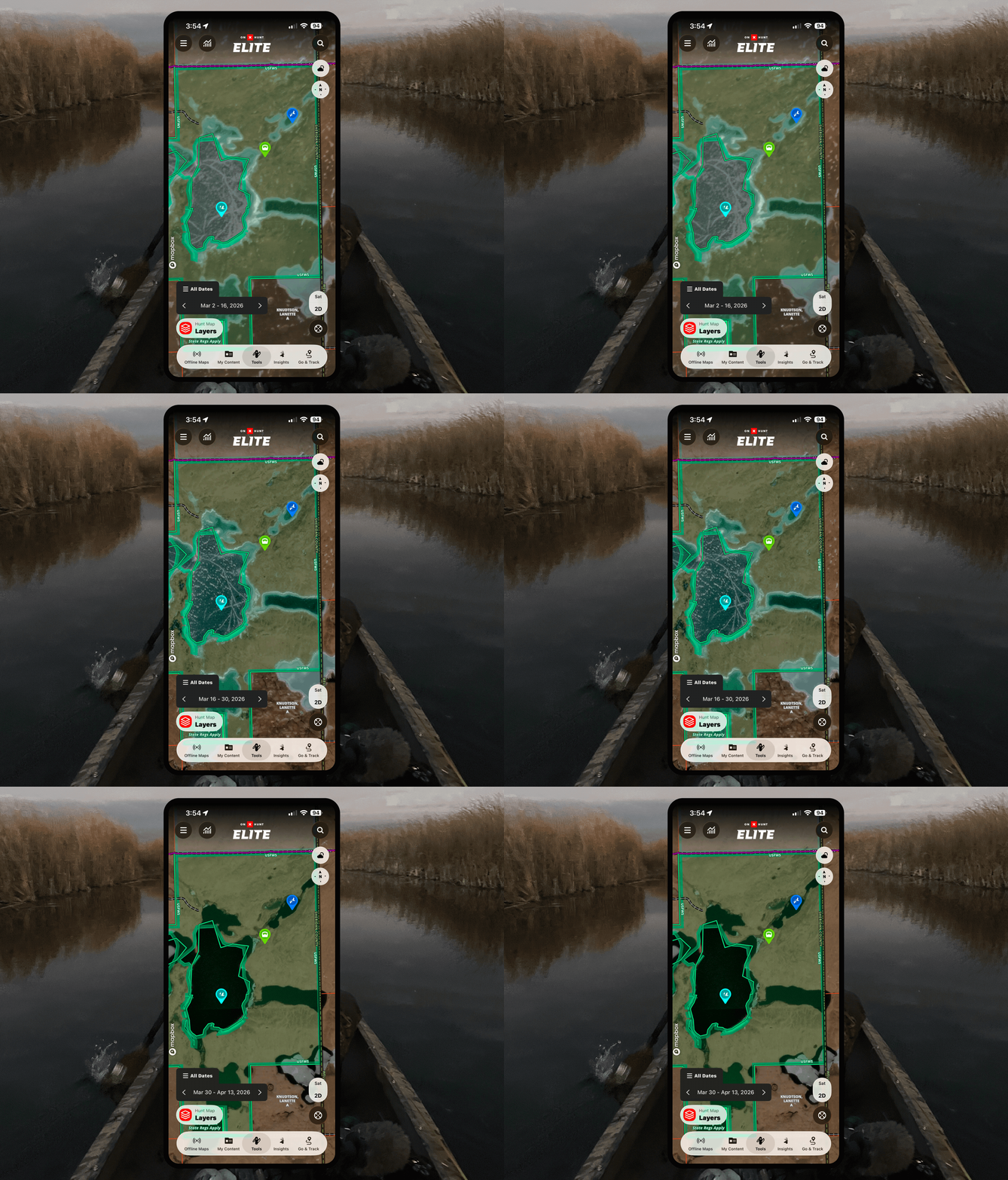
None of this requires Hoke’s years on the water. It requires a willingness to do the homework before you leave the driveway: a real destination checklist, a rig built for the hunt you’re planning, and a plan for the first two hours on the ground. Download the onX Hunt App and start building that plan. Mark your primary spots, mark your backups, and download your maps offline before you go. The rest is just driving.
Frequently Asked Questions
Freelance duck hunting is a mobile, do-it-yourself approach where the hunter travels, often across multiple states, hunting unfamiliar water without a lease, a guide, or a permanent blind. Success depends on scouting ahead of time, reading new water quickly, and adjusting when a spot doesn’t produce.
Aerial imagery and a land ownership layer, like the ones in the onX Hunt App, let you spot likely water and confirm legal access before you leave home. National wildlife refuges and state wildlife management areas are reliable starting points. State wildlife agency websites can fill in gaps that satellite imagery can’t.
It depends on how committed the birds already are. Thomas Hoke runs as few as four decoys on a jerk rig when birds are already piling into a spot, since a crowded spread just draws attention to the hunter. When birds are moving all day without settling anywhere, a fuller spread signals a safe place to land. In a field, two spinners alone can outperform a full spread with no motion.
At minimum: a federal Duck Stamp (required for hunters 16 and older), Harvest Information Program enrollment through your home state, and a separate state hunting license and waterfowl stamp for every state you hunt. Buy what you can before leaving home and carry every license for every state on the trip.
Overpacking. Thomas Hoke, who calls himself a self-proclaimed decoy addict, has hauled three jet sleds of decoys nearly two miles into a spot and regretted it both ways. Map the walk before you load the truck, and load for that walk, not for the biggest spread you own.