Every duck spread eventually fails in one of two ways: birds flare off something that didn’t look right to them, or a setup that kills birds in October goes dead by December. Both problems come down to the same question: what are the ducks reacting to right now, not what worked last time.
It’s important to understand the fundamentals of building a spread ducks want to land in and how to break strategy down by water type. Here we offer real approaches from three onX Hunt Ambassadors: Thomas Hoke, a freelance duck hunter who chases birds from the East Coast to the Prairie Pothole Region, Jordan Fromer of Duck Gun Podcast, and Brook Richard of Higdon Outdoors.
How To Set Up a Duck Decoy Spread
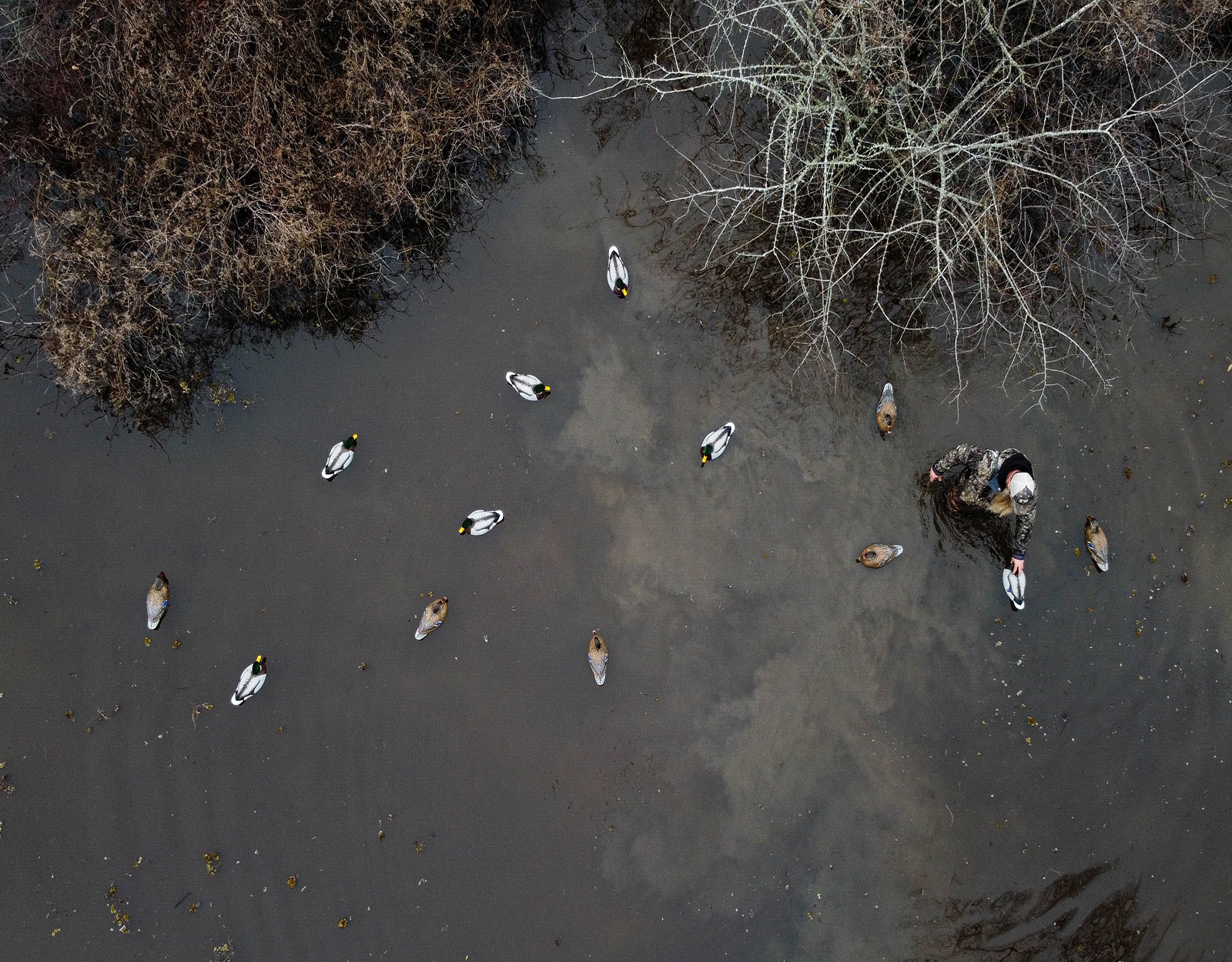
Ask three duck hunters why birds flared off a spread that looked right to the hunter, and you will likely get the same answer. Fromer says the first thing he checks when birds flare is not the decoys, it is the hide. Hoke agrees. By his own estimate, the hunter is the problem far more often than the decoys are. He has pulled spinners and rearranged decoys plenty of times with no luck, then moved 10 yards further back into the brush and had birds land right in the spread. Hide comes first, decoys second. Richard puts it in the plainest terms of the three: 99% of the time, a blown set comes down to concealment, not the decoys themselves.
Beyond the hide, a spread must give ducks an opening, basically a believable landing zone, and enough contrast and spacing to look like real birds are already comfortable on the water. All that can shift with wind, sun, water type, and how much pressure the birds in that area have already seen that season. Read into what the ducks are doing that day before you build the spread, not after they have flared twice.
Richard builds from a looser starting point than a rigid plan. He keeps his early spread relaxed and natural rather than trying to force ducks into one exact script, since he has been burned too many times trying to make birds do a specific thing. Once he sees a pattern in how the birds are working the area, that’s when he tightens the spread to match it.
Start With Wind Direction and the Landing Zone
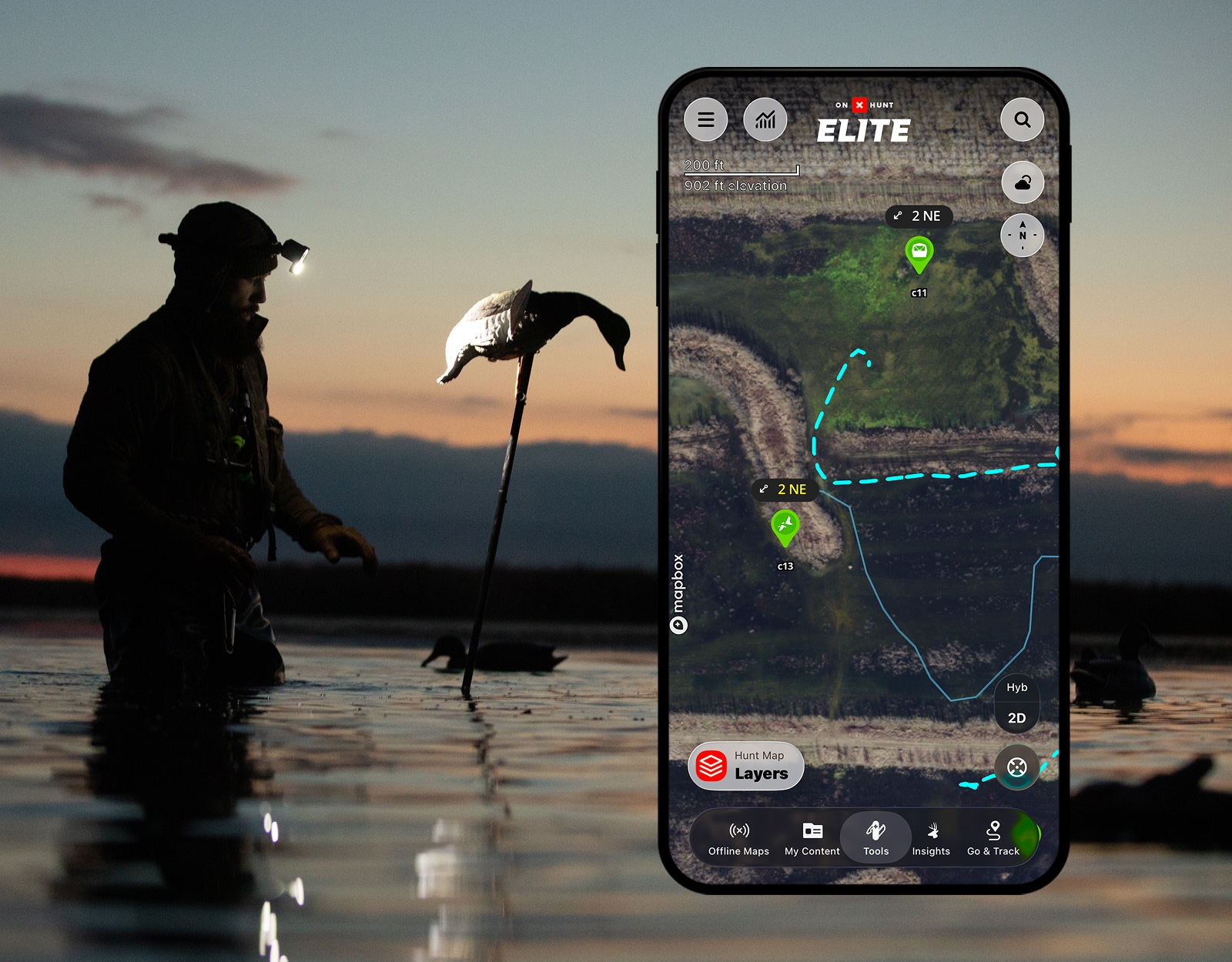
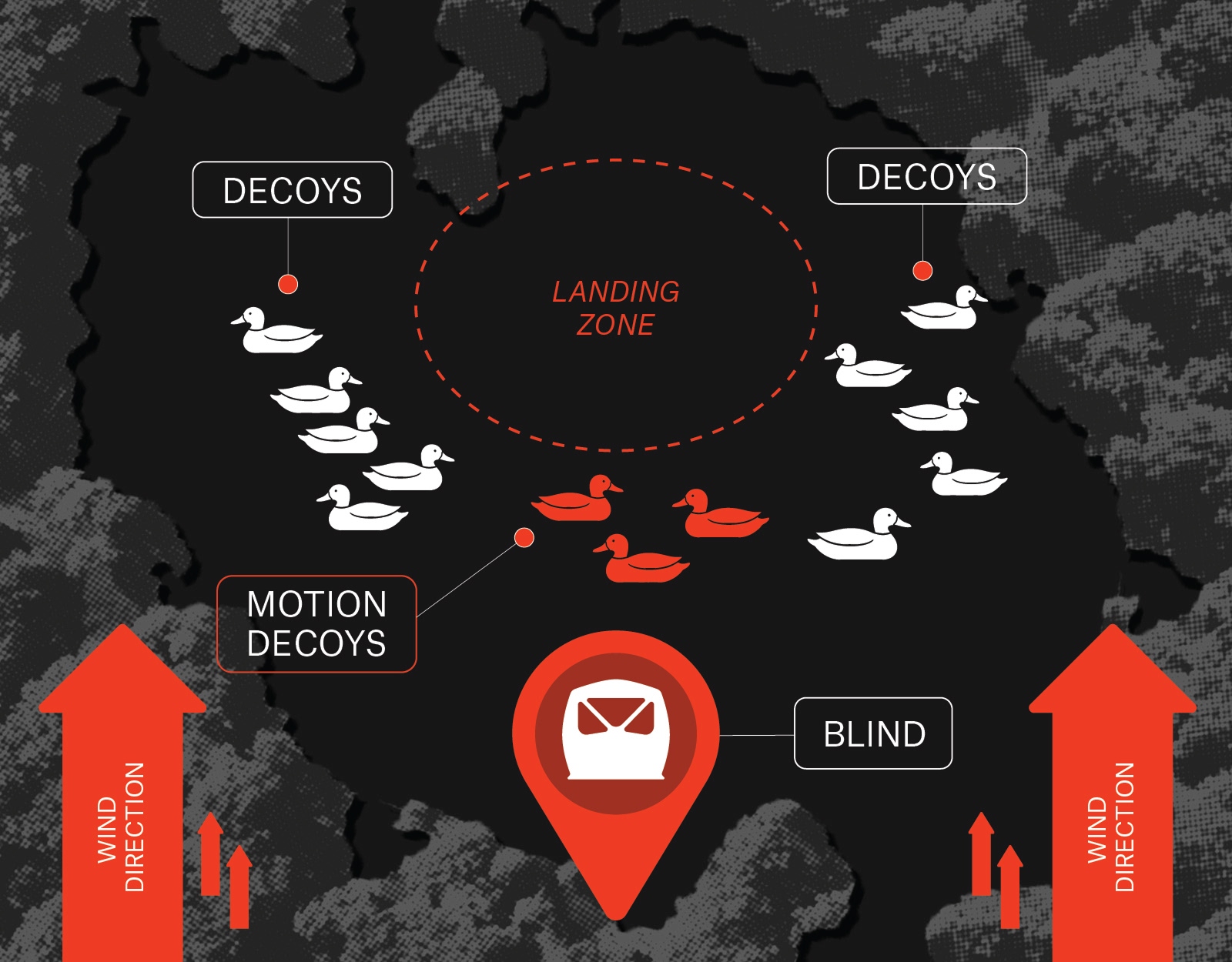
Ducks land into the wind, turning to fly against it as they drop into the landing zone. Set up so approaching birds have to fly upwind toward your decoys, with the wind in their faces, not coming in from behind them.
Fromer builds his landing hole, or kill hole, around three things, in order: wind, sun, and vegetation. In a perfect setup, wind and sun both come from behind you: sun at your back keeps it out of your eyes, and wind at your back means incoming ducks will fly toward you, into the wind, for a straight-on shot. When that lines up, he places large groups of decoys to the left and right of the landing zone, then adds a small pod of just three to five decoys in the middle.
For ducks, that middle pod gets a spinner (when and where legal), a motorized decoy with spinning wings that mimics birds coming in to land. Skip the spinner if geese are part of the mix.
When wind and sun do not cooperate, Fromer takes a side shot instead of shooting into the sun, which he says can risk wrecking both accuracy and your hide, so caution is needed. For a side shot, push the decoys to one side in a concave shape, with a handful placed right in the kill hole in front of the hunters.
Wind is not the only thing worth checking before you set up. Areas with easy access, a boat ramp, a well-worn trail, or another hunter’s blind tend to read as higher risk to ducks no matter how good your wind angle is. Weigh access and disturbance history along with wind when you are picking a spot to hunt.
Number of Duck Decoys for an Effective Spread
There is no single right number, but a few ranges hold up across water types:
- Tight ponds and potholes: Six to 12 decoys
- Medium water: 18 to 36 decoys
- Big water or fields: Four dozen or more
Fromer’s answer, when pushed for a real number:
“The real number is whatever is natural for the birds to see in that area.”
Forced to pick one spread size, though, he would go small: two dozen decoys with motion and a spinner.
Decoy investment measurably improves hunting success, even on heavily pressured public water, so “less is more” is not a universal rule. It depends on pressure, water type, and what the birds in that spot are already used to seeing.
Duck Decoy Spreads by Water Type (With Diagrams)
A spread built for a tight, tucked-away pothole should not look like one built for open big water. Ducks read each water type differently based on what is scarce or available nearby and how exposed they feel, so spread size, shape, and motion all need to shift with the water.
Flooded Timber Decoy Spreads
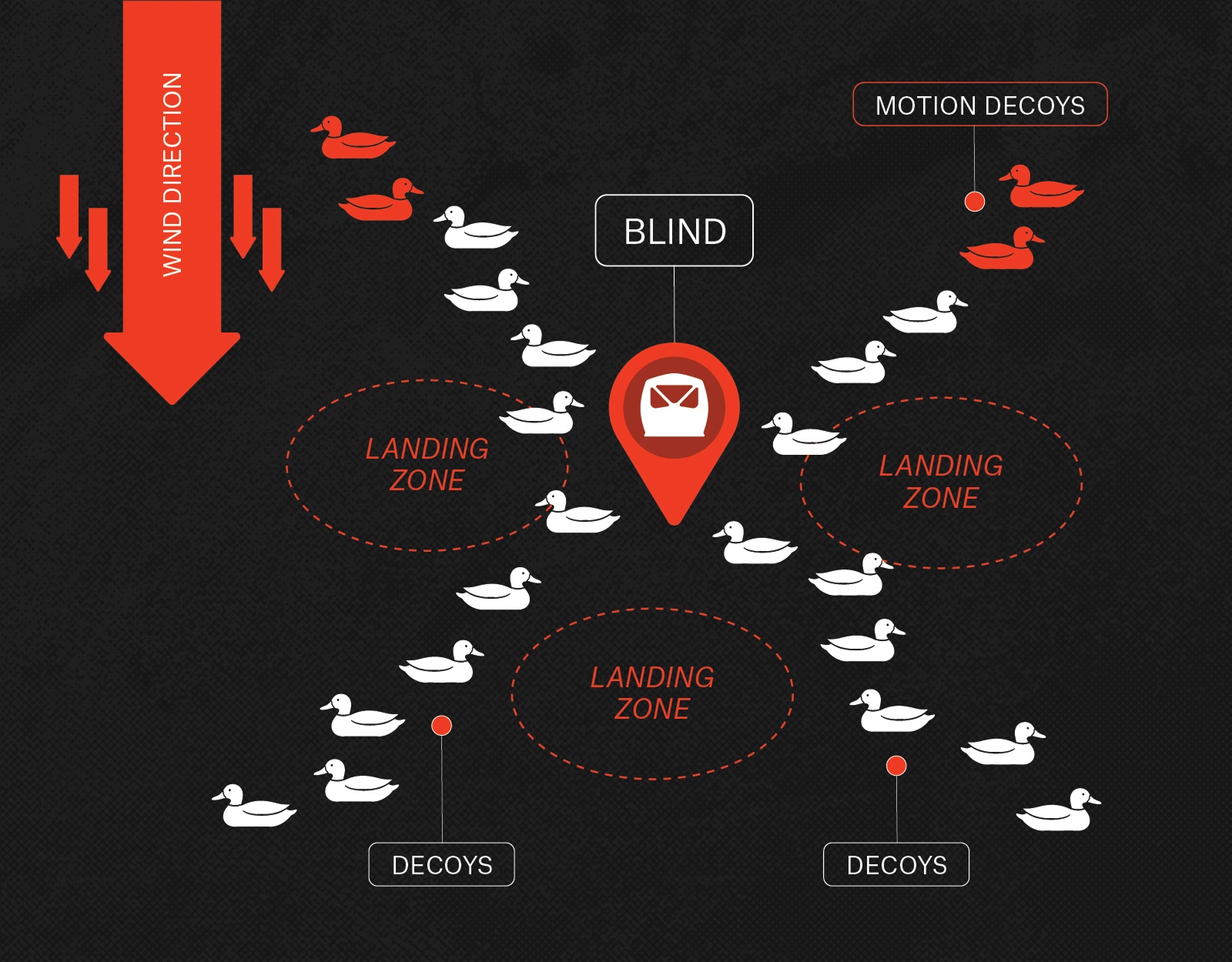
Put most of your decoys upwind of the landing hole, then add a smaller group, around six decoys, downwind.
Mallards and wood ducks flood into bottomland timber almost as soon as heavy rain fills it, and sunny mornings tend to be the best window to hunt it.
Put most of your decoys upwind of the landing hole, then add a smaller group, around six decoys, downwind. Birds bounce between the two groups instead of sliding downwind and landing out of range. Keep the groups loose, three to six decoys per cluster, with roughly eight to 12 feet between groups. Run a single jerk rig, a line-and-anchor rig you pull by hand to create ripples, near the center and upwind of the kill hole.
That is the setup for birds that are ready to commit. When it turns into a true traffic situation, ducks working back and forth without settling anywhere, Richard goes the opposite direction: more decoys, not fewer. His rule for a flooded timber traffic hole is 10 dozen decoys minimum, and he is often running closer to 30 dozen with 15 or more motion decoys mixed in.
Big Water Decoy Spreads
Run a J-hook or X-shape spread so you can adjust to shifting wind throughout the day.
Big, visible groups of decoys pull ducks across long distances on open water, but by midseason, pressured big-water ducks tend to favor the edges of a raft over the middle of it.
Run a J-hook or X-shape spread so you can adjust to shifting wind throughout the day. Plan on four dozen decoys or more, with a few different types of motion staggered along the upwind leg. Set your blind with the sun in mind as much as the wind. A squinting hunter is a hunter who misses.
Duck Decoy Spreads for Ponds
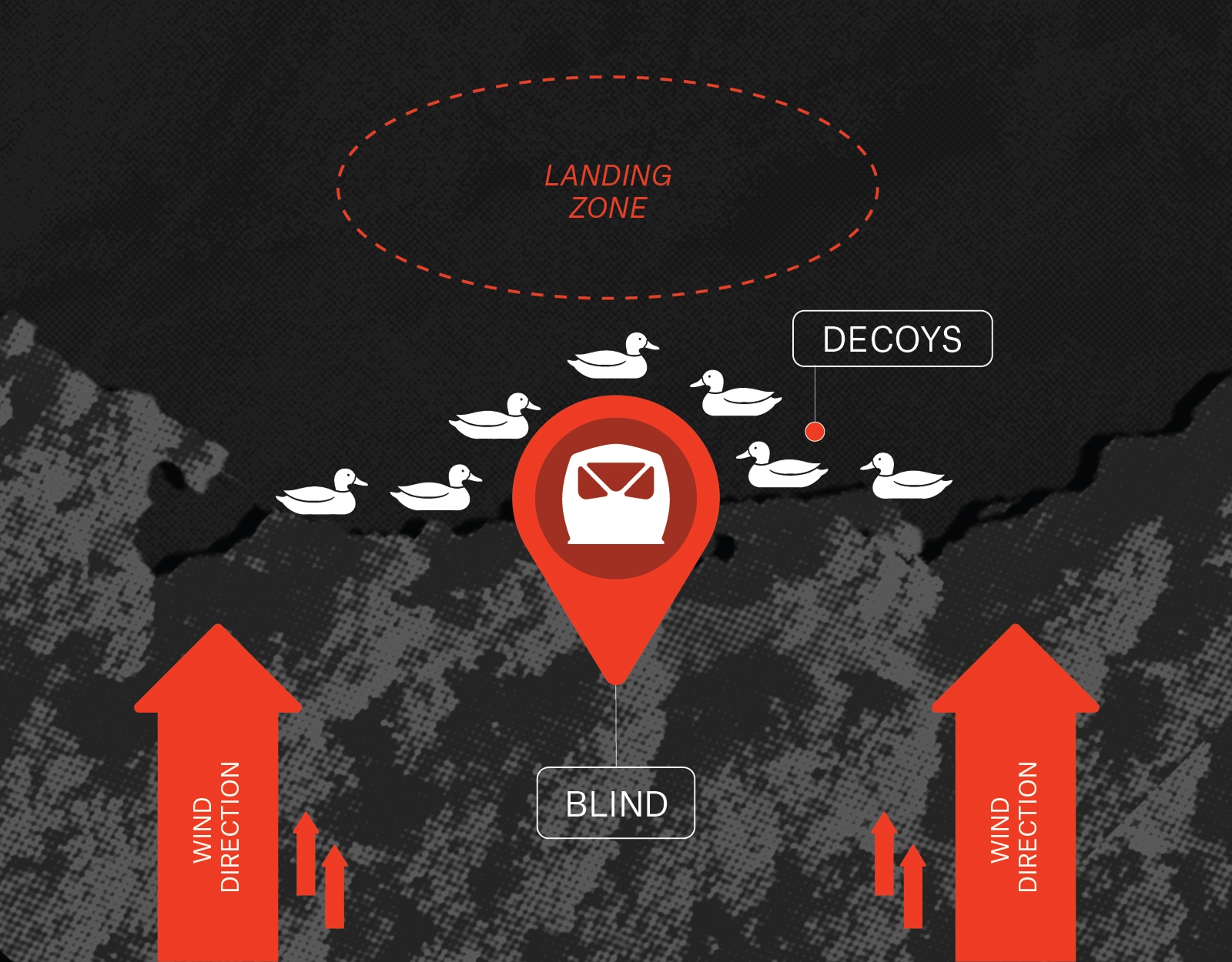
Run six to 12 decoys tight to the bank near the blind, and leave most of the water open as a clean landing lane.
Hoke’s own trips show both ends of the pond spectrum. On one hunt, birds were piling into a pothole with no hesitation and no circling. His answer in that situation: go minimal. Four decoys on a jerk rig, he says, can be an effective spread over water when the birds already want to be there. Crowd the spot with more than that, and all you are doing is drawing attention to your setup, not to the birds.
He has learned the opposite lesson the hard way, too. On one trip out west, he mapped a 1.8-mile walk into a pothole where he had seen ducks dropping in on his scout the day before, then talked himself into hauling three jet sleds of decoys back there anyway. The walk out, weighed down with a full bag of birds and the same overloaded sleds, taught him to match the spread to what the scouting told him, not to what fit in the truck.
For general numbers, run six to 12 decoys tight to the bank near the blind, and leave most of the water open as a clean landing lane. Cut motion back, or drop it, on pressured, late-season potholes. A slightly bigger, higher-quality spread can still out-hunt a minimalist one when the pond is genuinely loaded with birds and pressure is low.
Duck Decoy Spreads for Rivers
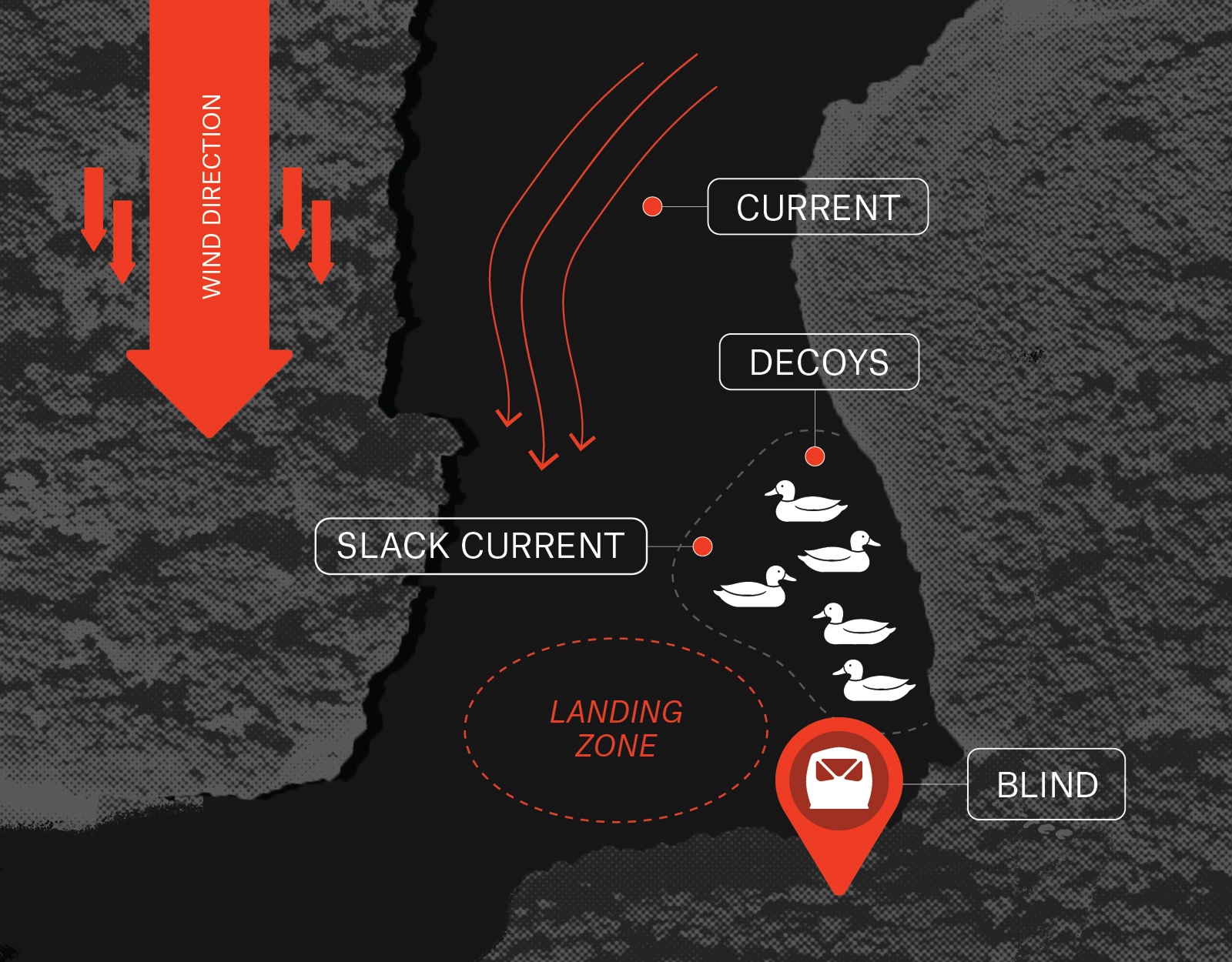
Set decoys along a calm eddy behind a bend, sandbar, or point. Leave an open pocket on the downstream side and position the blind for a crosswind shot.
Hoke’s Nebraska trip is a clean example of a river strategy. Late in the season, he set up on a stretch where birds were not committing to any one spot. They were bouncing from a field to the river and back all day. He calls that traffic hunting, and it flips the pothole approach: bring as many decoys as you can rather than as few. The goal is not to pull birds to one exact spot, it is to convince a river full of moving birds that your stretch is safe and comfortable to sit down on. That is the same principle Richard leans on in flooded timber when the birds will not settle: show up bigger, not smaller.
For the hide, he scouts ahead of time on onX Hunt, looking for a stand of trees right on the river’s edge he is confident he can disappear into.
General strategy: set decoys along a calm eddy behind a bend, sandbar, or point, since that is where ducks naturally loaf on rivers. Leave an open pocket on the downstream side and position the blind for a crosswind shot rather than fighting the current’s sightline.
Motion Duck Decoys: When They Help vs Hurt
Spinning-wing decoys and jerk rigs work by mimicking the wing flash and ripples ducks associate with birds that are already comfortable on the water. Early season, sunny days, and fresh migrators are when motion earns its keep. Hoke says spinners work better on sunny days than cloudy ones, since the flash that catches a duck’s eye is less visible without direct light. Fromer runs some form of motion in nearly every spread he sets: a jerk rig, a Quickcoy, a splasher, unless the wind is already making its own ripples.
Richard draws a clear line between the two types of motion. Water motion from a jerk rig helps on nearly every hunt, in his experience: it breaks birds out of formation, helps finish them, and gives incoming ducks something besides the blind to focus on. Spinning-wing motion is where he is more careful, since it can work against you on cloudy days, specifically when you are trying to finish birds. His fix is simple: run it early, then toggle it off if birds start hanging up.
Motion works against you with pressured, late-season birds that have learned to connect that exact flash or splash with the riskiest hours of the day. That is a specific, learned response tied to shooting hours, not just birds getting smart in general, which is why cutting motion back on heavily hunted, late-season water is worth trying before blaming the decoys themselves.

Watch the Line
Keep an eye on your dog around a jerk rig, too. Hoke’s own dog has gotten tangled in the line more than once. Whoever is running the cord needs to remember to lift it clear every time the dog gets sent.
Adjust Your Duck Decoy Spread as Hunting Pressure Changes
Ducks in December are not behaviorally the same birds they were in October. Research tracking GPS-tagged mallards found that as hunting pressure builds through a season, ducks shift toward a “safe by day, feed by night” pattern: they return to feeding areas later in the evening, leave earlier in the morning, and largely stop exploring new water once they have settled into a routine. The birds hitting your spread late season have already learned the local hunting schedule.
That points to a three-stage approach:
- Early season, naive migrators: Run a bigger spread with full motion. These birds have not learned to be wary yet.
- Mid-season, arriving migrators: Trim to a moderate spread with selective motion. Some of these birds have already seen decoys elsewhere.
- Late season, educated and pressured birds: Go small, realistic, and tucked into secluded water, with motion cut back or off.
Separate research on wetland disturbance backs this up: waterfowl sanctuary use roughly triples during periods of low-to-moderate disturbance and still rose by about half during high-disturbance stretches. The exact spot ducks want to be shifts with disturbance, not just water type, so treat it as a moving target through the season instead of a spot you find once and hunt the same way through January.
Unconventional Duck Decoy Tactics That Actually Work
Hoke’s trick: mix goose decoys in with ducks late in the season. Once ducks pair up, they often avoid crowds of other ducks, so a dozen or two goose decoys with just one or two duck pairs mixed in can replicate a safe, sheltered-feeling spot without the competition a bigger duck spread implies. He has noticed the same pull around swan concentrations in the upper Midwest each October and November, where puddle ducks and divers alike seem to gather near the bigger birds.
Fromer’s trick: the micro spread. On dead-calm days, he runs a jerk rig, a Quickcoy, or a splasher for motion, then adds only a spinner and four to seven floaters, all tucked inside the ripples the motion creates. The key, he says, is keeping every floater inside that ripple radius so the whole set reads as natural movement instead of a handful of decoys sitting still on glass.
Richard’s trick: mix a handful of snow goose decoys into a timber duck spread. In a true traffic situation, the bright white floaters add visibility from a distance with little downside, since ducks do not seem to mind sharing the water with a few snow geese. His advice: don’t knock it until you have tried it yourself.
Mix goose decoys in with ducks late in the season.
Scout Your Duck Decoy Setup Before the Hunt
All three Ambassadors build their spread before they step in the water, and all three lean on the onX Hunt App to do it.
Fromer sets a pin the night before a hunt and checks the Wind on Waypoint feature for that exact spot, then decides which side of the slough to set up on if the forecast shows the wind shifting through the morning. He also compares Recent Imagery against current conditions to gauge water levels, so he knows where the water is deeper or shallower before he ever gets there.
Hoke uses aerial imagery the same way, planning how far he will need to walk or paddle, whether a spot calls for a kayak, and what a stand of cover looks like from above before he commits to hiding in it. He has also used it to find a shorter route onto public land by getting permission to cross a neighboring landowner’s property instead of walking the long way in.
Richard uses onX Hunt daily, checking wind, sun direction, distance, and topography before he leaves the truck or boat. In his words, it lets him visualize the hunt before he’s standing in the water.
A spread that looks right and a spread that keeps working all season are two different problems, and chasing one at the expense of the other is how most decoy strategies fall apart. Build from the hide out, match your numbers and motion to the water type and the pressure the birds have already seen, and treat your scouted spot as a starting point, not a guarantee. Get the fundamentals right and let the water and the calendar handle the rest.
FAQs
It depends on the water. Six to 12 decoys work for tight ponds and potholes, 18 to 36 for medium water, and four dozen or more for big water or fields. Jordan Fromer’s own answer, when forced to pick one spread size: two dozen decoys with motion and a spinner.
Start with the hide, not the decoys. Build the landing hole around wind direction and, when you can manage it, the sun at your back. Place larger groups to the sides with a small pod in the middle for a straight-on shot or push everything to one side in a concave shape for a side shot.
Yes, in most conditions if your state allows them. Always check your local hunting regulations. Motion works best in the early season, on sunny days, and with fresh migrators. Cut it back, or drop it, on pressured, late-season water where birds have learned to associate a specific flash or ripple with danger.
Run six to 12 decoys tight to the bank near the blind, leave the rest of the water open as a landing lane, and cut motion on pressured, late-season potholes. When birds are already committing with no hesitation, go even smaller. Thomas Hoke has run as few as four decoys on a jerk rig in that exact situation.
Yes. Overcrowding a spot is a far more common mistake than under-decoying it. Leave real open space for birds to land instead of packing the water solid.
A tight, minimal spread: six to 12 decoys along the bank, with most of the water left open. Add a jerk rig for water motion, especially on dead-calm days.
Put most of your decoys upwind of the landing hole, with a smaller group of around six decoys downwind so birds bounce between the two instead of sliding out of range. Run one jerk rig near the center, upwind of the hole.
For a straight-on shot, place it in the small middle pod of three to five decoys. Use a spinner for ducks but skip it if geese are part of the spread too.
Mostly, yes, but there is a real exception. Some hunters mix in goose decoys with a small number of duck decoys late in the season to create a safe, uncrowded look that paired-up, wary ducks respond well to.