The ducks you’ll chase this season in the Prairie Pothole Region were likely born there.
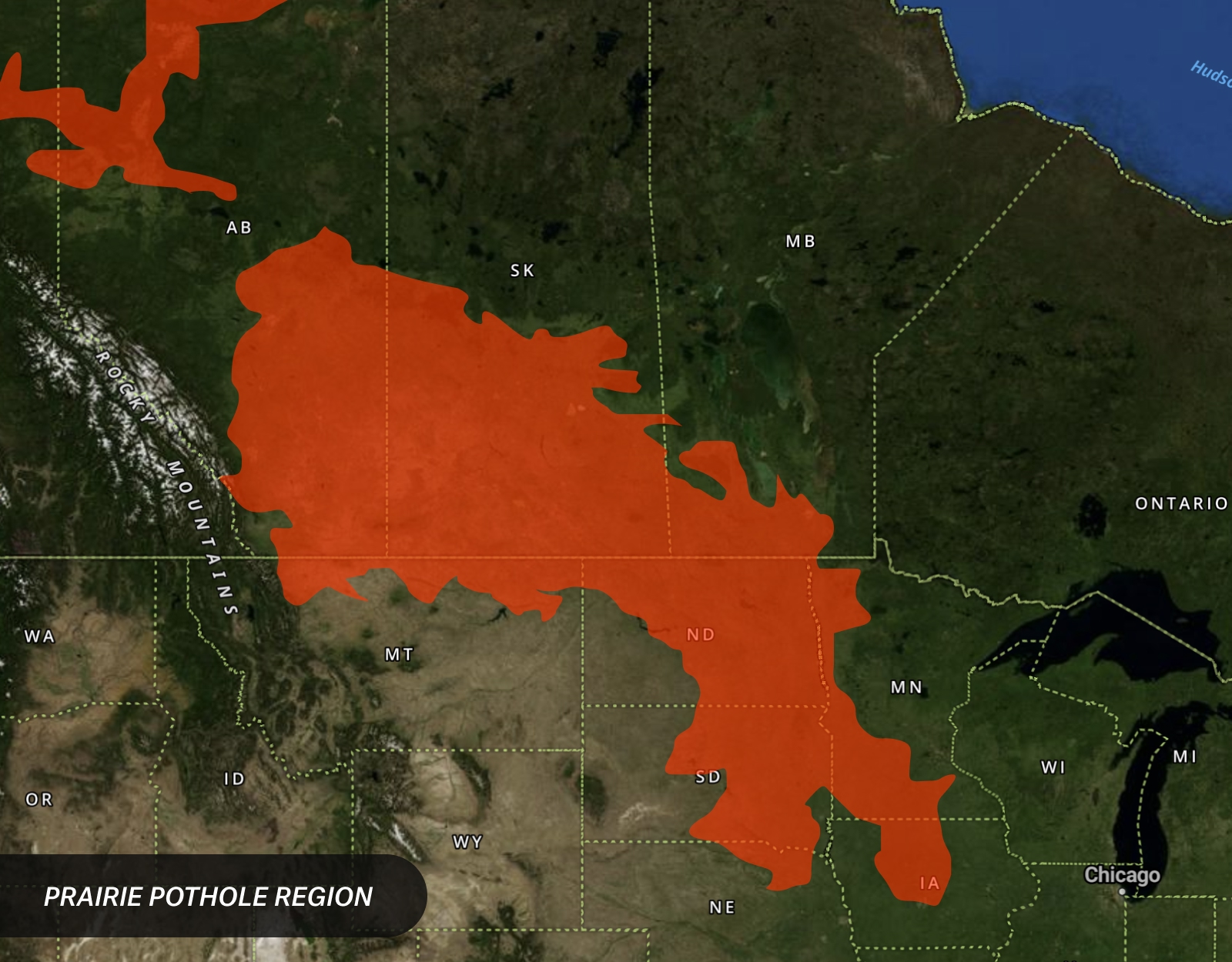
The Prairie Pothole Region is a glacially pocked mosaic of shallow wetlands and grasslands running from central Alberta south through the Dakotas and into Iowa, and it produces most of North America’s ducks. Hunters call it “the duck factory” for good reason. Field hunting ducks here means working birds at the source, before the rest of the Central and Mississippi Flyways have touched them.
That head start hunters get here is measurable. A 60-year analysis of band recoveries from more than 2.5 million mallards, pintails, and blue-winged teal banded in the Canadian prairies found mallards and teal now migrate faster, pintails start earlier, and mallard and pintail recovery locations shifted north by as much as 140 miles between 1960 and 2019. Migration patterns are changing, so having a chance to hunt the ground that sees them first is more valuable than it used to be.
To take advantage of this region, though, one must understand how dry field duck hunting requires a different strategy than hunting water. Duck hunting in a field rewards planning over luck, and it punishes hunters who show up hoping. Here’s a decision tree for planning and executing your next hunt in the Prairie Pothole Region.
Scout for the Right Feed
Prairie dabblers run a daily loop: roosting on water overnight, flying to a field at first light, loafing and drinking through midday, then feeding again before dark. The strategy here is to find the feed, not the roost.
Evening scouting beats morning scouting nearly every time. Sit near water an hour before sunset, watch which direction birds leave, and then follow them. Morning birds are already committed and moving fast in bad light. Evening birds will show you the whole pattern, and they usually repeat it at dawn.
But be mindful where logic from spring and brooding activity might mislead your scouting efforts. The habitat that produces ducks in May is grassland-buffered wetland, which is well away from cropland. The habitat that feeds them in October is the cropland itself. Don’t scout a fall field for what makes a good brood water. Scout it for food sources and a quiet roost nearby. You’re looking for fresh waste grain, a short commute to undisturbed water, and little to no pressure on either end.
Roost conditions shape everything downstream, and this fall they’re tight in spots. Dr. Scott Stephens, Senior Director of Prairie and Boreal Conservation Strategy at Ducks Unlimited, was pointed about it when he spoke to us in September.
“I can tell you in eastern South Dakota it is super dry. It’s like you’re going to be finding kind of permanent water to hunt. Birds are not likely to stop and spend a bunch of time there, because resources are going to be hard to come by.” Stephens says.
Fewer roosts mean fewer feed options, which cuts both ways. If there’s less country to search, the fields you do find will be busier. However, none of that makes cropland the enemy, either. Grasslands grow ducks in the spring. Grain feeds them in the fall.
What Crops Attract Field-Feeding Ducks
- Small grains: Harvested wheat and barley stubble is the prairie staple, especially early. Easy walking and visible waste grain.
- Corn: A magnet once temperatures drop. Standing corn can be hit-or-miss; cut corn is gold.
- Peas and lentils: Common across North Dakota, northeastern Montana, and the Canadian prairies. Often skipped by hunters chasing corn.
- Soybeans: Ducks use them, but they rank behind the rest.
One caveat rooted in spring biology: research on nine prairie-breeding duck species found early-nesting ducks fare worst in cropland because inviting stubble gets tilled before nests hatch. That same tillage schedule decides which fields still hold waste grain in October. A freshly worked field is a dead field.
Read the Field
Once you know birds are using a field, read it like one might read terrain on a map.
- Pinpoint where they’re landing: Ducks rarely use a whole field. Find the X, usually a wet spot, a knoll, or the heaviest grain, and mark it. Treat that mark as a starting point, not a fixed address.
- Note which way they’re feeding: Ducks eat across a field. If you watched them at 4 p.m. and pulled out at 6 p.m., they likely kept working for a couple more hours after you left. Mark the direction they were moving and then set up on the front edge of what they haven’t hit yet. Sit on picked-over ground and you’ll watch them land 200 yards out.
- Judge the stubble: Height and texture decide your hide. Tall residue hides an A-frame. Short, sparse stubble forces you low, or forces you to haul cover in.
- Work the topography: A two-foot swale or a terrace edge is the difference between a silhouette and an invisible hunter. Flat prairie is never as flat as it looks.
- Trace the flight line: The route they run from roost to feed tells you which side of the field they’ll come from, and that’s the side you set up on. It also keeps you out of a bad morning, with birds crossing a field on the way to somewhere else. Set up under that traffic by mistake and you’ll have ducks overhead for two hours and none in the spread, but do it on purpose and it’s a different hunt entirely.
The last point has an upside. If the field they’re feeding in is locked up but you can get permission on ground under the route, you can hunt traffic on purpose. You’re not offering the meal they have already chosen, so the job shifts from blending in to getting noticed. Motion and calling carry more weight here than decoy count. The play is to turn a share of what passes overhead. Treat this as a fallback plan instead of a substitute one, but when the field you want is off-limits, this sure beats staying home.
Something else should be stressed here. You should get in and out without educating anything. Walk the edges, keep the truck off the skyline, and leave the roost alone. Having a pair of binoculars and a window-mounted spotting scope sure helps.
How the Wind Determines Your Setup
Wind matters more in the open prairie than anywhere else you’ll hunt ducks. No timber to break it, no shoreline to funnel birds. Wind tells you which direction a duck will commit from, and it sets your blind placement and your spread shape.
Ducks land into the wind. That one fact drives the strategy here:
- Start the landing hole downwind of the X and inside shooting range: That’s a starting point, not a law. Birds do not always finish over the top of a spread, and pressured birds often won’t, so treat the layout as your best guess until the first flight tells you otherwise.
- Set blinds crosswind or slightly off the hole rather than dead upwind, where birds coming up the wind line stare straight into your face.
- Tighten the spread when it’s blowing: Real ducks bunch and sit tight at 25 mph. A loose rig looks wrong.
- Open it up and add motion on calm days, when birds circle longer and have time to pick you apart.
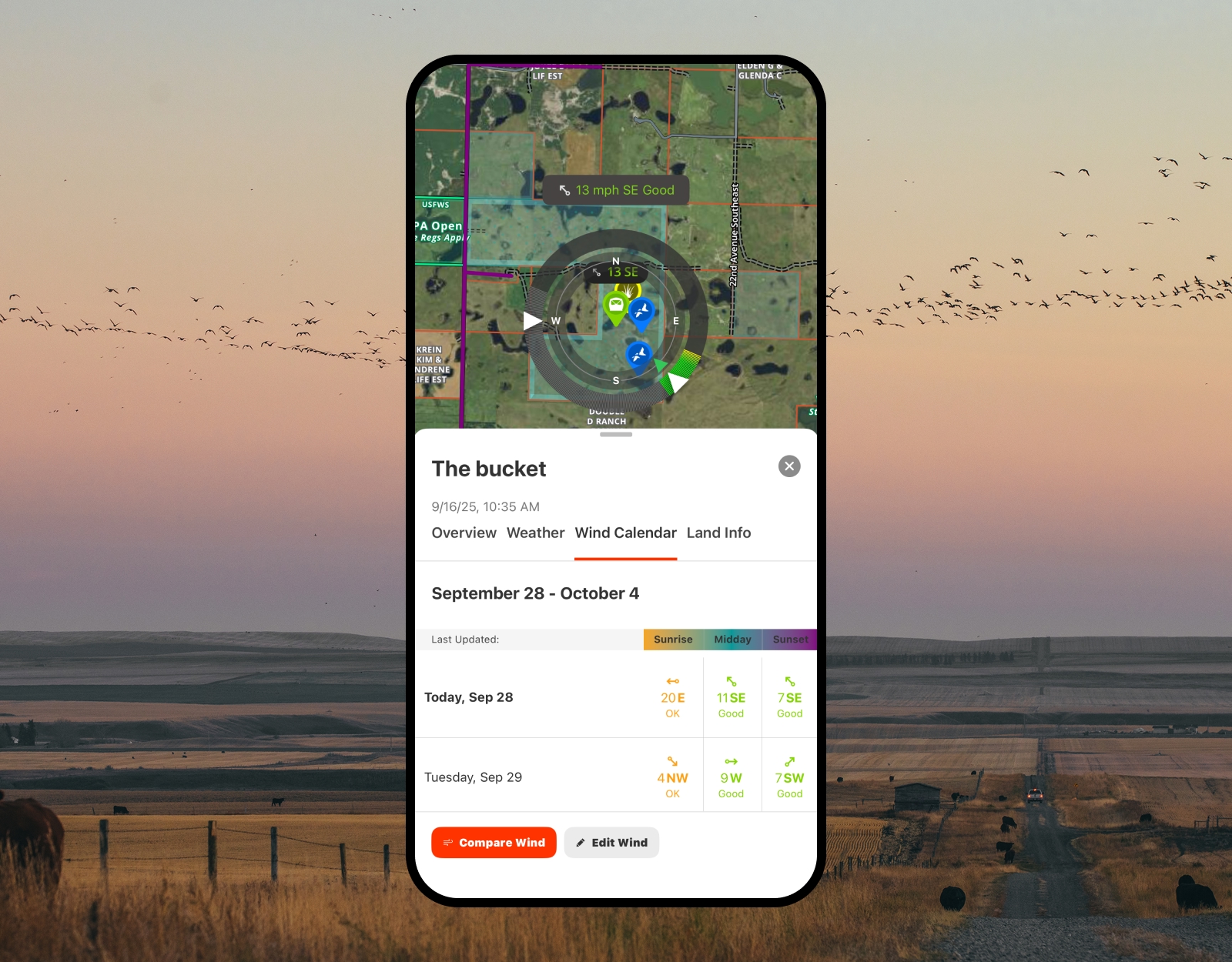
Check the forecast before you commit to a field, not while standing in it at 5 a.m. A field that sets up perfectly on a northwest wind might not be huntable on a southeast one, and knowing the night before saves you the drive. Weather Forecasts and the Wind Calendar show forecasted wind for a specific Waypoint across upcoming days, so you can match the field to the day.
Perfect Your Hide: A-Frame vs. Layout Blind
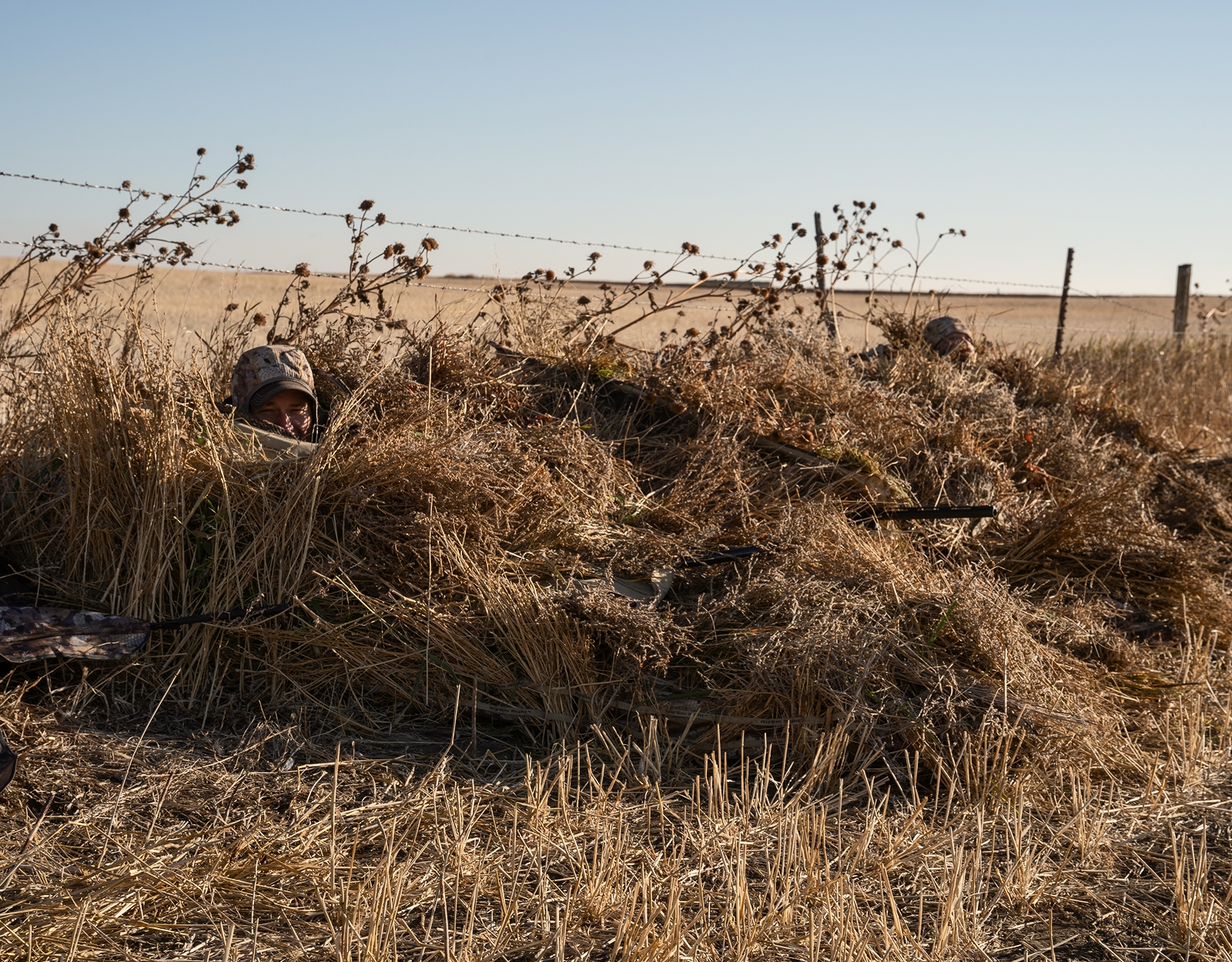
Concealment is the hardest part of duck hunting in a field. Layout blind duck hunting and A-frame hunting both work in the Prairie Pothole Region, and neither is the automatic answer.
A-frames win on comfort, capacity, and speed. You sit upright, shoot faster, can fit more hunters, and stay warmer. The cost is a taller silhouette, which is the wrong feature in eight-inch wheat stubble. A-frames need cover. Use them to hunt tall residue, brush them heavily with material you brought, or tuck them into an existing edge.
Layout blinds win on concealment, which is why they dominate the Dakotas. Flat on the ground, well mudded and well stubbled, a layout is close to invisible. The cost is comfort, limited visibility, and rise-and-shoot mechanics that take practice. If you haven’t drilled sitting up and mounting a gun from flat on your back, do it in the yard first.
Prairie stubble is often short and thin, so plan on importing cover either way. Raffia, bundled local stubble, or a few armloads of straw from the field go a long way. Mud the blind to kill shine and put the sun behind you if you can.
Field Duck Decoys: Build Your Spread
Field duck decoys do a different job than water decoys. On water, you’re selling a comfortable place to sit. In a field, you’re selling birds actively feeding, so posture and placement beat paint.
- Place full-bodies and sleepers near the blind, and add silhouettes or windsocks for cheap volume at the edges.
- Leave an obvious hole. A C-shape or funnel with a clear opening downwind of your blind tells birds where to put their feet.
- Mix in goose decoys when geese share the field. Ducks read geese as an all-clear, and it adds visibility at distance.
- Run spinners early, then back off. Spinning-wing decoys are devastating on naive local birds and increasingly counterproductive as birds wise up. Late season, many prairie hunters run one at distance or none.
Scale to the birds, not to your trailer. Early on, three dozen decoys in the right spot beats a hundred in the wrong one. We go deeper on rigging in our duck decoy spread breakdown.
Adjust to Real-Time Duck Activity
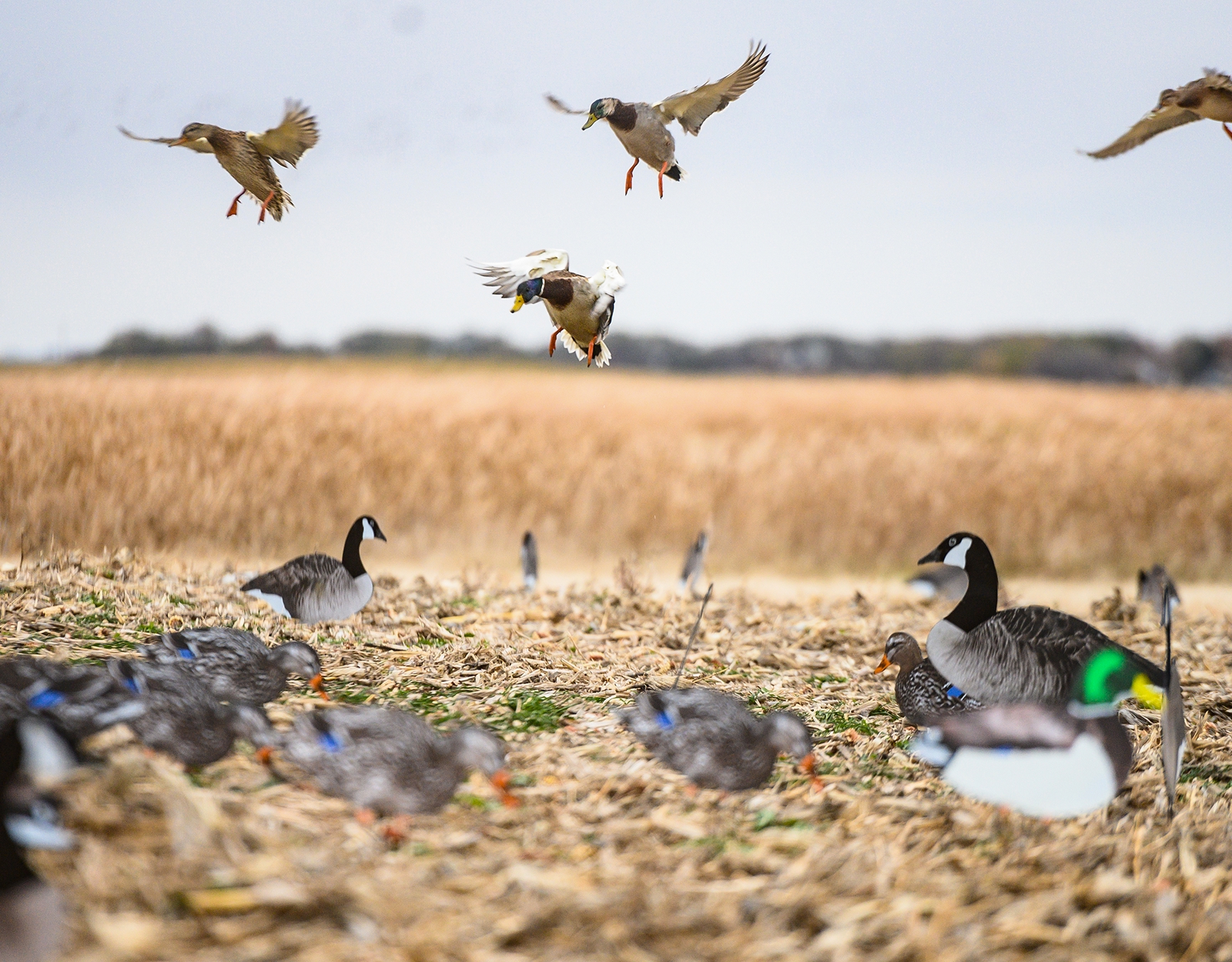
The Prairie Pothole Region is both a nursery and a highway. It raises more ducks than any other region on the continent, and it sits underneath the birds working down out of Canada and the boreal forest. Therefore, the ducks over your spread on a given morning tend to fall into two camps: locals that hatched within a few miles of where you’re sitting and migrants that dropped in overnight from a few hundred miles north. Farther down the flyways, nearly everything that passes you is a migrant.
That mix is the advantage. It also means reading which kind you’re working, because they don’t behave the same.
Local birds are patternable. Same roost, same field, same schedule, and early in the season that’s most of what you’ve got. One consistent flock is the easiest hunt in waterfowling. Migrants drop in overnight with no established pattern, often in bigger groups, and most have already been shot at somewhere north of you.
This year the local component should skew young. Stephens told us production conditions improved over last season, which means a higher share of juveniles in the fall flight.
“They’re less experienced. They’ve not played the game before. They’re a little more naive. So they’re more susceptible to decoys and those kinds of things.” Stephens said.
That distinction sets your approach:
- Stay put on a consistent flock. Trust the pattern, hunt it lightly, and resist chasing every group on the horizon.
- Read and move on rotating flocks. With no pattern to trust, watch where the first groups try to land and shift toward that spot between flights.
Pressure changes the clock either way. Research from the Cohen Wildlife Lab, which GPS-tracked nearly 900 wintering mallards, found harvest opportunity dropped roughly 50% after opening day as birds sorted out where the safe water was. Ducks adapt fast. The longer a field gets hunted, the tighter and later your window gets.
How Field Hunting Strategy Changes Through the Season
Same field, three different games.
| Early Season | Peak Migration | Late Season | |
|---|---|---|---|
| Scouting | Feeds close to roost, smaller flocks. | Longer flights, patterns reset daily. | Freeze-up concentrates birds on fewer roosts. |
| Field choice | Small-grain stubble near water. | Bigger corn and bean fields. | Any exposed grain, as energy is everything. |
| Wind | Lighter, more circling. | Hard fronts, as birds commit fast. | Strong and cold, as birds bunch tight. |
| Hide | Cover plentiful, either blind works. | Match to residue, watch silhouette. | Snow forces whites and a rethink. |
| Spread | Smaller, spinners on. | Bigger to match flock size. | Smaller, more realistic, cut spinners. |
The Final Word
A good dry field hunt is a system: find the feed, confirm the access, read the field, let the wind place you, hide better than you think you need to, leave a hole in the spread, and adjust to the birds in front of you.
And the Prairie Pothole Region is the advantage. Duck hunting in a field out here means hunting the duck factory and hunting it first. For more from the flyway, check out our waterfowl coverage.
Good luck out there and let us know how the season treats you.
Field Hunting Ducks FAQs
Scout in the evening. Sit near a roost wetland an hour before sunset, watch which way birds leave, and follow them. Mark the exact spot they land, because ducks will use a small part of a big field. A feed you find at dusk is usually good at dawn.
Less than hunters assume. You need the spot birds are already using, not the whole field. A quarter section is plenty, and good prairie hunts happen on a few acres around one wet corner. Permission on the right 10 acres beats access to the wrong 200.
Put your spread where they already want to be, leave an obvious landing hole downwind of it, and hide well enough that nothing flares. Ducks land into the wind, so orient everything off wind direction. If birds keep sliding one way, move the decoys instead of calling harder.
Harvested small grains like wheat and barley are the most consistent draw in the prairies, especially early. Cut corn becomes the magnet as temperatures fall. Peas and lentils are productive and often under hunted. Soybeans work but rank last.
Two to four dozen covers most early-season prairie hunts, built around full-bodies near the blind with silhouettes adding volume. Scale up during peak migration as flocks grow, then scale back late when educated birds pick apart anything staged.