If there’s any state that calls to hunters like a siren song, it’s Alaska. How could it not? It’s The Last Frontier: a place where the wild still reigns supreme and everything is just…bigger.
For hunters with their sights set north, the good news is that there are actually a lot of ways to make an Alaskan hunt a reality. The state offers non-residents six types of permits, including over-the-counter options. Of course, the prohibitive factor is often cost, but that’s a matter for another day.
Here, we review just one of the ways to hunt Alaska: through its drawing hunt permit system.
TL;DR: Alaska’s drawing hunt permits run on a pure lottery system, meaning everyone has equal chances at permits. Applications open Nov 1–Dec 15, results drop the third Friday in February, and each species allows up to six applications (with some exceptions). You’ll need a valid hunting license to apply, and application fees are non-refundable. If you draw, be ready to purchase required locking tags, and remember you can’t draw the same permit two years in a row. Missed the deadline? Check undersubscribed hunts released in early March for leftover opportunities.
What’s New
There are no changes to Alaska’s drawing hunt permits for the 2026-2027 season. Alaska’s hunting application process for drawing hunt permits is relatively straightforward; read on for details.
Alaska Hunting Application Season Dates
Those looking to participate in Alaska’s draw process can submit their application(s) any time between November 1 and December 15 (closes at 5 p.m. Alaska time).
Results are announced on the third Friday in February via email and can also be accessed via the Alaska Department of Fish and Game’s website.
Alaska Hunting Permits and Draw Cost Overview
To apply for a drawing permit hunt, you must first buy an Alaskan big game license ($160). You may apply with any valid hunting license (current year or future year—i.e., 2025, 2026, or 2027 license is allowed).
On top of your license fee, each application chance you submit (more on that below) costs $5 (muskox and bison cost $10).
You must apply online via a credit card, and all application fees are non-refundable.
While not technically a part of the draw process, applicants should be aware of Alaska’s locking tag system. If you’re successful in drawing, you need to be ready to pay locking tag fees, which range from $300 for deer to $2,200 for muskox.
Also: When budgeting, be aware that if the hunt you draw spans two calendar years, you need to purchase licenses and locking tags for both calendar years.
Alaska Drawing Hunt Big Game Species
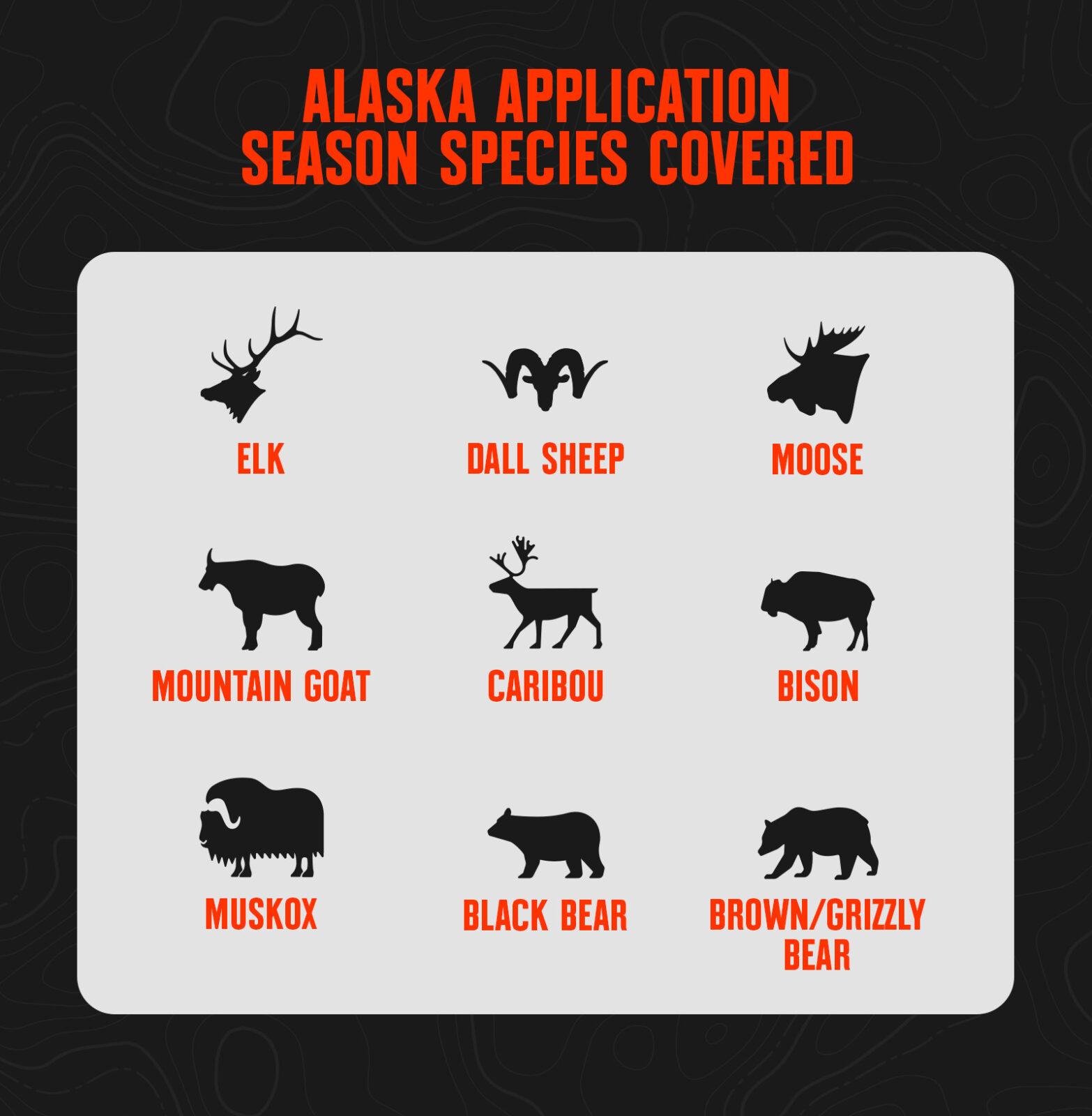
Alaska’s drawing hunt permits apply to the following species:
- Kodiak Brown Bear
- Brown/Grizzly Bear
- Black Bear
- Bison
- Barren-Ground Caribou
- Roosevelt Elk
- Mountain Goat
- Alaska-Yukon Moose
- Muskox
- Dall Sheep
Alaska Draw Hunts 101
Alaska’s drawing permit hunts are issued via random lottery. This means everyone has an equal chance. Since there are no points, draw odds are simply a matter of dividing the number of available permits by the number of applications.
You can submit up to six applications per species (there are exceptions for a few moose permits and Kodiak brown bear). And, to help increase your draw odds, it’s recommended you consider submitting multiple (or all) of your six applications per species for the same hunt. With an onX Hunt Elite Membership, you get access to Hunt Research Tools, which makes seeing your draw odds for any combination of species and units an easy exercise.
When you apply, you’ll also need to put your applications in order of choice: If there’s potential for you to draw more than one hunt for a species, the state will use your hunt choice order to determine which permit you draw.
You cannot draw the same permit two years in a row (this is one of the most common application mistakes; be sure you’re not applying for a permit you drew the year prior). You can also only draw one permit per species per year.
Always read the Alaska Drawing Permit Hunt Supplement. A dedicated edition is published each year.
A note on non-resident + guide requirements: For Dall sheep, mountain goat, and brown bear, non-residents are required to be accompanied by an Alaska-licensed guide or a relative of the second degree (e.g. spouse, (step)mom, (step)dad, (step)sister, (step)brother, grandparent) who is an Alaska resident 19 years of age or older. Non-residents hunting big game species that require an Alaska-licensed guide (again, Dall sheep, mountain goat, and brown bear) must have a signed guide-client contract before or at the time of application.
Youth Opportunities
Youth draw hunts are available to those 10-17 who have completed hunter’s ed. Youth hunters must be accompanied by a licensed adult (21+) permit holder. Youth bag limits count toward both the youth and adult.
Party Applications
You know the saying that goes “…three’s a crowd, four’s a party?” Well, not in Alaska. Party applications are restricted to two hunters. If you and a hunting partner are hoping to apply in Alaska as a party, be sure you’re both eligible for the hunt(s) you’re applying for: If one hunter is ineligible, it’ll void the whole application, and neither of you will be entered into the drawing.
Undersubscribed Hunts
Forgot to apply, or the luck of the draw didn’t roll your way? There’s still hope: On the first Friday in March, the Alaska Department of Fish and Game announces undersubscribed hunts (i.e. leftover tags). So, if you missed the boat in December, these first-come, first-served permits offer another shot at Alaska.
Resources
- Head to Hunt Research Tools for draw odds and unit trends.
- View general Alaska drawing hunt permits info.
- Read the 2026-27 drawing hunt permits supplement.
- Elite Members: Don’t forget to dive into Huntin’ Fools’ insights, free with your membership. Not Elite yet? Sign up today.
FAQs
Head to the Alaska Department of Fish and Game’s “store.” From there, you can choose to apply with a guest account or create an account and apply. You’ll need a credit card and an understanding of which species applications you want to submit. Use Hunt Research Tools and Huntin’ Fool to inform your plans, and be sure to read the latest drawing hunt permits supplement from the Alaska Department of Fish and Game.
Every year, the Alaska Department of Fish and Game releases draw results on the third Friday in February.
Alaska offers six types of hunting tags (called permits in Alaska) to non-residents: drawing permits, registration permits, general season permits, governor’s permits, small game permits, and waterfowl permits. Residents have all of those options, plus more, such as subsistence hunts.
Caribou hunting in Alaska follows caribou migration patterns, with hunts happening in August and September. Visit the Alaska Department of Fish and Game’s caribou resources page, and then read up on how to plan your own caribou hunt.
The bulk of moose hunting season in Alaska occurs in September, but depending on your residency, method of take, and unit, seasons stretch from August into February. Every unit has its specific dates and regulations, so you should review information directly on the Alaska Department of Fish and Game’s site. Then, get tips on how to e-scout for moose.
It depends on which species you’re hunting. For Dall sheep, mountain goat, and brown bear, non-residents are required to be accompanied by an Alaska-licensed guide or a relative of the second degree (e.g. spouse, (step)mom, (step)dad, (step)sister, (step)brother, grandparent) who is an Alaska resident 19 years of age or older.
Non-residents hunting big game species that require an Alaska-licensed guide (again, Dall sheep, mountain goat, and brown bear) must have a signed guide-client contract before or at the time of application.
Non-US citizen non-residents need a guide for all big game.