For most western hunters, the farthest shot they’ve ever taken on an animal lies somewhere between 200 and 400 yards, and rightly so. Ethical hunting demands close-range, well-placed shots where confidence, not guesswork, drives the trigger pull. But in recent years, a growing number of hunters and recreational shooters are turning to long-range shooting as a skill-building hobby. Why? Because hitting steel at 1,000 yards not only scratches a precision itch, it sharpens the very fundamentals that make you incredibly accurate at shorter distances.
Before we dive in, this article is not about taking long-range shots at animals. We’ll repeat that often. This is about recreational shooting on steel or paper, learning the mechanics of ballistics, building stable shooting positions, and developing the kind of confidence that carries over to your 250-yard mule deer opportunity.
To explore this world, we turned to our friend and a decorated expert in the field, Matthew “Matty” Nelson, former Green Beret sniper and current Director of Business Development at Seekins Precision.
Meet the Expert: Matty Nelson, Seekins Precision
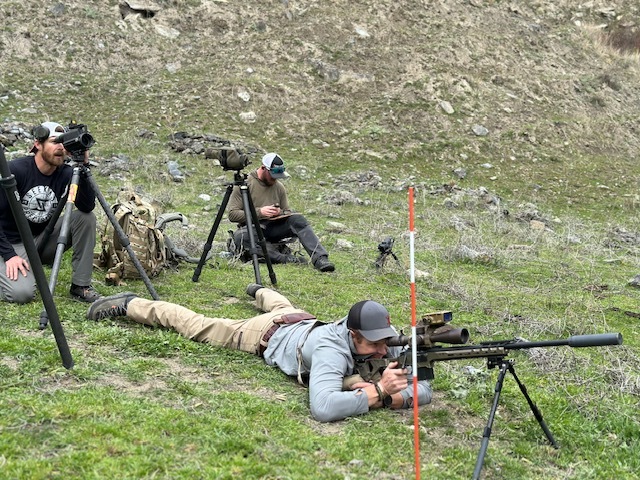
With a decade in Army Special Forces, including seven years as a sniper, Matty Nelson knows long-range shooting at the highest level. In his final years of service, Nelson trained and operated as a dedicated sniper, spending his days skydiving and shooting at long distances. Today, he splits time between running marketing and R&D at Seekins Precision and training elite military units at Idaho’s legendary Hat Creek Training range.
“I’m still teaching guys how to shoot long range with extreme angles,” Nelson says. “We’re right outside Hells Canyon—cross-canyon shooting, tricky wind, all the stuff that makes it the hardest environment to train in.”
What Is Long Range Shooting?
There’s no single definition, but most shooters consider anything beyond 600 yards as entering long-range territory. Precision Rifle Series (PRS) and National Rifle League (NRL) competitions often include targets from 400 to 1,200 yards.
It’s important to remember, however, that “long-range” is about more than distance. It’s about managing variables—wind, ballistics, stability, optics, and shooter input. That’s what makes it so compelling.
“You can buy a lot of accuracy these days,” Nelson says, “but you can’t buy good trigger control, wind reading, or position-building. Those are earned.”
The Appeal of Long Range Shooting
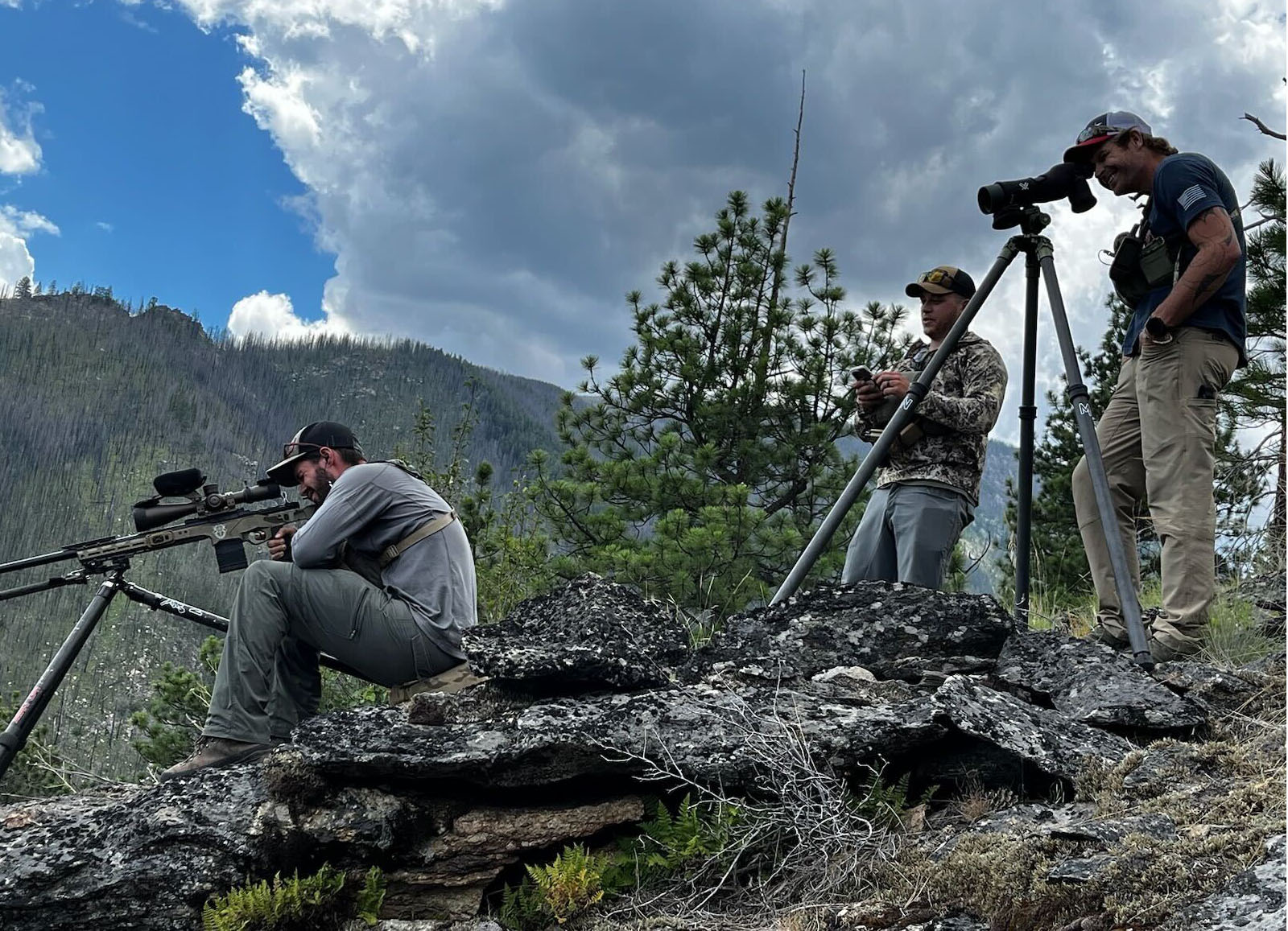
The first time you hear the satisfying ping of steel at 1,000 yards, it feels like magic. But it’s not magic—it’s math, mechanics, and mindset.
For those drawn to the technical side of shooting, long-range offers a playground of ballistic solvers, scope turrets, and eye-numbing charts. Tools like Kestrel wind meters, ballistics apps, and laser range-finding binoculars do the heavy lifting now. According to Ballistipedia, modern solvers can produce firing solutions within 1% accuracy out to 1,200 yards—if your inputs are correct.
Still, the biggest challenge isn’t in the tools—it’s in the wind.
“Reading wind is the hardest part,” Nelson says. “I carried a wind meter in my pocket for a year just to calibrate my feel. At 800 yards, a two-mile-per-hour misread is a miss. It’s that simple.”
Getting Into It: Gear and Goals
So what does it take to start shooting at long range? Nelson is quick to point out: while the gear matters, you don’t need to go full custom to begin.
Start With What You Have
If your hunting rifle consistently shoots 1.5 MOA at 100 yards, try it at 300, 400, and 500 yards on paper. Track your groups, analyze wind, and evaluate repeatability. “The biggest thing is to know your system’s limitations before spending a dime on new things,” Nelson says.
Once you’re ready to upgrade, here’s a rough progression of what you should be buying:
- Tripod: Adds stability and doubles your effective range.
- Ammo: Match-grade ammo with high ballistic coefficients (BCs) reduces wind drift and maintains stability in transonic flight.
- Optics: A quality scope with parallax adjustment and repeatable turrets lets you dial accurately. “Parallax can take a two-inch group and shrink it to half an inch,” Nelson adds.
- Rifle: Only after mastering the above should you consider a precision rifle upgrade.
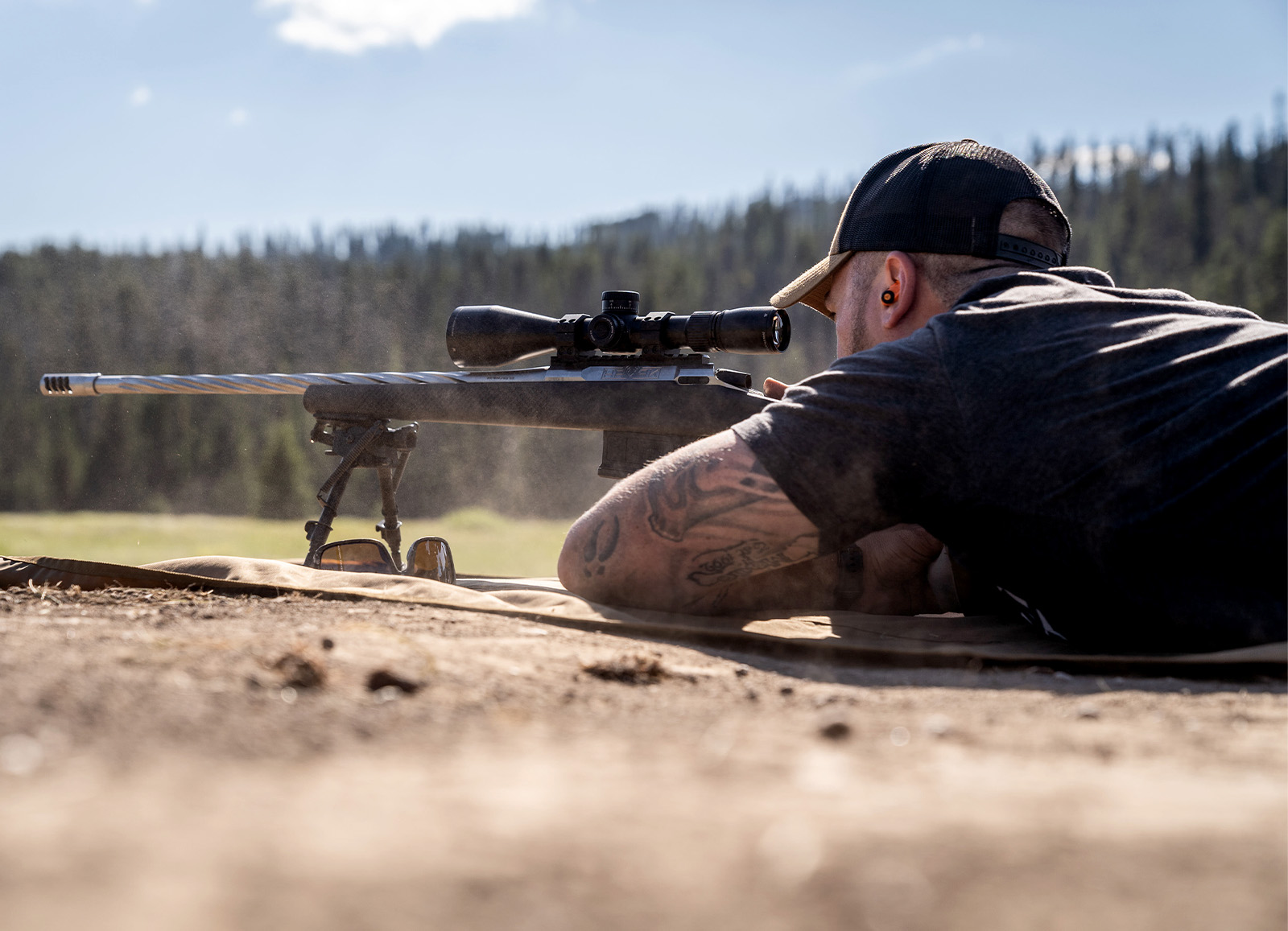
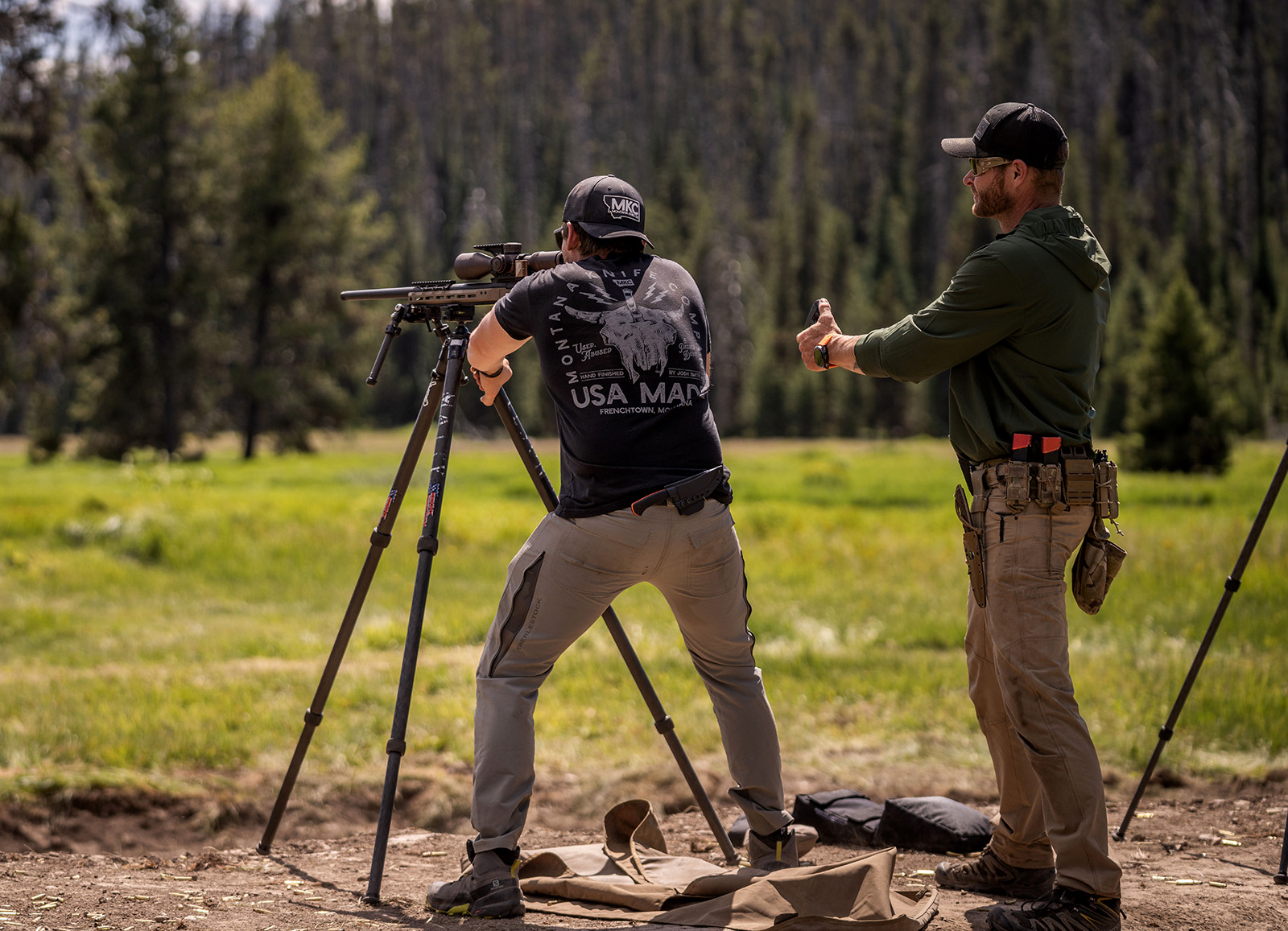
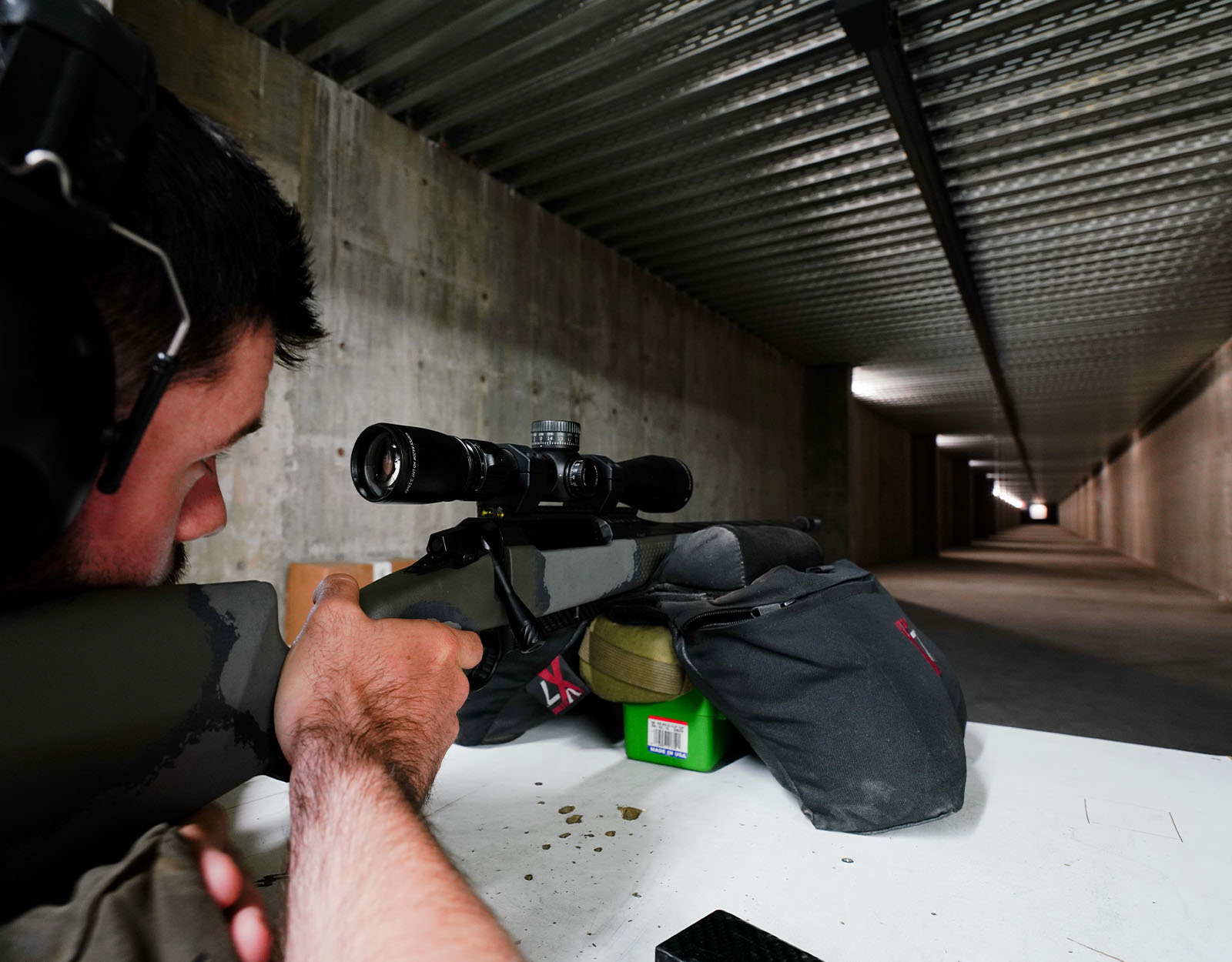
Tripods: The Ultimate Force Multiplier
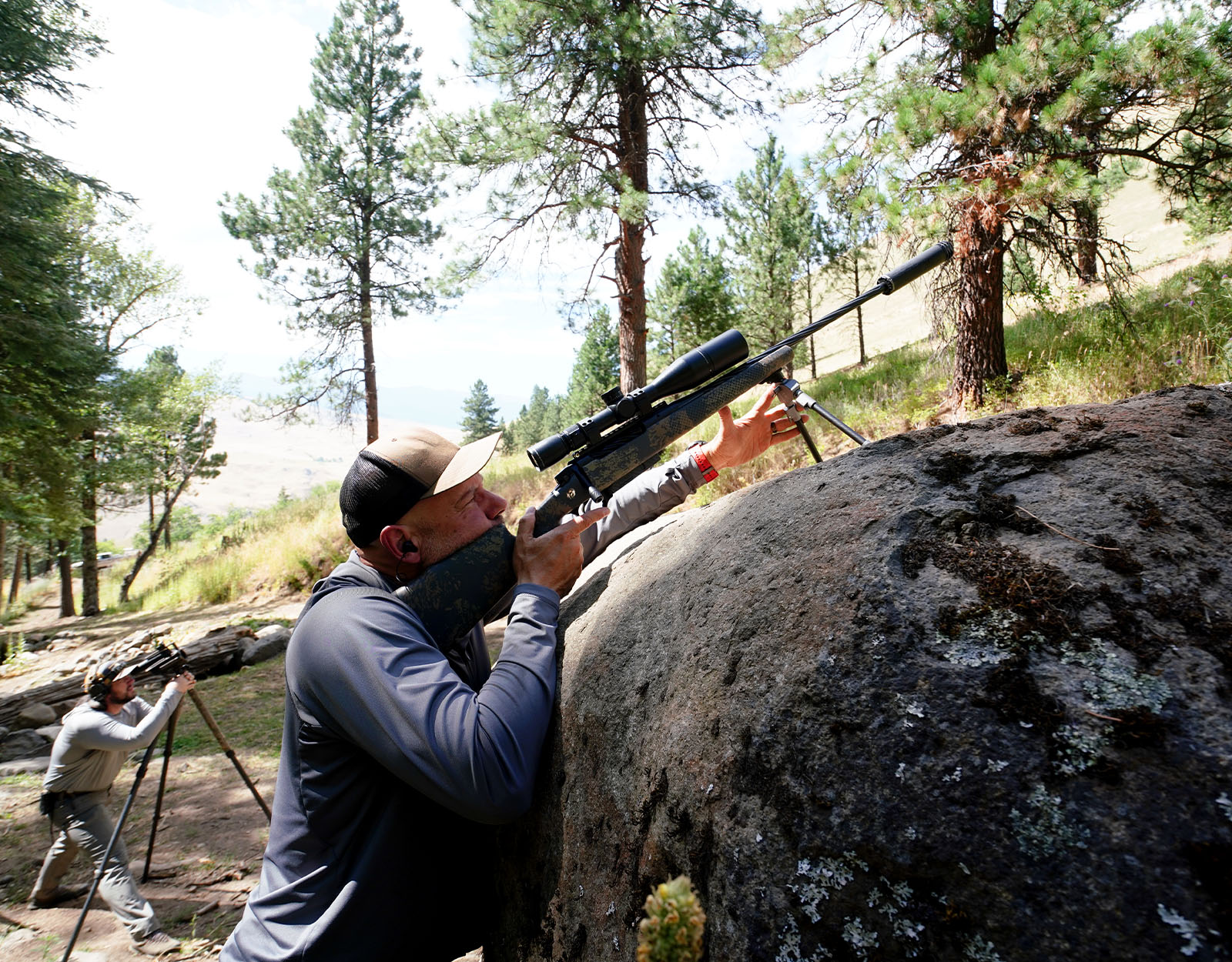
Tripods have changed the game, especially for hunters trying to shoot from uneven terrain.
“A tripod creates a guaranteed stable shooting position,” says Nelson. “If you give me 10 minutes of practical training, I can double your effective shooting distance.”
His advice for using a tripod efficiently:
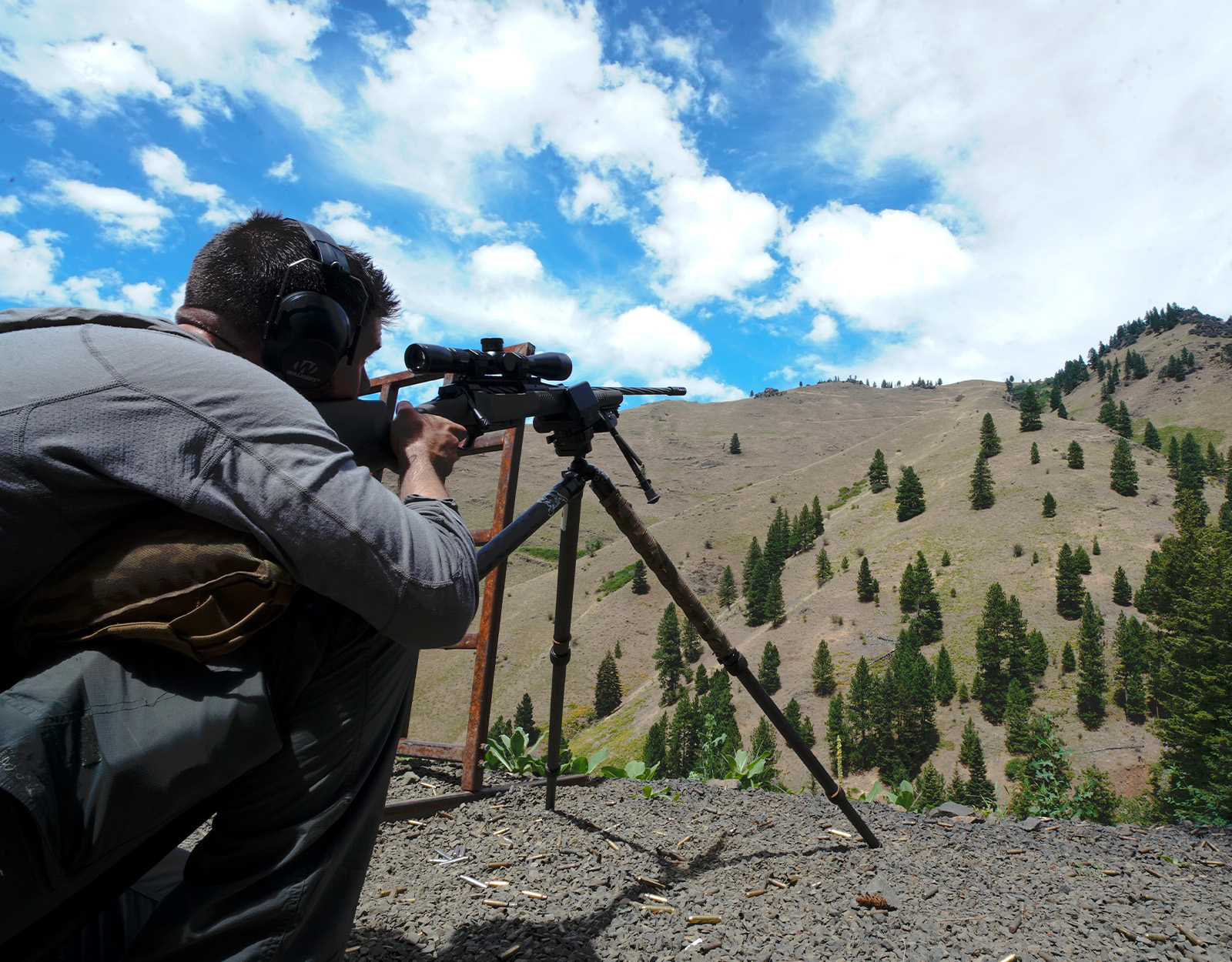
- Don’t shoot standing unless you have to. Nelson explains, “Shooting off a full stand is the least stable way to use a tripod. Lower your body—kneeling or seated is way better.”
- Use the push/pull method. Push forward into the tripod with your support hand and pull back slightly with your firing hand. “That takes your shoulder out of the system and reduces your wobble from one mil to two-tenths,” Nelson says.
- Leg placement matters. “I usually run two legs to the rear,” he adds. “That way, recoil drives me straight back and I settle right back on target.”
- Use a rear support. If possible, use a second tripod, pack, or rear bag. “My daughter shot a bear at 550 yards off a tripod with front and rear support. One shot. Clean kill. That’s stability.”
Tripods are common in military and competition settings, and they’re finally gaining traction among hunters. “I wish I got royalties on how many I’ve sold just by teaching guys,” Nelson laughs.

Budget Tip
Many western shooters are already 80% of the way there. With some time behind paper and a good tripod, you can start stretching distances effectively without blowing up your wallet.
What Makes an Effective Long Range Shooter?
Nelson breaks it down into two areas: technical fundamentals and mental control.
Fundamentals
- Sight picture – proper sight alignment while aimed at the target you intend to shoot.
- Trigger control – the deliberate and smooth application of pressure to the trigger, without disturbing the sight picture.
- Recoil management – the deliberate and smooth application of pressure to the trigger, without disturbing the sight picture.
- Stable position (prone, seated, kneeling, tripod) – minimizing movement of both the body and the rifle, allowing for a steady and accurate shot.
“You can’t fake your way to long-range accuracy,” he says. “Even the best rifle can’t overcome poor fundamentals.”
Mental Control
- Calm under pressure.
- Patience with wind calls.
- Focus on process, not outcome.
To train yourself, Nelson recommends shooting paper at increasing distances with five-shot groups and recording weather and wind with every group.
“It’s not sexy,” he says, “but paper doesn’t lie. Steel gives you a ping. Paper shows you the truth.”

Elevate Your Rifle Game
onX Hunt Elite Members have access to our expert shooting courses, designed in partnership with Seekins Precision and Vortex Optics. With more than 50 videos covering everything from sighting in your rifle to reading the wind and position tips, you’ll walk away a more well-rounded hunter.
From Range to Ridge: Why Long-Range Training Sharpens Short-Range Ethics
Practicing at 800 or 1,000 yards has real benefits for your 200-yard hunting shots. The process of:
- Building repeatable positions.
- Reading and adjusting for wind.
- Mastering trigger press.
- Understanding your rifle’s ballistics.
…all make you a more ethical, more confident hunter.
“The best snipers in the world don’t take no-fail shots beyond 400 meters,” Nelson says. “And they shoot for a living. So ask yourself: what’s your 100% hit distance? That’s your ethical hunting range.”
Long-range training helps you find that distance and shrink your margin of error. But the goal is never to extend your lethal range on animals—it’s to tighten your confidence at the ranges you already shoot.
Getting Involved: Competitions and Community
You don’t have to live a solo long-range shooting life. Across the West, more shooters are joining PRS and NRL Hunter competitions. These are not elite-only games. In fact, NRL Hunter events are tailor-made for folks with lightweight rifles and a hunting mindset.
- Competitions teach:
- Shooting under time pressure.
- Range-finding and data collection.
- Building positions fast.
“These matches are the closest thing to a real hunt,” says Nelson. “Heart pounding, timer ticking, and you’re solving problems on the clock. It’s great training.”
Sound interesting? Find matches near you.

Top 5 Beginner Mistakes in Long-Range Shooting
Skipping Paper: Steel is fun, but paper shows your true accuracy. Always verify on paper.
Ignoring Parallax: Misadjusted parallax shifts your point of impact. Learn how to dial it properly.
Underestimating Wind: A 2-mph wind misread can mean a clean miss at 800 yards.
Shooting Off Unstable Positions: Prone or tripod with rear support is key. Offhand? Not so much.
Over-Trusting Technology: Apps and solvers help—but only if your data inputs are solid.
Final Thoughts
If you’re a western hunter who’s never shot beyond 250 yards, don’t think of long-range as some tactical fantasy. Think of it as a hobby that builds better hunters. It teaches you to slow down, shoot better, and trust your process.
You may never take a 1,000-yard shot in the field—and frankly, you shouldn’t. But when that bull steps out at 340 and your crosshairs settle without a tremor, you’ll know why you practiced at 800.