Two words: flooded corn. The practice is common among waterfowl wildlife managers and hunters in many parts of the country—and it is also one of duck hunting’s most controversial topics today.
Here’s what flooded corn is, why it has become such a flashpoint in recent years, and what the policy and science say about it.
What Is Flooded Corn?
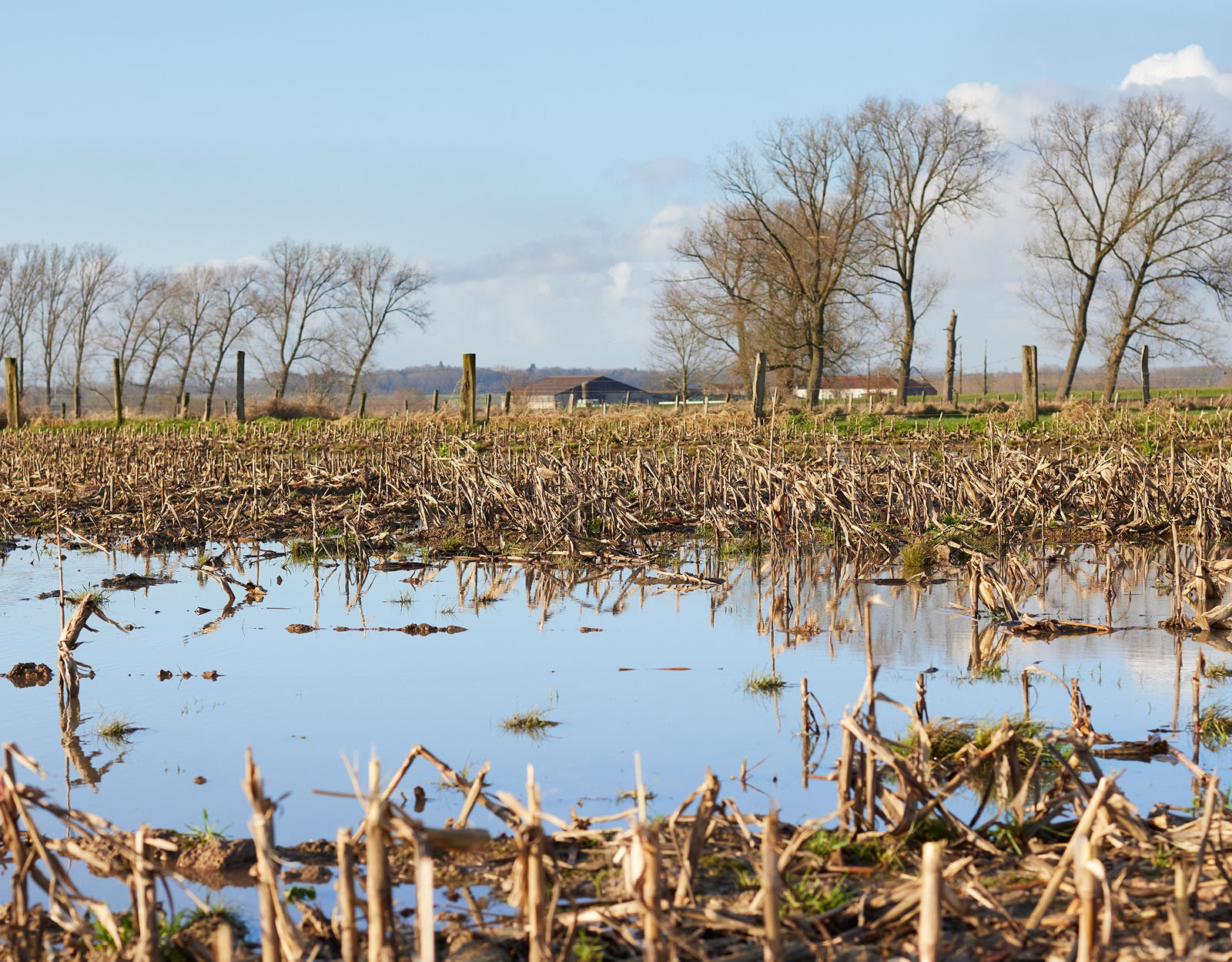
Flooded corn is something that can happen both intentionally and unintentionally. The term typically refers to when a field of standing corn becomes flooded with water. Often, this is done artificially by wildlife managers, who use pumps or turn off drains to allow fields of unharvested corn to fill with water. Of course, a similar result can occur when cornfields flood naturally because of fall rains or other weather events.
Regardless, a field of flooded standing corn gives waterfowl access to corn—an energy-rich food source—that they otherwise would struggle to feed on; flooded water puts them at a height where they can reach corn ears. Intentionally flooding corn is common in the fall when waterfowl require high-value food sources along their migration routes, and when natural food sources are diminished or frozen. Flooded corn offers an easy food source for those birds—and it can create damn good duck hunting for folks able to hunt over it.
Flooding corn is one type of “hot cropping,” which is when waterfowl managers flood unharvested crops for hunting purposes. This is also done with other crops such as millet and rice.
Why Is Flooded Corn Controversial?
What’s the Argument Against It?
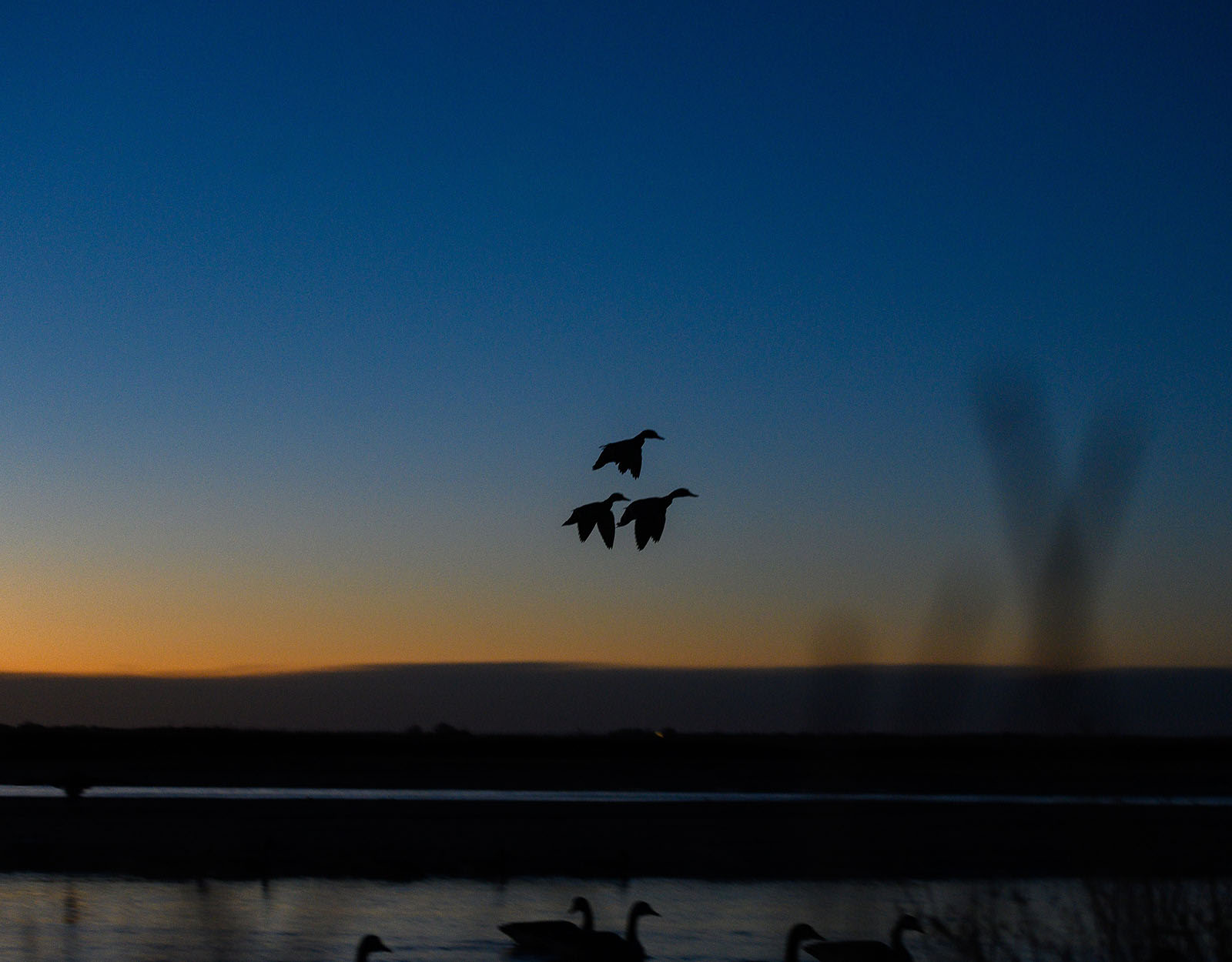
Hunting over flooded corn isn’t popular among all waterfowl hunters. The arguments against it vary, with some hunters calling it unsportsmanlike and comparing it to baiting, which is illegal for waterfowl hunting. While that argument has been around for a long time, a recent surge of discontent against flooded corn has grown in the Southeast U.S., where hunters have seen poor duck hunting during years in which some migratory ducks didn’t reach historic wintering grounds at the same time as there have been anecdotal reports of increased flooded corn in higher latitudes of the Mississippi River Flyway. As a result, some hunters claim that flooded corn is “short stopping” birds from reaching southern wintering areas.
The pushback against the practice has led to the organization of advocacy groups such as the Flyway Federation, which declined to comment for this story. However, the group’s mission statement proclaims that it hopes to “preserve the natural rhythm of North America’s waterfowl migration. Rooted in the traditions of ethical hunting and guided by a deep respect for the land, Flyway Federation was founded to restore integrity to the flyways that once pulsed with life from the Canadian boreal to the Gulf Coast marshes.”
The backlash against flooded corn has even reached Capitol Hill, where in January 2026, Louisiana Senator John Kennedy published an open letter calling on the U.S. Fish and Wildlife Service (USFWS) Director Brian Nesvik to study the impacts of what he termed “legal baiting” on waterfowl migration.
“Manually flooding cornfields for the sole purpose of attracting and shooting waterfowl undermines the foundational standards of wildlife conservation,” wrote Sen. Kennedy. “The widespread practice of ‘legal baiting’ throughout the northern regions of the Mississippi Flyway has played a significant role in the decline of waterfowl migration to Louisiana.”
And the Argument for It?
On the other side of the argument, hunters who utilize flooded corn counter that the practice provides much-needed food and habitat to migratory birds, and that the arguments against it are misguided.
“Flooded corn isn’t anything new,” says Tony Vandemore, one of the founders of Habitat Flats, a waterfowl hunting lodge in Missouri that incorporates flooded corn as one part of the property’s habitat management strategy. “At the end of the day, we are losing habitat at an alarming rate. To get rid of more of it [by outlawing hunting over flooded corn] would be ridiculous.”
The Legal Framework for Flooded Corn
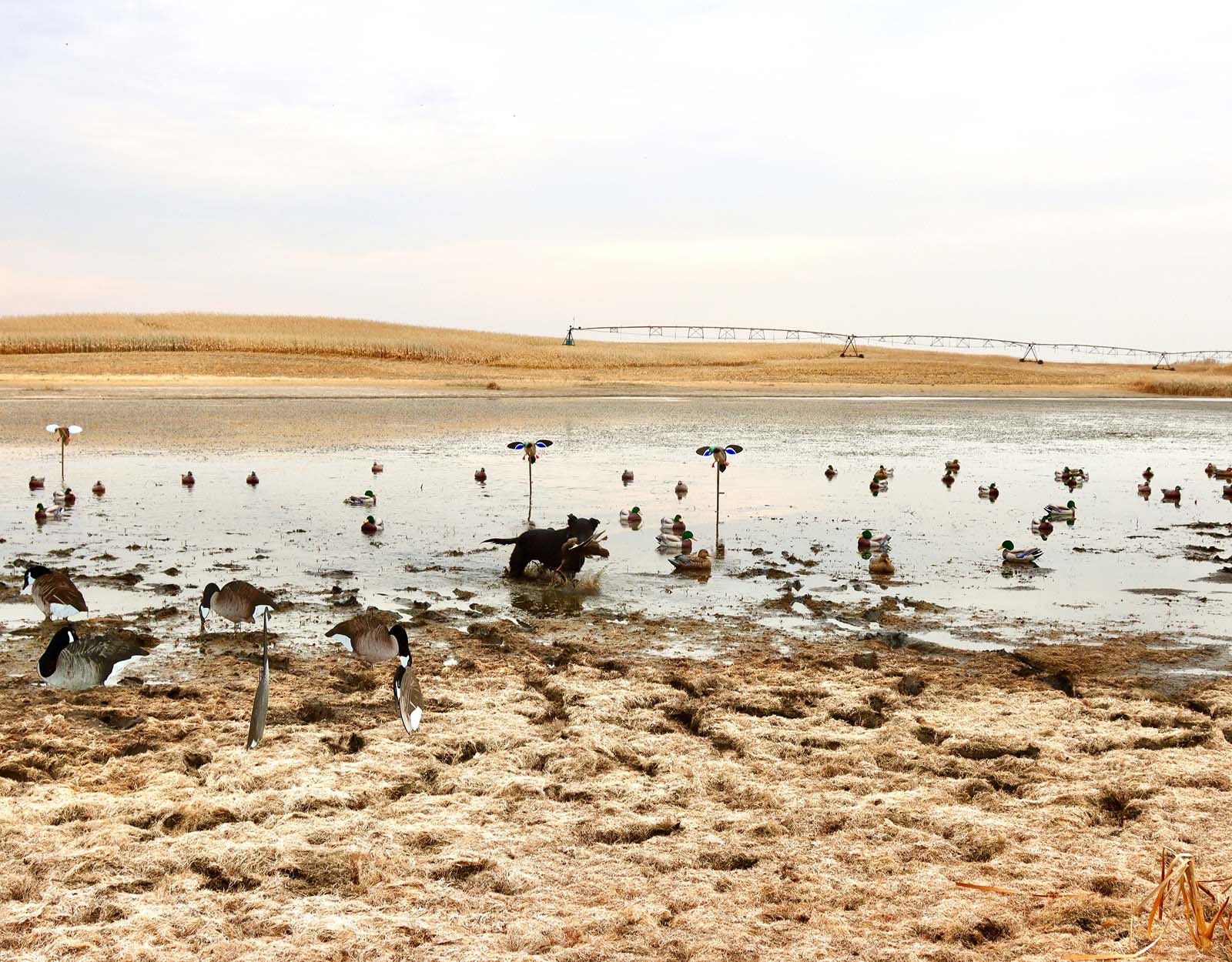
Regardless of whether you agree with Vandemore’s perspective, his statement that hunting waterfowl over flooded corn has been considered legal for a long time is true. The regulations on the issue stem from the Migratory Bird Treaty Act (MBTA) of 1918. That landmark legislation was passed to implement a treaty between the U.S. and Great Britain (representing Canada) designed to protect non-game birds and regulate the harvest of migratory game birds. At the time, the legislation was intended, in large part, to put an end to market hunting and the interstate transport and sale of meat and feathers.
In doing so, the original version of the law also had something to say about how recreational hunters could legally target waterfowl. For example, it forbade taking waterfowl with a shotgun greater than a 10-gauge, as well as “concentrating, driving, rallying, or stirring up migratory waterfowl” with “an airplane, or a powerboat, sailboat, or other floating device.”
The Question of Baiting
The initial law, however, which led to the USFWS developing the regulation known as 50 CFR Part 20, did not have anything to say about baiting, which was initially controlled through a system of permits and provisions. Then, according to Ducks Unlimited, in the late 1930s, the USFWS incorporated regulatory language regarding baiting into Part 20:
Migratory game birds may not be taken by the aid of baiting, or on or over any baited area; baiting shall mean the placing, exposing, depositing, distributing or scattering of shelled, shucked, or un-shucked corn, wheat or other grain, salt or other feed so as to constitute for such birds a lure, attraction or enticement to, on or over any area where hunters are attempting to take them
The agency, however, included a relevant exception:
Nothing in this subparagraph shall prohibit the taking of such birds over standing crops, flooded standing crops (including aquatics), flooded harvested crop lands, grain crops properly shocked on the field where grown, or grains found scattered solely as the result of normal agricultural planting or harvesting.
But What About Unintentional Baiting?
The next major development to those regulations came in 1998, when the federal government passed the 1998 Migratory Bird Treaty Reform Act. Mike Oropallo is an attorney for the law firm of Barclay Damon LLP, which has an outdoor and wildlife law department. He says that the Reform Act resulted in part because of recent legal issues.
“There was a case out there where some hunters didn’t realize that the field they were hunting had been baited but had been charged with felonies for hunting over it,” says Oropallo. “It went up to the circuit level. The court there held that under the existing laws and regulations, baiting was a strict liability offense.”
In other words, the court ruled the hunters were liable for hunting over the baited field even if they didn’t have any knowledge that the field was baited. This prompted legislators to remove the strict liability standard for baiting and instead clarified that hunters are liable for baiting only if “the person knows or reasonably should know that the area is a baited area.” This is known as the “scienter standard” of criminal liability.
In 1999, the USFWS published a final rule that interpreted the new law, and it defined a baited area as one where “salt, grain, or other feed has been placed, exposed, deposited, distributed, or scattered, if that salt, grain, or other feed could serve as a lure or attraction for migratory game birds.”
The regulations maintained that hunting over flooded standing crops would remain legal, though they specified that it must take place over crops that were cultivated or harvested using “normal agricultural operation”—as defined by the U.S. Department of Agriculture. The regulations also dictated that this means crops cannot be “manipulated” in ways that do not align with normal agricultural operation.
What Counts as Manipulation?
According to Oropallo, manipulation includes such things as bushhogging a cornfield before flooding it or even just intentionally removing ears of corn from the stalks and scattering them in the water. However, the regulations explicitly note that “accidental scattering of seeds or grains incidental to hunting activities” does not count as this kind of manipulation.
In his letter, Senator Kennedy claimed that the Migratory Bird Treaty Reform Act “repealed the strict liability standard” and, by doing so, “removed the enforcement mechanism that previously restricted the growth of hunting over intentionally flooded standing crops, particularly corn.” But according to legal experts, this was not the case: hunting over flooded standing corn was legal before the Reform Act ever went into effect and remained so afterward, so long as it isn’t manipulated or harvested outside of normal agricultural operations.
Could the Rules Change?
Still, several possible paths exist for flooded corn opponents to outlaw the practice, though doing so would be difficult and could lead to unintended complications. The clearest path would be passing new federal legislation, though the result could lead to murky situations. For example, if a law explicitly banned hunting flooded standing crops, would that mean that you wouldn’t be able to hunt a cornfield after it becomes muddy from rain? Additionally, according to Oropallo, this kind of legislation could be subject to a constitutional legal challenge for being overbroad as not the least restrictive means to address the matter.
The definition of “baiting” and other interpretations or guidance issued by the USFWS could also be challenged given the U.S. Supreme Court’s recent Loper Bright decision, where it struck down a 1984 ruling known as Chevron and so-called “Chevron deference.” That decision essentially curtailed the power of federal agencies’ “deference” in their interpretation of ambiguities in federal laws when creating rules and regulations. That said, this kind of challenge for flooded corn is yet to occur.
Flooded Corn: A Brief Legal History
Federal rules prohibit hunting waterfowl over bait but make an exception for flooded standing crops.
Hunters can be convicted of hunting over bait if they knew or reasonably should have known a field was baited.
The rules retain the flooded-standing-crop exception and incorporate the hunter-responsibility standard passed in 1998.
The Leading Science on the Migration Issue
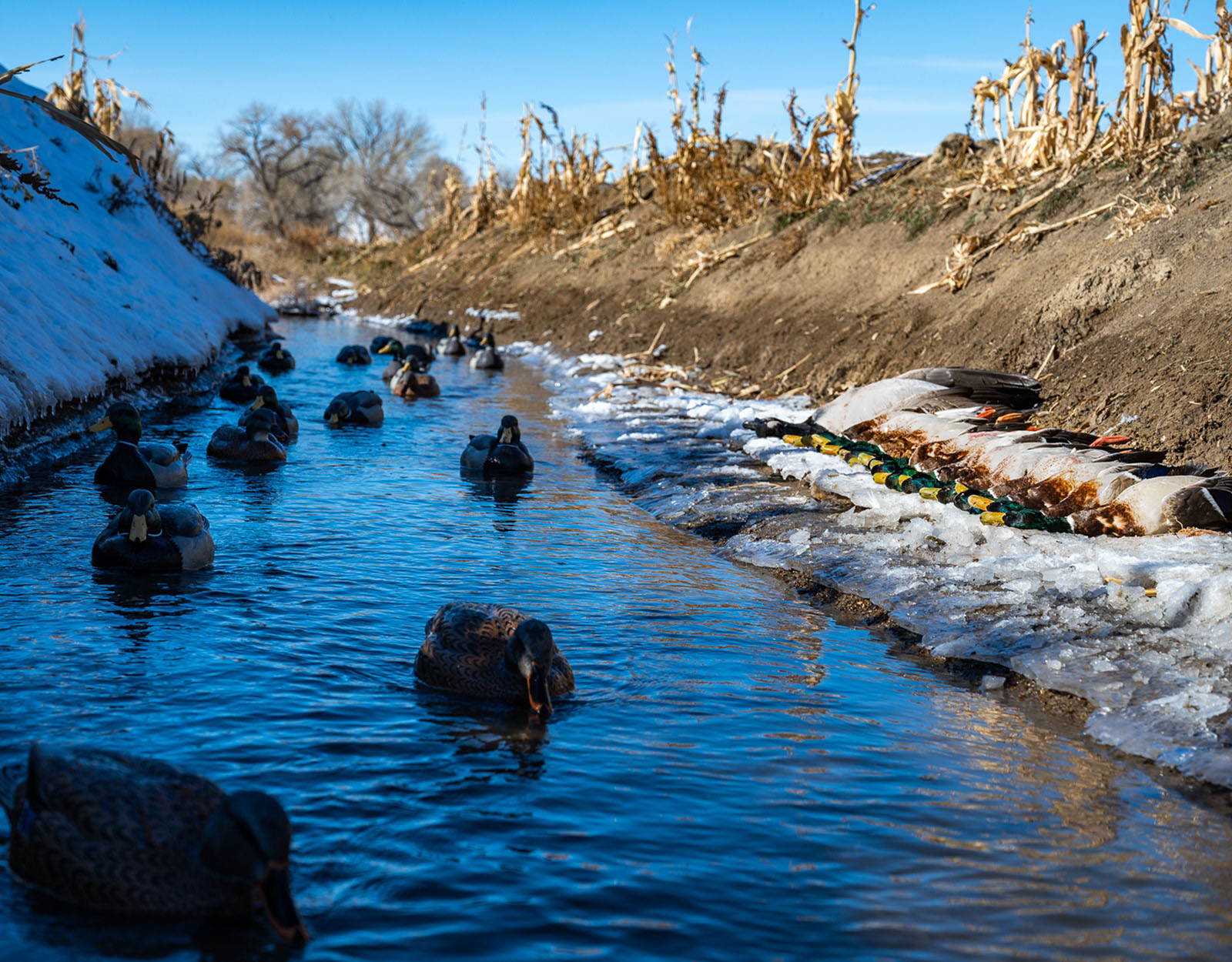
So far, the science does not support the claim that the presence of flooded corn is the main reason some birds aren’t reaching southern wintering grounds, though studies have conclusively shown that some mallards have shifted their wintering ranges north.
What Makes a Duck Head South, and Is Flooded Corn Short Stopping Ducks?
The main reason those mallards are shifting their migration routes is that weather patterns have been shifting in recent years.
According to Mississippi State University Extension Waterfowl & Upland Gamebird Specialist Dr. James Callicutt, understanding this pattern requires understanding that migration strategies exist along a gradient, with some birds migrating in response to seasonal cues like the photoperiod (hours of daylight vs. dark), while others remain further north until weather conditions force them south.
There is variation between species, with mallards tending to be relatively weather-influenced, but even within species, there is also individual variation for migration strategies, with some birds migrating early while others wait for weather to push them. Many mallards are likely the ones that aren’t reaching southern wintering grounds, while species such as greenwing teal, pintails, and gadwall, which generally don’t require the same amount of weather severity to migrate but also eat corn and grain, are reaching those southern areas.
The main reason those mallards are shifting their migration routes is that weather patterns have been shifting in recent years, likely due to the influence of climate change. “We’re not seeing the same frequency or duration of prolonged freezing conditions across many of the latitudes north of us. When those areas remain relatively mild, ducks can continue using habitats that historically may have become unavailable earlier in the winter,” says Callicutt.
A study authored by Dr. Michael Schummer, Associate Professor at the State University of New York College of Environmental Science and Forestry, has shown that weather severity has the greatest impact on the regional abundance of ducks during the autumn-winter migration. And fall and early-winter weather severity has been trending lower. “We most certainly have a warming trend,” he says. “And the level of warming up here is something that people in the South may not understand.”
He also notes other factors at play. “In the mid-latitudes, there’s been a ton of conservation work with wetland restoration,” he says. “Compared to those massive acres of restored wetlands, flooded corn is likely a speck on the landscape.”
So, How Much Flooded Corn Is Out There?
That said, researchers are working to more accurately quantify how much flooded corn is actually on the landscape, which could help more definitively determine if it’s impacting migration patterns; this is difficult to do, though recent advantages in satellite imaging technology may help scientists accurately accomplish this—and by doing so, isolate whether or not it may be a factor impacting waterfowl migration patterns.
Anecdotally, Dr. Ryan Askren, Research Center Director at Five Oaks Ag Research & Education Center in Arkansas, says that birds in his GPS backpack telemetry studies that stay in the upper Midwest during mild winters spend a lot of time in dry cornfields. “They’re staying on major rivers or open water on cooling lakes and sewage treatment plants and going out to feed on dry cornfields.”
Corn, it should be noted, is an imperfect food source for ducks. The kernels are high in carbohydrates, which can be easily converted into energy, but they lack other nutrients waterfowl need in their diets. “Corn is an excellent source of energy for ducks, especially during winter, but it doesn’t provide everything they need nutritionally,” says Callicutt. “Natural wetlands provide additional foods, including seeds, aquatic invertebrates, and other plant material, that help meet their nutritional needs.”
In other words, even if hunting clubs or refuges make flooded corn available to birds, there must still be other wetlands available for ducks to make a living on the landscape.
What Researchers Know About Local Impacts
While researchers have yet to show that flooded corn affects waterfowl migration as a whole, they have demonstrated that it influences birds’ distribution on a more localized level. In particular, a study by researchers at the Cohen Wildlife Lab at Tennessee Tech University showed that flooded cornfields attract waterfowl as forage resources, with “corn ears closer to the water surface depleted faster.” Additionally, that study showed that hunted flooded cornfields were depleted by waterfowl at a slower rate than ones that acted as sanctuaries; this means that hunting pressure is another local influencing factor for waterfowl distribution, even with the presence of flooded hot crops, but that flooding corn does alter where ducks go on the landscape at a localized level.
While researchers have yet to show that flooded corn affects waterfowl migration as a whole, they have demonstrated that it influences birds’ distribution on a more localized level.
This information could be used in arguments by folks on either side of the subject: Opponents of flooded corn can argue that it’s taking opportunities away from hunters who don’t hunt over flooded corn, while proponents can show that it offers food and habitat value—but not so much that it fully dictates local bird movement. Because of the ecological benefits of flooded corn, some scientists warn that a potential effort to remove it from the landscape could have a negative impact on broader waterfowl populations, or at least carry localized effects on waterfowl abundance.
Still, researchers are working to learn more about how ducks use flooded corn in this way. For instance, while the forage value of corn is relatively well understood, the benefits it provides ducks beyond food are less so.
“One of my big questions is around the thermal and predator sanctuary benefits of different cover types [including flooded corn],” says Dr. Askren. “There’s a lot more to understand about the role that cornfields play in providing thermal cover and not just food resources.”
The Final Word on Flooded Corn
Further research could improve our understanding of flooded corn’s potential impacts on waterfowl, positive or negative. Thanks to advances in GPS telemetry and satellite imagery, this kind of work could come relatively soon.
In the meantime, though, the debate over the practice will carry on. Being able to flood a cornfield requires significant amounts of land and money, which is why it’s often done at duck clubs and lodges; in contrast, public hunters don’t often have access to this resource-intensive habitat management tactic. Additionally, waterfowlers in the Midwest, where cornfields are regularly flooded, have seen good action for greenheads in recent years, while those in the South have seen declining mallard harvests. In both cases, the imbalance has led to conflict, and the controversy is likely to continue.