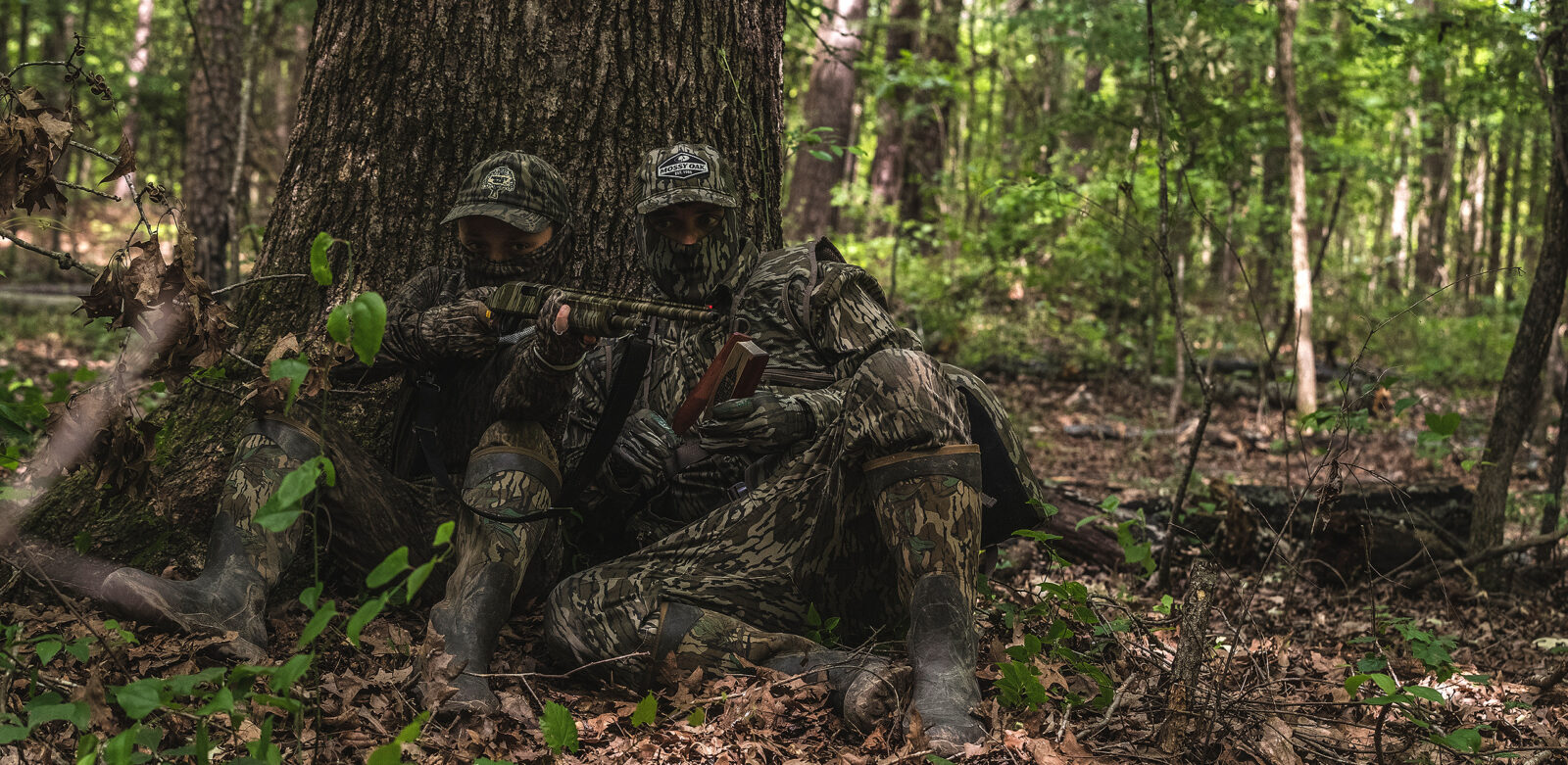

Chapter 2 – Gear, Shotgun Patterning, and Safety
Overview
There are a few essential pieces of turkey hunting gear you’ll need every time, as well as a handful of tools you’ll be glad you brought. See what the Mossy Oak crew won’t do without when chasing gobblers.
Patterning your turkey gun is a key step in setting yourself up for success. Learn how to achieve a dense pellet count at your max range so you can take a lethal, ethical shot when the opportunity presents itself.
Beyond that, we’ll cover precautions you can take to keep safety at the forefront of your hunts, such as what colors to avoid wearing and how to safely run decoys, especially on public land.
Course
Learn how to prepare your firearm for maximum effectiveness and review important safety considerations.
- Turkey Vests 101.
- Must-Have Turkey Gear.
- Choosing Camo Patterns.
- Understanding Shotguns and Turkey Shells.
- How to Pattern Your Shotgun.
- Safety in the Turkey Woods.
Get Access to More Courses
We’re gifting turkey hunters with Turkey Academy so they can prep for the season. For full access to other Elite Expert Resources covering topics ranging from shed hunting to marksmanship, become an onX Hunt Elite Member.
Chapter 2 – Gear, Shotgun Patterning, and Safety
Chapter 2 – Gear, Shotgun Patterning, and Safety
Skill Level: Beginner
2.1: Turkey Vests 101
What You’ll Learn:
• Key features of various turkey vest designs.
• Pocket must-haves.
2.2: Must-Have Turkey Gear
What You’ll Learn:
• The inside scoop on the items the Mossy Oak crew keeps in their turkey vests.
2.3: Choosing Camo Patterns
What You’ll Learn:
• Considerations to keep in mind when choosing your camo patterns.
2.4: Understanding Shotguns and Turkey Shells
What You’ll Learn:
• Types of shotguns.
• TSS advantages.
• Choke tube considerations.
2.5: How To Pattern Your Shotgun
What You’ll Learn:
• Basic patterning.
• What you can do to compensate for a firearm that doesn’t shoot straight.
2.6: Safety in the Turkey Woods
What You’ll Learn:
• Key firearm safety measures.
• Proper decoy handling.
• Considerations for approaching hills and fences.
• Colors to avoid wearing when turkey hunting.
Go back to review terminology or move ahead to learn about scouting for turkeys.
Video Transcript
Source: YouTube transcript; please forgive typos.
2.1: Turkey Vests 101
Today, we’re going to talk about my favorite subject as far as gear is concerned—one that I own an awful lot of—and that is turkey vests. There are dozens of great turkey vests on the market in various Mossy Oak patterns, but if you’re a newcomer, it can be a little intimidating trying to determine which vest to purchase. One of the main differences you’ll find is the overall build. Some are strap vests, which some people prefer because they’re lighter weight during hot weather, while others are more traditional vests that cover the chest.
One thing you’re always looking for in a turkey vest is lots of pockets. When you’re turkey hunting, you may carry a lot of gear—various calls, clippers, shotgun shells, and even carrying the turkey when you go out. Another feature is the seat. There are numerous seat designs on turkey vests. Some have fold-down seats, some have strap seats you can lay on, and some have internal frames that support your body. All of these designs have a function and a place in the turkey woods throughout the United States.
I might not be the most organized person in my life, but one thing I’m very organized about is my turkey vest. I want to know exactly where everything is. If I need to sit down in a hurry and I’ve got a longbeard gobbling, I want the right tool for the job—whether that’s a box call, gloves and a face mask, a friction call, or a mouth call. I want easy access to find it.
When I’m looking at a turkey vest, especially if I’m buying a new one, I pay close attention to the pockets—how they’re positioned and how they’re secured. I look for zippers, magnets, or pull tabs to keep everything secure. I like zippers because they’re quiet. I don’t like Velcro on my turkey vest. If I need to reach for something with turkeys close by, I want it to be quiet. Another big advantage of zippers is keeping gear from falling out when you’re walking, crawling, or loading your vest into a truck or hunting camp. Without zippers, things tend to fall out, and on your next hunt, you may be missing something you need.
When you’re shopping for a turkey vest, look at several options. Consider where you’re hunting and the style of hunting you’re doing. If you’re not walking very far and sitting for long periods, you may need more cushion, a frame seat, or the ability to carry more gear. If your tactic involves a lot of walking or running and gunning, you may sacrifice some comfort or seat support for a lighter-weight vest.
First, know what tools you’re going to be carrying in the turkey woods and match your turkey vest to that. Many people can use the same turkey vest whether they hunt in Florida, Washington state, or anywhere else in the country, but don’t be afraid to try, or own, several types of turkey vests based on how you hunt. There are many options out there, and the good thing is a lot of them come in Mossy Oak camouflage.
2.2: Must-Have Turkey Gear
There are no absolutes. A couple of things I have in my turkey vest, you may not have in yours, and I’ll explain why I carry them. One thing I carry is an old-school compass. If you don’t know how to use an old-school compass, you should learn—it’s a great thing to have in your turkey vest, and everybody needs to know how to use one.
Another thing I carry that’s priceless is a tiny flashlight, about the size of three-quarters of a big pen. It clips into a pocket, and I call it my gate opener. It’s for gates, locks, and anything I can’t quite see. If you go turkey hunting a lot, you’re going to do some of it in the dark. I can turn that flashlight on and hold it in my teeth to quietly get a chain off. There’s quiet, and then there’s turkey quiet. If you can’t see, you end up with noise. A compass and a flashlight are two things I’ll have laid out a month before turkey season.
Another thing I use is a turkey chair with a shotgun sling on it. It’s not much heavier than carrying a cushion. It folds up, and I sling it over my neck like a shotgun. I also personally carry a walking stick. If you’re hunting in Mississippi, Alabama, or Florida, you’re going to walk up on a snake. I’ve always felt better with a six-foot stick in front of me. I carry a little folding saw, too. As soon as I see the right stick that’s not an oak and nobody’s going to scream at me, I’ll cut it. I must have 50 of them laying around. A walking stick, a compass, and a folding saw—you can’t beat them.
I’ll also carry a dried turkey wing sometimes. If I’m close to a gobbler and don’t want to call too much, flapping a turkey wing or scratching it against a tree like a hen flying down off the roost is sometimes all you need to kill a gobbler. I carry small items like cough drops and things like Rolaids or Tums. If you eat something at hunting camp that doesn’t agree with you, they’re great to have. I also carry extra shotgun shells. Typically, I’ll carry three shells in my gun, but I’ve had bad luck before, and having extra shells in your vest can keep you hunting instead of going back to the truck or lodge.
Other items you might want to carry are binoculars or a rangefinder, depending on where you hunt. I like to keep them in my vest so I can glass open country or pre-range distances in a field setting. That way, if a turkey comes in, I know exactly how far it is and can decide whether it’s a good shot. Insect repellent, whether it’s a spray or a Thermacell unit, along with pruners and limb saws, are also common items. Turkey vests have spots and pockets designed for all of this.
A turkey vest is absolutely a must for any turkey hunter, regardless of where you hunt, because you need a way to carry all the gear and items you need to hopefully be successful.
2.3: Choosing Camo Patterns
Camouflage is a big deal. The better you can hide yourself, the more successful you’re going to be. As the seasons change, I like to get a little green in my camouflage, which is why most of my turkey gear is Obsession. To me, it’s unbeatable because you can sit down anywhere—the tones, the greens, everything works. I learned this the hard way years ago when I started filming turkeys with big cameras. I learned real quick that camouflage matters. Remember to cover everything: the bottoms of your boots, the soles, anything a turkey might see.
Camouflage is essential to turkey hunting because a turkey’s eyes are extremely keen, as sharp as any game species we hunt anywhere in the world. One important thing about camouflage is matching it to the terrain you’re hunting in. At Mossy Oak, we make numerous camo patterns. Some great patterns from the past aren’t on the market anymore, others have always been available, and we’re constantly releasing new ones. Most of our patterns work anywhere and any time of year, but it’s worth fine-tuning your camouflage based on your location, local foliage, and the time of year you’re hunting.
The woods can look very different throughout turkey season. For example, hunting in the South in mid to late March looks completely different than hunting the same spot in early May. When the leaves aren’t on the trees yet, Mossy Oak Bottomland—our original pattern from 1986—works great because there isn’t much foliage. Bottomland can work late into the season, too, but as things green up, we have other options like Greenleaf. Later in the season, patterns like Shadow Leaf and Obsession work fantastic when everything is green. Some places, like South Florida, are green year-round, while other places, like the Northeast, may stay brown with a lot of dead leaves. We have both older and current patterns that work well for all of this.
The biggest thing is matching your camouflage to your location and terrain. That will make you a more effective hunter. I like to have everything camouflaged—from my boots to my hat to my face mask and gloves, which are especially important. All of my accessories are camouflaged as well: my gun, gun sling, turkey chair, turkey vest, and anything else I use. Most of it you can find in Mossy Oak, and if not, you can modify it to better match your surroundings.
2.4: Understanding Shotguns and Turkey Shells
We’re going to talk about turkey shotguns. When I first started turkey hunting, the most popular gauges by far were the 12 gauge. At that time, 12-gauge 3½-inch Super Magnum shotguns were all the rage, and 10 gauges were still very popular. Over the years, smaller gauges such as 20 gauges, and now even 28 gauges and .410s, have surged in popularity, largely due to advances in ammunition.
I’ve hunted every turkey subspecies with every American gauge: .410, 28 gauge, 20 gauge, 16 gauge, 12 gauge, and 10 gauge. All of them can be extremely effective on turkeys, but a .410 bore is much more comfortable to shoot than a big, heavy-kicking 10 gauge. Depending on your physical build, how much you like or dislike recoil, and the effective range at which you want to harvest a turkey, the gauge you choose can vary.
With the advent of heavier-than-lead shells such as TSS, the playing field has been leveled. .410s, 28 gauges, and 20 gauges are far more effective and popular than they were 20 years ago when shooting traditional lead. Every gauge has its place in the turkey woods, and honestly, you can hunt turkeys with any of them—it just comes down to personal preference.
When discussing turkey guns, there are a lot of options, and if you’re new to turkey hunting, it can be confusing. There is no perfect turkey gun. It’s all about what you prefer. There are pump-action shotguns, semi-automatic shotguns, single-shot shotguns, double-barrel open-action shotguns, and even bolt-action shotguns on the market. Depending on your age, your preference, whether you want a follow-up shot, and safety considerations, all of that plays into what you should choose.
Recoil is another important factor. If recoil bothers you, semi-automatic shotguns—whether inertia-driven or gas-driven—are typically easier on the shoulder than pump-action shotguns, and much easier than single-shot shotguns. The amount of recoil you’re comfortable with should be taken into consideration.
The next thing to consider is what type of shotgun shell you need and how to pick the right choke tube. Every gun likes a different choke and a different shell configuration. Traditionally, turkey hunters shot lead, which still works great. As technology advanced, other shot types came along, and now tungsten shot, also known as TSS, has become extremely popular. TSS is the heaviest-density shot material commercially available, which means more pellets downrange that maintain trajectory and penetration, often resulting in more effective and ethical kills at distance. In my opinion, TSS makes every turkey gun better.
Once you’ve picked your gauge, action, shot type, and shell, the next step is choosing a choke tube. Different shotguns and barrels may prefer different constrictions. Ultimately, you want to match your shell and your gun to the right choke. Tighter choke tubes generally produce better patterns at longer ranges, which can be useful in open fields, western terrain, or prairie areas. If you’re hunting thick woods where turkeys may come in very close, a more open choke, such as a modified choke, can be a better option. It gives you a larger pattern and a little more forgiveness. A lot of turkeys get missed at long range, but many also get missed at close range.
2.5: How To Pattern Your Shotgun
Today, we’re going to spend a little time talking about patterning a shotgun. Patterning your shotgun before a turkey hunt is extremely important. What I mean by patterning is knowing where your shot is hitting and how many pellets you’re getting in a certain area at a certain distance. Every shotgun shoots differently.
When I pattern a shotgun, I do it at 40 yards. In many cases, turkey loads have heavy recoil, so I’ll use a lead sled or sandbags to reduce it. I shoot at a large piece of paper with a small dot in the middle at 40 yards. Then I draw a 10-inch circle and count the number of pellets inside that circle. If I have over 100 pellets in a 10-inch circle at a given distance, I know that’s my most effective range.
Patterning also tells you two important things: how far you can ethically shoot a turkey and where your point of aim compares to your point of impact. Not every shotgun shoots exactly where you point it. Some shoot high, some low, some left, and some right, depending on the load. I always pattern a shotgun to make sure my point of aim and point of impact match. If they don’t, you can use a red dot or another optic to correct it and get the gun shooting exactly where you want.
I hunt with a mix of older and newer shotguns, and they all shoot differently. Whether you’re aiming with a bead or a red dot, you want that aiming point as close to the center of the pattern as possible. Some of my older shotguns don’t shoot accurately off the bead—they may shoot low and left or high and right—so I’ll add a red dot to center the pattern. Other guns shoot perfectly straight off the bead, so I don’t change anything. I approach each gun differently.
The key is that when you get a shotgun and plan to turkey hunt with it, you need to find the center of the pattern. Whether you’re using a bead, a red dot, or another optic, knowing exactly where that pattern hits is critical.
2.6: Safety in the Turkey Woods
What do you need to do to be safe turkey hunting? Rule number one applies to all pursuits: always be safe with a gun. Always have your gun on safety, unload it when you get in a vehicle, and never point the barrel at anyone. Basic gun safety is the most important thing when handling a firearm, whether you’re deer hunting, duck hunting, target shooting, or doing anything else. If you have a gun in your hands, being safe with it comes first.
If you’re hunting public land, be smart and pay attention to the turkey sounds you’re hearing. People are very good at mimicking gobbler sounds, and some hunters even walk around with full-strut or jake decoys. Don’t get so excited that you hear a gobble or see a decoy and assume it’s a real turkey. Every time you hear a gobble, stop and think about it. Is it a real turkey, or is it a person imitating one? It’s about thinking and not just reacting to sound.
When using decoys, be smart. Don’t walk around the woods with a decoy exposed. If you have a decoy bag, keep it in the bag until you’re ready to set it out. Go to your spot, put the decoy in the ground, and walk back to your tree. Don’t carry it in front of your face and don’t walk over the top of a hill toward turkey noises. You never know if another hunter is on the other side. If you top a hill with a strutting decoy and someone mistakes it for a real turkey, that can be dangerous.
Treat every gun as if it’s loaded, and never have a loaded gun in a vehicle. When I’m turkey hunting, I don’t load my gun or allow anyone I’m hunting with to load until we’re ready to hunt. Keep the safety on until you’re ready to fire. Always identify your target. In turkey hunting, that means knowing the difference between a gobbler and a hen. Look from the tail to the beak, identify the beard, and confirm the male characteristics of the turkey. You also need to know what’s beyond your target.
Crossing fences is another important safety point. Always unload your gun before crossing. If you’re hunting with decoys, sit with your back against a tree that’s wider than your shoulders. That gives you some protection if someone is behind you.
Another aspect of safety is your clothing and gear. The head colors of a male gobbler are red, white, and blue, so those are colors you want to avoid wearing. Try not to wear bright red, blue, or white on your hat or clothing, as those colors can be mistaken for a turkey by another hunter.
Whether you’re hunting on public or private land, you need to be defensive and aware of your surroundings. Other hunters may be hunting the same turkey, even on private land, and there’s always the possibility of someone who shouldn’t be there. If you encounter another hunter, use your voice or whistle to identify yourself rather than waving, which can draw unwanted attention.
Basic gun safety is critical. No turkey is worth an injury or a death.
Learn more about the onX Elite Membership.
Don't have an account?