
Chapter 6 – Hunt Scenario Breakdowns
Overview
Dozens of decisions lead to the moment you flip your safety off, from when to call and where to set up to how aggressive to be. In this chapter, we dissect several in-field scenarios to help you gain a better sense of the types of decisions you may encounter.
Course
While every hunt is as unique as the bird you’re after, there are a handful of scenarios you’re more than likely to encounter. We break down the decision-making process associated with nine hunt scenarios:
- Gobbler on Roost.
- After Fly Down.
- On a Hot Turkey.
- Henned-Up Gobbler.
- Field Turkeys.
- When Not to Call.
- Barriers.
- Shock Gobbles.
- Midday Hunting.
Get Access to More Courses
We’re gifting turkey hunters with Turkey Academy so they can prep for the season. For full access to other Elite Expert Resources covering topics ranging from shed hunting to marksmanship, become an onX Hunt Elite Member.
Chapter 6 – Hunt Scenario Breakdowns
Chapter 6 – Hunt Scenario Breakdowns
Skill Level: Beginner to Intermediate
6.1: Gobbler on Roost
What You’ll Learn:
• Why your approach toward a roost often matters more early in the season.
• How to learn and improve each day throughout the season.
6.2: After Fly Down
What You’ll Learn:
• Why patience pays off.
• The best time to call.
6.3: On a Hot Turkey
What You’ll Learn:
• How to take advantage of a hot turkey.
• The best tactic for getting a hot turkey in range.
6.4: Henned-Up Gobbler
What You’ll Learn:
• Factors that make hunting a henned-up gobbler difficult.
• Why calling might not be your best tactic in a henned-up scenario.
6.5: Field Turkeys
What You’ll Learn:
• What to look for before calling.
• The best setup for field turkeys.
6.6: When Not To Call
What You’ll Learn:
• Contextual factors that affect turkey behavior.
6.7: Barriers, Shock Gobbles, and Midday Hunting
What You’ll Learn:
• How to work around barriers.
• When to provoke a shock gobble.
• How midday hunting might differ from mornings and evenings.
Go back to review turkey sounds or move ahead for lessons on turkey behavior.
Video Transcript
Source: YouTube transcript; please forgive typos.
6.1: Gobbler on Roost
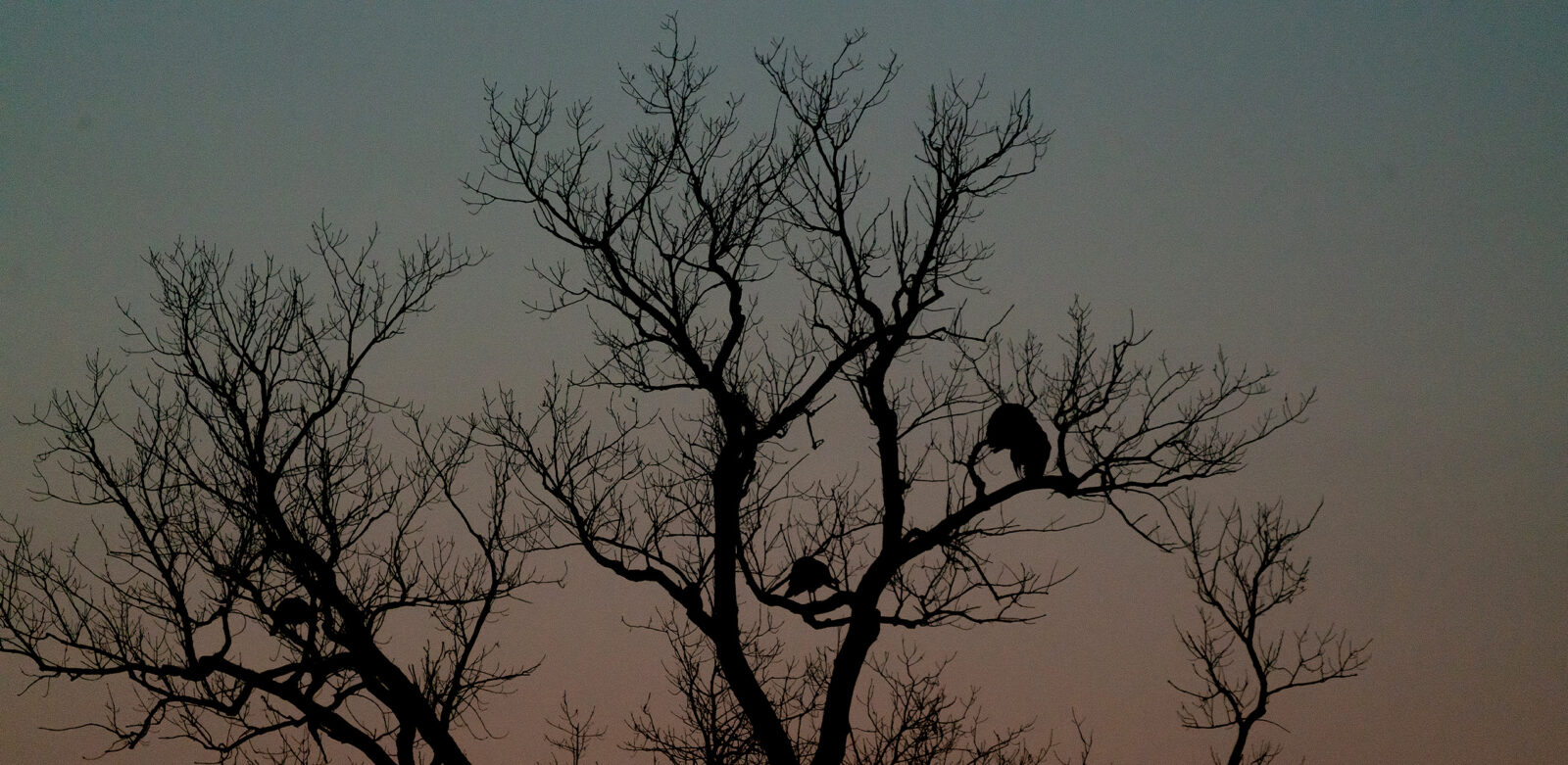
It’s right before sunup, and it’s early. You think you know where a turkey spent the night on the roost, and you hear him gobble. There’s a lot going through your mind at that point. Early in the season, no matter where you are, the foliage isn’t out yet, and cover is thin. That means two things: you can hear him from much farther away than you could later in April or May, and he can see you much more easily. A turkey has incredible eyesight, and if he’s a hundred feet up in a tree looking down, you have to think about things like where you parked your truck and whether he can see it. I always err on the side of staying too far away because your chances are better.
Some people will say if you can get within a hundred yards and get inside that bubble, more power to you. That’s hard to do early in the season when there aren’t many leaves out, and all the dead leaves are on the ground. You’re going to make noise trying to get in close. If you spook him by pushing too close, your hunt is probably over unless there are multiple turkeys around. Because of that, I prefer to stay back and let things develop.
I also like to see if a turkey will sound off on his own. I’ll give it a few minutes, then use an owl hooter or a crow call to make him gobble. Getting a turkey to sound off while he’s still on the roost is a big deal. If you do that two or three mornings in a row and eventually kill him, you’ll start to learn which direction he leaves the roost. That’s where day three, four, or five really comes together. The roost is one of the most exciting parts of turkey hunting. If you mess it up, keep your chin up—every minute that goes by still has the potential to be magic.
Things change over the course of the spring season. Turkeys may use an area for a few days and then disappear. The most consistency I see is late in the season, when hens have established nesting areas. At that point, turkeys tend to roost in the same places instead of moving around. There may be an old gobbler or two with them, and those birds will often roost in the same spot night after night. Late-season turkeys like that are important to pattern and can be very good birds to hunt.
Always pay attention and make mental notes. If you hunt a turkey at daylight and he beats you, that’s often the one you should go back after. If you didn’t say much to him and learned something from the encounter, go back the very next morning and hunt him again using what you learned.
6.2: After Fly Down
We’re going to talk about what happens after fly-down. Let’s assume you found a turkey on the roost, didn’t get too close, and listened while you were set up. Maybe you heard him a lot, maybe you didn’t. Then all of a sudden the woods go quiet. A lot of things start running through your mind—you think you got too close, he didn’t like your tree yelp, he didn’t like your box call. Ninety-nine times out of a hundred, none of that is true. They’re just doing what turkeys do every day. The hens call the shots. He flew down with his hens because he could hear them, they got together, and now they’re moving through the woods.
In my opinion, this is universal. No matter where you hunt—Florida, California, Texas, Tennessee—there is almost always a lull after fly-down. It’s very rare to hear a turkey keep gobbling nonstop after that. He gobbles to call hens to him, and once they’re with him, he has no reason to gobble, so he usually won’t.
After fly-down, your best weapon is patience. If you think you know which direction they went and they didn’t come by you, don’t just charge in there. Make a big circle, sit down, and kill some time. Around 9:30 or 10 o’clock, things can start getting good again. If he’s been breeding hens and they start leaving—maybe a hen goes to sit on a nest—he may suddenly find himself alone. That’s when calling becomes very effective. That’s when his window opens.
So after fly-down, remember two things. First, there’s going to be a lull—be patient and don’t run turkeys off by chasing them. Second, stay determined. Keep hunting, use a good locator call, and be ready. Chances are, if it’s going to happen, it’s going to happen after fly-down.
6.3: On a Hot Turkey
So the first thing you need to consider when hunting turkeys early in the morning on the roost is getting a sense of what that turkey is doing. By that, I mean judging his “temperature.” When a turkey is gobbling on the roost, pay attention to how often he’s gobbling. If he’s gobbling every ten or fifteen seconds, I consider that a pretty hot turkey. Hot means he’s fired up, actively seeking hens, or possibly already around hens and trying to assemble his flock.
Remember, we’re taking on the role of a hen. We’re trying to be another hen in the woods and show our availability by carrying on a conversation with him. If he’s gobbling back and I feel like his temperature is climbing, I’m not going to do anything to slow that down. I’ll pour it on him and try to get him even more fired up. If I hear multiple turkeys gobbling, that’s a great opportunity to be aggressive. Early in the season, when multiple gobblers are together, they’re still jockeying for position. You can often get them fired up against each other and create a situation where it almost becomes a race to you. That said, every turkey is different and every situation is different, and you have to learn your way through each interaction.
When people talk about a hot turkey, they’re usually talking about a gobbler that’s by himself with a high hormone level. He’s passionate, ready to breed, and actively looking. Often, that turkey isn’t lonely—he’s a heavily breeding bird that just doesn’t have a hen with him at that moment. He may already know the hens around him and knows they aren’t receptive, so he’s looking for something new. Those turkeys will often cut you off when you call and may already be closing the distance within a gobble or two.
That said, not every turkey that cuts you off is coming in. I’ve had plenty cut me off repeatedly and never take a step. There’s really no way to know for sure. Because of that, it’s smart to stay put. I don’t want to risk bumping a turkey. I’d rather let him walk off and have a smaller chance of killing him than bump him and make him ten times harder to kill the next time.
6.4: Henned-Up Gobbler
We’re talking turkey hunting tactics, specifically henned-up turkeys. Henned-up simply means a gobbler has all his hens with him, especially early in the season. At that point, he’s the boss of the flock, and his focus is on breeding those hens. Sometimes that process takes a while, so you may see a gobbler with five, ten, or even twenty hens. That’s a tough situation to deal with.
There is no magic call for a henned-up turkey. Woodsmanship matters more than calling. You may have watched them for several days and learned which direction they drift from the roost, but calling a gobbler away from a flock of hens is unlikely. There are no absolutes, but henned-up means he has all his girlfriends around him and has little to no interest in another hen.
If you’re lucky and patient, you can keep track of that flock. Maybe not that day, the next day, or even the first week, but as hens start drifting off earlier after fly-down, knowing the geography helps. If a gobbler is henned-up in a field and won’t come to you, you’re not alone. Henned-up turkeys are tough.
Any turkey, anywhere—even ones that have never been hunted—can be extremely difficult to call when they have hens. You’re just another hen to them. Hunters often get caught up in yelping to make one gobble, then he quits gobbling and they assume he’s leaving. He might actually be coming in. Don’t get bored and overdo it. Sometimes all you need to do is let things play out.
Look for opportunities when hens start leaving him. A turkey that’s hard to call isn’t necessarily a bad turkey. Most of the time, the issue is simply that there are too many hens around him. Hens have been pressured and shot out of flocks over the years, and they may even pull him away or leave when they hear too much calling.
The main point is simple: don’t overdo it, and be really patient.
6.5: Field Turkeys
Some turkeys will fly down and spend all day in the woods, while others may spend all day in a field. Some will fly off the roost into a field and fly back up to roost without ever leaving it. Typically, a turkey that stays out in a field is harder to hunt unless you’re using a decoy. They can see where you’re calling from and don’t have to move any closer, so they’ll often just wait on you.
Field turkeys can be hunted more effectively once foliage is on the trees. With leaves out, you can move along the edges of the field and use natural cover to maneuver. If you can watch them and see which direction they’re headed, you may be able to get around and call from a place they’re already moving toward. There are different ways to hunt field turkeys, and it depends a lot on the situation.
The term “field turkey” is broad. Is it a two-acre field or a fifty-acre field? Size matters. In a large field, I’d be very careful about getting right on the edge and doing a lot of calling. I’ve rarely seen that work unless it’s just an unusual turkey. Even in smaller fields, I don’t like crawling right up to the edge and calling. The same goes for riverbanks. Instead, set up far enough back—maybe thirty yards or more—so that if the turkey steps into the woods or comes to the edge, you’re in range.
If you get right on the edge of the field, the turkey can easily pinpoint where the sound is coming from, look over, and decide there’s nothing there worth coming closer to. Treat every turkey like it’s the only one you have to hunt. If he’s a field turkey with only one or two hens, or maybe none at all, I’d ease up, sit with him, and keep my mouth shut for a while to see what happens.
If you stay with a turkey long enough and haven’t overcalled, you may get a window of opportunity. He might be strutting and gobbling, then the hens slip away, and suddenly he’s ready. Or he may start gobbling out of the blue, signaling he’s looking for company. If you’ve already done too much calling, that opportunity may not work in your favor.
If you get to a field and start trying to work a turkey, be careful. Don’t rush to the edge, and if he doesn’t come right in, back off a little. Stay patient. Field turkeys will often give you a small window when they’re vulnerable, and patience is what lets you take advantage of it.
6.6: When Not To Call
When to call is a tough question because every turkey is different. You have to approach each turkey differently, just like every person is different. Personalities vary, and pressure plays a big role. On heavily pressured public land, you generally don’t want to call as much. If you’re hunting turkeys that haven’t been hunted much, you can usually be more aggressive. Every situation is different, so you have to listen, pay attention, and let the turkey dictate how much or how little you call. If he’s responding aggressively, you might call more. If he’s not gobbling much or you know he’s been pressured, it may be better to yelp less and rely more on soft sounds like scratching in the leaves or subtle turkey noises.
There isn’t a clear, one-size-fits-all answer. Many really successful turkey hunters follow a simple philosophy: use as few calls as possible to kill the turkey. They call sparingly and wait for the right moment, then pour it on when it matters. For me, if I call to a turkey and he cuts me off, I’ll wait a bit and call again. If he cuts me off again and then later goes quiet, I won’t panic, but I also won’t keep yelping nonstop. That might be when I switch to softer yelps, clucks, or subtle calls. If things start getting too excited or aggressive, I’m often thinking in the back of my mind that it may not work out.
If you’re watching a turkey, especially a field turkey, pay attention to what’s actually happening. Many times, what’s really going on is that a hen has his attention. She may be close, or he may even be breeding her. In those situations, calling usually won’t get much response. Often, once a turkey goes quiet for a while, the best move is patience. If you wait long enough, he may gobble on his own again. And if he leaves during that time, he was probably going to leave anyway. Getting quiet didn’t run him off.
The bottom line is to be patient, stay observant, and let the turkey tell you when to call.
6.7: Barriers, Shock Gobbles, and Midday Hunting
So you’ve got a turkey that’s hung up, and you think there’s a barrier. Barriers can be a lot of different things. People usually think of creeks, ditches, or barbed-wire fences, but it can also be a fallen log or something subtle. That’s one reason I keep my binoculars up when I’m turkey hunting. I keep them snug so I don’t have to make a big movement. If you’re lucky enough to see what the barrier is, the fix can be simple. If he’s reached a point and won’t come any farther, shut up and let him ease away. That’s easy if you can see him. If you can’t, your mind starts racing, wondering what stopped him.
If a turkey comes to a certain spot and won’t move any farther, give it time. There’s no set time limit, but if you don’t hear drumming, clucks, yelps, or any turkey sounds for a while, ease in that direction. You’ll often find what held him up. Once you identify the obstruction, get far enough away that he doesn’t think the sound is coming from the same spot. Move to one side of it, maybe 100 or even 200 yards, and try again. Sometimes you can fool him the second time.
When I try to strike one again, I like to use a loud call. I often do it with a tube call, but you can use anything. I’ll hit two or three sharp, really loud notes to pierce the air and trigger a shock gobble. The key is being ready. I don’t walk along ridges or field edges, blowing on a call. I ease into a spot where I know the sound will carry and where I could sit down immediately if I get a response. Good shade and good back cover matter before you ever make that call.
I personally like using a loud cut or sharp turkey sound because I think it provokes more gobbles, but there are no absolutes. Middle-of-the-day hunting is different. Your chances of calling a turkey in after striking him are often better midday than early in the morning. Afternoon success depends a lot on terrain. In wide-open areas, I try to stay near thickets or cover and rely less on calling. I’ll stop, call sparingly, be patient, and keep my eyes open. Then I may move again.
One of the most overlooked parts of midday hunting is terrain. What the land looks like often dictates what you should try more than anything else.
Learn more about the onX Elite Membership.
Don't have an account?