Duck Migration Report
We spoke with Dr. Scott Stephens, Senior Director of Prairie and Boreal Conservation Strategy at Ducks Unlimited, to help make sense of what duck hunters can expect this season.
What Hunters Can Expect in 2026-27
- Fewer breeding ducks, a bigger fall flight: The May count is down. Production was better. Both are true.
- More young birds, which means friendlier birds: The best news for this coming season.
- Canada gained water; the U.S. prairies lost it: The wettest ground is a belt in central Saskatchewan.
- Mallards are the worry: 5.9 million, the lowest count since 1993.
- Watch the freeze-up north of you, not the calendar: Dr. Stephens tells you exactly what to look for below.
According to the Migratory Bird Hunting Activity and Harvest Report released in September, hunters took about 14.9 million ducks and 3.7 million geese in the 2025-26 season, both up around 4% over the year before.
The 2026 Waterfowl Breeding Population and Habitat Survey puts total breeding ducks at 33.4 million, about 6% below the long-term average and close to last year’s 33.9 million. Mallards came in at 5.9 million, down 11% and the lowest since 1993. May ponds rose 14%, but every bit of that gain was Canadian: prairie Canada up 29%, the U.S. prairies down 10%. On the regs side, a three-pintail bag is expected for 2027-28 under the interim pintail harvest strategy, and Atlantic Flyway hunters move to a three-mallard bag.
A down count is not a down season. The May survey counts the birds that came back, not the ducklings they are about to produce, and Stephens starts there. “The May numbers are down, but because we saw some of that increase in the Canadian prairies primarily, we expect production to probably be better than it was last year,” Stephens says. “I would say it’s not going to be phenomenal, because even though things improved in Canada, there’s still a bunch of areas that are dry.”
The wettest ground he named is worth circling on a map. “There’s especially an area between Saskatoon and Yorkton, Saskatchewan—we would call that Parkland region—that got really wet,” Stephens says. “There were roads flooded this spring when the snow ran off. And so that belt is going to have good production.”
That production shows up as juveniles, which is the part hunters feel. “They’re less experienced. They’ve not played the game before. They’re a little more naive,” he says. “So they’re more susceptible to decoys and those kind of things.” Last year ran the other way, and Stephens says you could hear it from hunters: “Oh, the birds were stale and they just didn’t work well and they weren’t cooperative and they were a pain.”
And if you’ve spent a few seasons convinced there aren’t as many ducks as there used to be, the data agrees. “If you anchor to when we had the last peaks in populations, it was about a decade ago, 2015 or ’16 depending on the species that you pick, but for mallards it was like we had twice the birds that we have now,” Stephens says. Recovery takes more than one wet spring, and a strong El Niño forecast means drier prairies ahead.
That volatility is the prairie’s signature. Boreal and tundra numbers grind along with far less variation, which is why a wet prairie spring is the only thing that produces a genuine boom.
“If we lost the prairies, the variation in duck populations would be a lot smaller,” Stephens says. “The question about what are things going to be like this year, the answer would be easy. It’s pretty similar to last year because it just doesn’t change that much.”
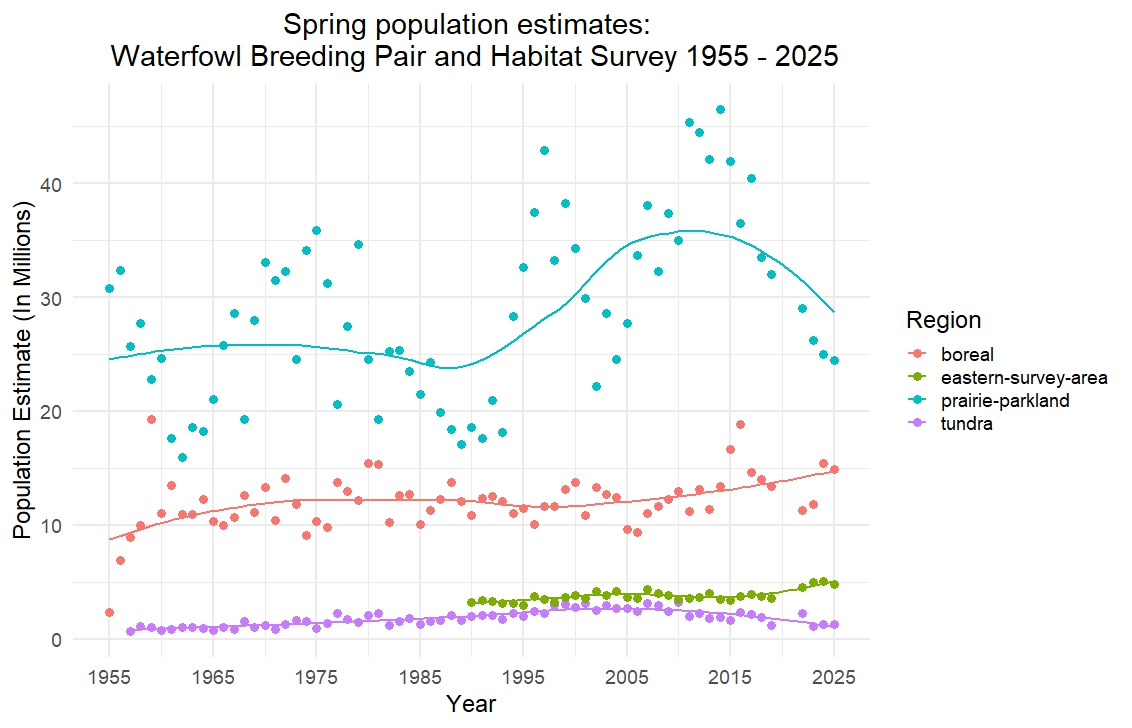
Spring breeding population estimates by region, 1955 to 2025, from the Waterfowl Breeding Population and Habitat Survey. The prairie-parkland line shows the boom-and-bust cycle that drives the continental duck count, peaking above 45 million in the early 2010s and falling to roughly 25 million by 2025. The eastern survey area begins in 1990, when that region was first surveyed. Graphic courtesy of Ducks Unlimited.
Your Flyway in 2026-27
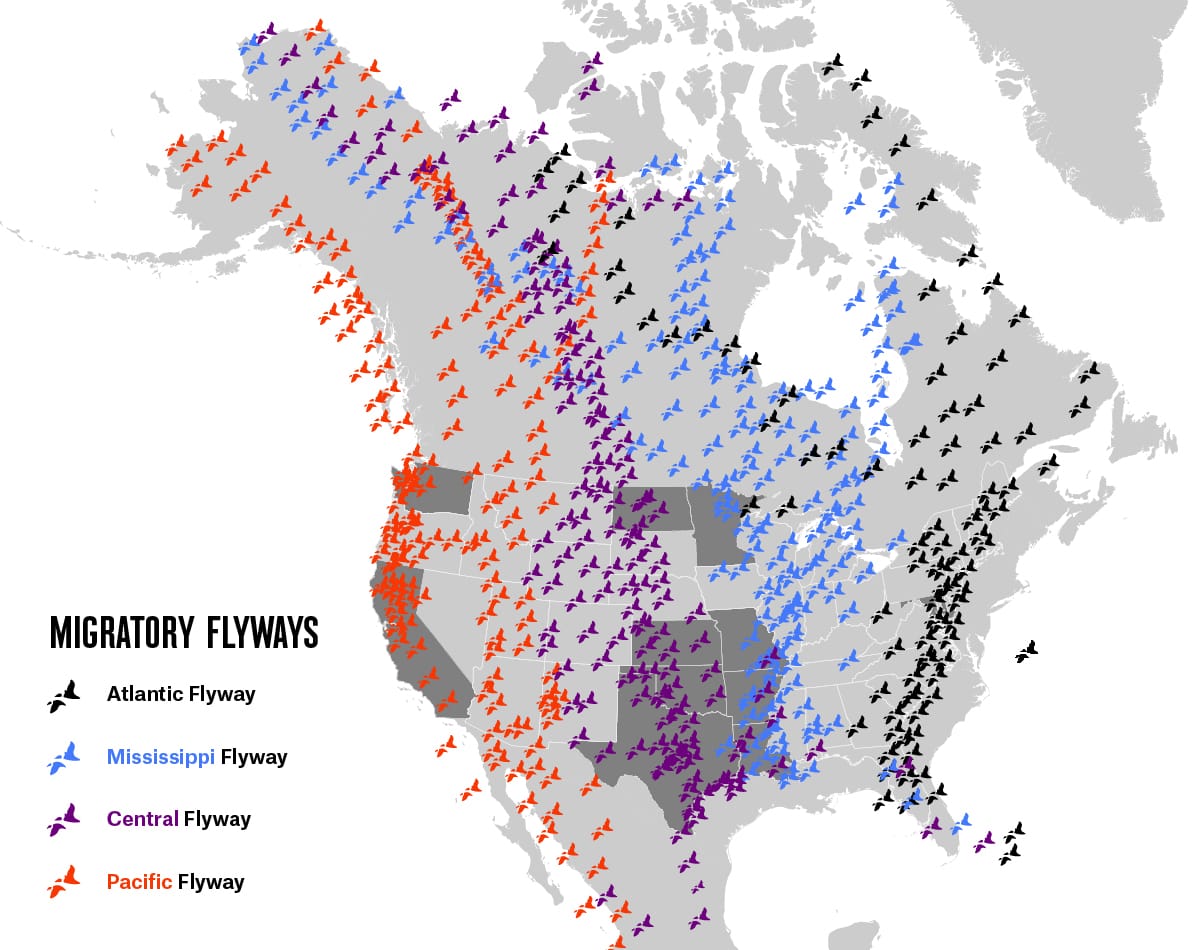
National numbers don’t tell you what’s happening in your corridor. Habitat details below come from the USFWS field reports written by the pilot-biologists who flew this country in May and June.
Central Flyway
The best water and the driest ground in one flyway. “Central Flyway, I think we’ll see most of the benefit of that wetness in Saskatchewan,” Stephens says, and that flooded Parkland belt feeds this corridor. South of the border, crews flying Montana and the western Dakotas logged the eighth-driest winter on record.
Stephens lives in Rapid City and didn’t soften it. “I can tell you in eastern South Dakota it is super dry,” he says. “You’re going to be finding kind of permanent water to hunt. Birds are not likely to stop and spend a bunch of time there, because resources are going to be hard to come by.”
Mississippi Flyway
A step behind Central. “Because it was somewhat drier in Manitoba and in the Dakotas, the Mississippi Flyway may not see as much benefit as Central,” Stephens says. Crews in the eastern Dakotas found below-average water from Lake Andes through Aberdeen, with the Missouri Coteau good and the Drift Prairie fair. Serviceable rather than strong.
Pacific Flyway
Good water up north, thinner production. The wetness landed in central Saskatchewan, not the western prairies feeding the Pacific Flyway, so Stephens expects production there to be lower. Farther north, Alaska and the Yukon saw spring melt fill lowland wetlands, and the Northwest Territories came in markedly improved after two poor years.
Atlantic Flyway
The quiet winner. Crews flying southern Ontario and Quebec found beaver-dam wetlands full or nearly full and reservoirs near capacity, with northern Quebec rated excellent. Pair that with the new three-mallard bag, and the Atlantic Flyway looks better than the national headline suggests.