Choosing and Training Hunting Dogs
Gain insights from three waterfowl dog experts on what to look for in a working dog and how to approach puppy training.
Meet the Experts
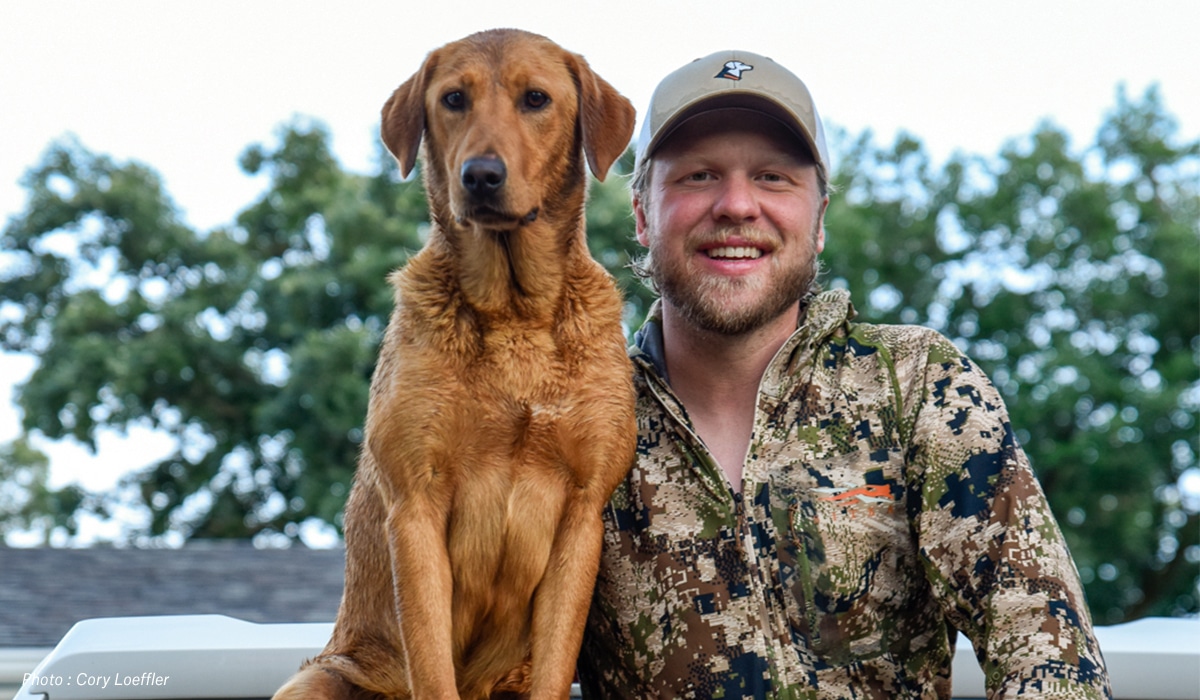
Cory Loeffler has been a full-time waterfowl call maker for the past 14 years. With his family and Labs, he hunts geese and ducks and focuses on producing well-rounded dogs that can go from field to family.
Bill Gibson is the Kennel Master at Mossy Oak Kennels in West Point, Mississippi. Specializing in breeding British Labrador Retrievers for hunting, Bill has a strong background in working dog tests in the United Kingdom and the Republic of Ireland.
Mike Fortner grew up hunting around Pointers, Setters, Beagles, and Coonhounds, then became a “Lab guy.” When his search for a versatile dog led him to the Deutsch Drahthaar in 2004, he “never looked back.” He owns Dilmunfast Drahthaars, focusing on producing dogs of character and confidence, ready to become part of the owner’s family.
What To Look For in a Puppy
Fortner on finding the right breed: “The number one thing I would tell someone interested in hunting with dogs is to find a breed that suits both your temperament and your intended uses. If you are a super intense, Type-A person, you probably won’t do well with a Small Münsterländer; likewise, if you don’t have a strong personality, you have no business with a Drahthaar.
“Don’t pick a hunting dog breed just because it’s the new fad or you ‘just want something different.’ Remember that the duck dog you buy is going to be a pet for at least 300 days a year; you have to like him and he has to be someone you can live with. Be realistic and be honest with yourself.”
Gibson on bloodlines: “Look for a puppy that comes from a good line of hunting Labs. You can’t build a nose in. You’ve got to have a dog genetically capable of using that nose; a nose genetically built over generations to hunt. If you go buy a dog not genetically predisposed to retrieve, you can’t put predisposition in; the dog’s got to have that.”
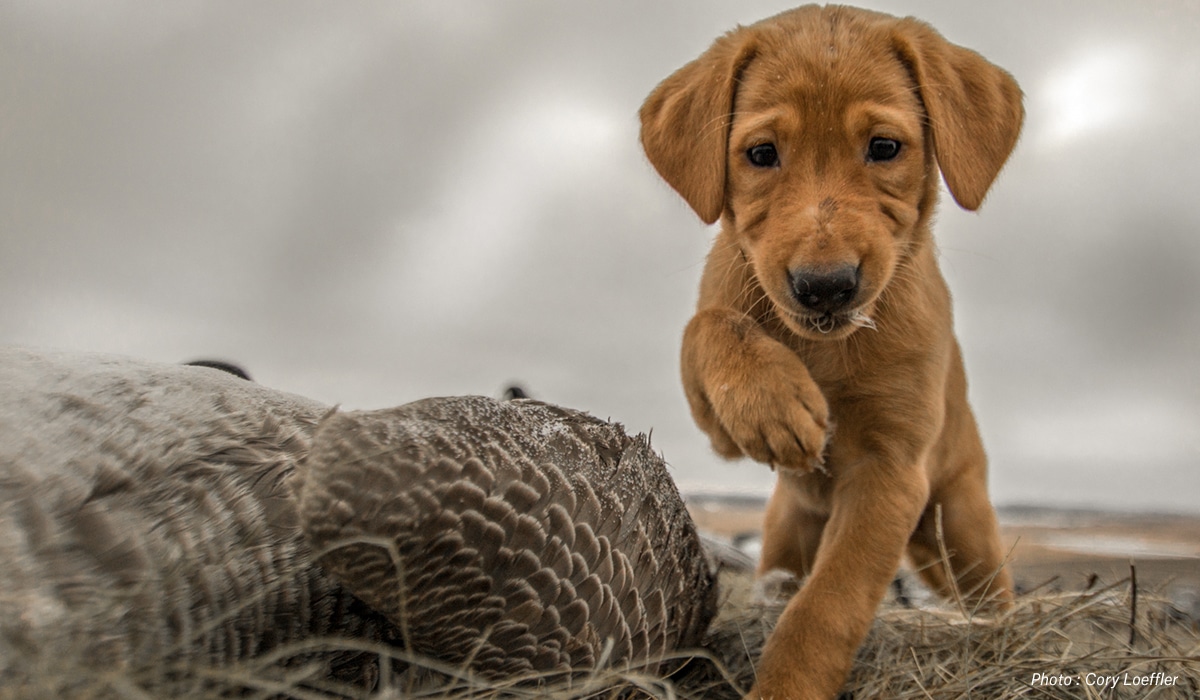
On puppy pick day, Gibson looks for puppies with a “medium” tail position, believing that if the tail is carried too high, the pup will be too dominant. Tail carriage that’s too low can mark a submissive pup. He also looks for lip licking: if he calls a puppy over, speaks kindly to it, and it licks its lips, this means the dog is trainable. He likes it when a puppy comes up, then sits and stares—this is an indication that puppy likes him and the stare demonstrates focus.
Loeffler on paperwork: “Seeing the puppy and interacting with it is probably my least important criteria or category; as long as everything else checks out, I know with training everything else will fall into place.”
His criteria includes health tests (hips, elbows, eyes, and genetic testing), parentage and pedigree to see where puppies came from, and titles and health tests that ancestors have earned. He uses Hunting Lab Pedigree, a user-submission-based site, to search males, females, stud dogs, litters, and other user-submitted information. “It’s super helpful, interactive, and free,” he said.
Training Programs and Pack Dynamics
Loeffler says, “If you follow [Bill Hillmann’s training] program to the letter, you’ll come out with an amazing six-month-old dog.” For Loeffler, the key to success is speaking the dog’s language in a way they’ll understand. “Dogs are domesticated wolves, so they have a pack mentality. A good family/pack structure has very defined roles from the alpha male, to the alpha female, down to the subordinate—the kids, the up-and-comers. They know where they fit in, know what their job is. There’s no question about it.”
He adds that what humans think dogs want is, in fact, sometimes a skewed perception of that pack structure.
“They [owners] treat dogs like human babies, and that’s how you create a problem dog. The owner is sometimes trying to discipline it, sometimes talking and treating it like a baby…the dog’s confused about its role. This makes the human weak in the dog’s eyes, so the dog then puts themselves above the human in the hierarchy. If you let the dog make decisions at home, who knows what that dog’s decision-making skills are going to be. We want humans making the decisions, not the dogs.”
Loeffler also recommends Tim and Lauren Springer’s Dynamic DIY Program for hunting dog owners wanting to train themselves alongside their dogs. The interactive training program provides users with a drill; the owner then videos themselves and their dog performing the drill and submits the video to the Springers for grading. Once the drill is marked with a passing grade, another drill is supplied via email.
Positive Reinforcement and Consistency
Loeffler is a firm believer in treat training as a positive, effective method of training young hunting dogs.
“Treat training at that young age is effective because you have something the dog wants. The dog should realize that give-and-take connection, and once dogs figure that out, their behavior changes from zero to 100. The better you are with timing in the treat training process, the faster they make that connection. As you get past one step, you can move onto the next one. The process goes in stride as owners move on to enhancing some of the dog’s natural abilities: enhancing retrieve drive for retrievers, introducing fetch and basic commands, and more.”
Then, move on to a check cord/lead, which gives you control over the dog so no matter where the dog’s head is, you can coax or reel them in; make it seem like it’s their idea to come back to you, bringing the bumper or toy. If you praise the dog when it comes in 100% of the time as a young puppy, that dog will never know a world that’s any different—they’ll never know another option. You get the bumper and you bring it back, and that’s the only thing they’ve ever done.”
The “100% of the time” factor is an important one, Loeffler emphasizes.
“A lot of people fail to realize that; a lot fail to respect the ‘100% of the time.’ You can’t really round it up; it doesn’t work that way.” The dog should know nothing different—there is no known world in which they don’t return when bid.
“It’s kind of like that old saying, ‘When I say jump, you say how high,’” he adds. “When all the steps are done right, when the dogs view and respect you as the pack leader, when they look to you for direction, I think that’s the perfect world. Creating that bond starts at a very early age, and continues on in giving them support in the right way; creating the total package that’s this retriever.”

Avoiding Common Pitfalls
Gibson believes training doesn’t simply stop at the dog. “Two things [need] to be trained: the dog and the owner, and the most difficult is the owner. We like the owner to come down as often as they can during the hunting dog training process.”
Fortner sees new dog owners make the mistake of relying on crowd-sourced advice.
“I see two mistakes commonly made by both experienced and inexperienced dog handlers,” he shares. “First, they ask questions of and seek advice from the internet—message boards and, in particular, Facebook. Most of the time, you do not know who you are talking to, or if that person really knows what they are talking about.
“The second mistake is that we unconsciously train our dogs to develop bad habits and bad canine manners. When you go pick up your puppy from the kennel, all the cute little pups are jumping up on the kennel fence clamoring for attention. Who can resist those cute furry faces? We just instinctively reach down and pet the pup. What just happened? The puppy just learned that by jumping up, he will be rewarded with attention from a human. Pups should only be petted or otherwise rewarded when they are sitting calmly or performing some other desired behavior. Don’t unconsciously reward undesired behavior.”
Fortner adds that this unconscious-trained behavior also translates into the duck blind and hunting retriever. When you are playing and informally training your dog in the backyard by tossing bumpers for him to retrieve, most of us will hype up the dog and let him chase and retrieve every bumper. The lesson learned? First, that retrieving is an exciting task. (Maybe in the field trial, but not in the duck blind). The dog has learned that every bumper or duck is his and his alone to go get. This leads to steadiness issues in the pit with the dog breaking at the sound of the gun or ducks falling. The better tactic is to allow the dog to retrieve every second or third bumper thrown, and only after being released or commanded to fetch.
“The behaviors are easy to train in the new pup, but once the undesired behaviors have been ingrained into the dog’s mind, they are hard to unlearn,” he notes. “Dogs are masters at nonverbal communication. They watch you and they pattern you. This means that dog training never stops. It’s not just the 30 minutes you spend with formal training in the backyard, it’s a 24-hour-a-day commitment.”
One of the most frequent questions Loeffler gets is about dogs who are eight to 12 weeks old, whose biting starts getting a bit more aggressive and beyond the puppy-play biting.
“One way I deter puppies from biting is when they come to bite, I’ll roll their gum under their tooth to replicate a bite (first time pretty light, and later slightly harder),” he notes. “People try to be too soft on the puppies—you don’t want to be too hard; you want to maintain love and trust, but you can’t let them get away with all the BS they’re going to try. Give ‘em an inch and they’ll take a mile. Get respect from an early age in a very humane way that they understand, like their mom grabbing by their throat and flipping over puppies. Immediately you see a change to a calm, submissive state in the puppy.”