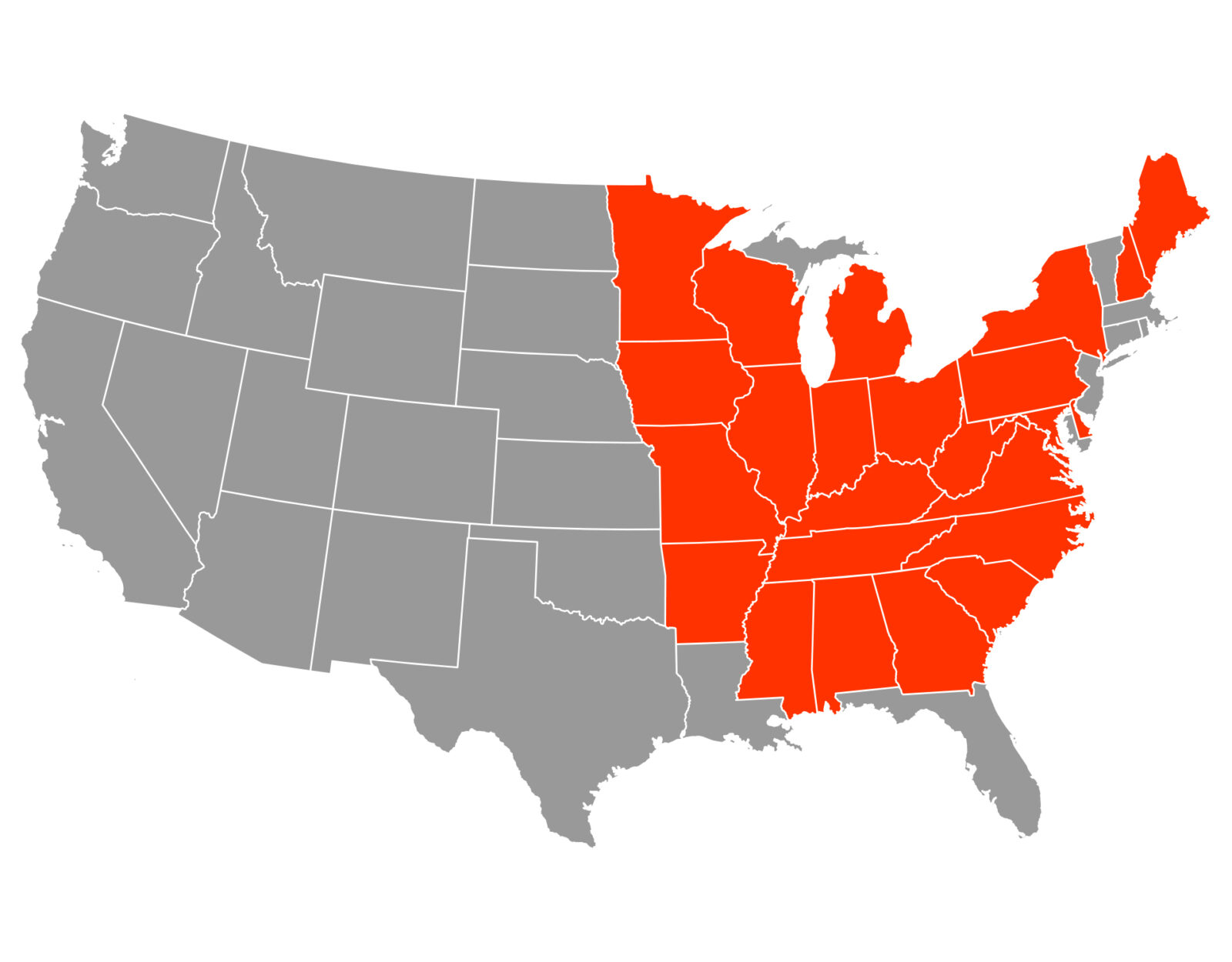
Where To Hunt Easterns
See the best eastern turkey hunting states and get local intel.
Alabama
At one point, Alabama was believed to have one of the best turkey populations per capita in the country. These days, things are different. Due to a suite of factors, the population has seen a large enough decline to cause concern. Government agencies have made changes to the spring season framework and seasonal bag limit. However, Alabama does still have a huntable population. Just don’t go down there expecting to find a gobbling turkey on every ridge or in every hardwood bottom.
Local Intel: Mossy Oak’s David Hawley
“With a season that starts in late March, Alabama is a popular destination for hunters looking to get a jump on their season and tangle with some of the most-pressured and seemingly-evil birds in the country. With terrain that spans from swamps along the state’s expansive river systems to the prairies of the famed Black Belt region in the center of the state and into the foothills of the Appalachian Mountains, doing battle with Alabama turkeys will test your skill and your shoe leather.
“While 92% of Alabama is privately held, large public land areas abound through the state, including the Talladega National Forest in northeast and central Alabama, and Barbour Wildlife Management Area (WMA) in east Alabama. Due to the popularity of the sport in Alabama, be prepared to arrive early and do plenty of walking to beat the crowd.”
Arkansas
Arkansas turkeys are struggling. Declining flock populations, reported poaching, and management concerns are proving to be real challenges for turkey hunting here. However, Arkansas offers more than three million acres of public land, and if you are fortunate enough to pull a draw for one of the coveted WMAs, then you can find yourself having a quality hunt.
Even without the draw, tags for the state’s two turkey zones (formerly there were 18 zones) can get you in the game. Arkansas allows for a statewide bag limit of two turkeys, but no bearded hens or jakes are allowed (unless you’re 6 to 15 years old, for the latter). Hunters are also only allowed one of their turkeys to be taken during the first seven days of the season, and the limit of two cannot be taken on the same day.
Local Intel: Split Reed’s Cade Trickey
“Arkansas is far from what most turkey hunters consider a dream destination, and for good reason. Over the last decade, Arkansas has been the ‘poster child’ state for declining turkey populations. Everyone seems to have their opinion on why we have seen a decline, but there is certainly no clear cut answer for what we are seeing happen to the wild turkey.
“Despite declining populations, the Natural State offers some of the most beautiful scenery and habitat you can find on any spring morning. The state is split in half with the Mississippi Alluvial Plain in the eastern region and the Ouachita and Ozark Mountain ranges in the northern and western regions.
“The delta has nearly nothing to offer a turkey hunter with its fluctuating river levels that are sure to flood the bottomland timber each spring. However, the Ouachita and Ozark Mountain ranges offer national forest lands that the eastern wild turkey claims home. Steep and rugged hardwood mountains with clear running streams between are what you can expect to put your boots on.” It is no walk in the park to tackle an Arkansas public land gobbler; however, if you’re willing to put the time in and find one, he is capable of giving you everything you could ever want out of a spring turkey hunt.”
Delaware
Since the mid-1980s, Delaware’s wild turkey population has been on the mend, providing today’s turkey hunters valuable opportunities at an eastern gobbler. Delaware’s mix of farmlands, woodlands, and wetlands offers excellent turkey hunting chances through a variety of setups. Delaware also has public land opportunities through several state forests and at least one state park.
Local Intel: Mossy Oak’s Jason Hart
“A total of 801 wild turkeys were harvested during the 2025 season, ranking as the highest harvested in Delaware since the season opened in 1991. The previous high was in 2023 when 723 turkeys were harvested. Most wild turkeys harvested in 2025 were taken from private lands, though a record number, 171 birds, were harvested on public lands.
“A permit is needed to hunt turkey on public lands in Delaware and with the “Chasing 49” phenomenon becoming more popular, the permit lottery is becoming more competitive. Applications for public land hunting in Delaware are due in early January, but if you are successful in drawing, the state offers some incredible public land opportunities.
“Before hunting turkeys in Delaware for the first time, all hunters age 13 and older must complete a mandatory turkey education course. If you are new to the area, the turkey terrain in Delaware is much like the eastern Shore of Maryland: Coastal Plain: flat land, with lots of agriculture and mixed hardwood pine stands.”
Georgia
Georgia has been home to many diehard turkey hunters, especially boasting over 3.6 million acres of public land, a million of which are designated WMAs spread over 90 different properties. You can chase turkeys here in a variety of terrain, from flatland pinewoods and swamplands to red clay farmlands or among the Appalachian Mountains.
Like many other states, Georgia is taking precautions to protect its turkey population, which is showing substantial declines. The bag limit has been scaled back to two turkeys, and the opening date has been moved to one to two weeks later, depending on whether you’re hunting on a WMA or not.
Local Intel: Hunt Club TV’s Phillip Culpepper
“A Georgia turkey has been rumored to be one of the ‘toughest’ turkeys to bag. However, there are still places in Georgia that are incredible turkey hunting honey holes. There are several WMA’s scattered across the state that are loaded. It may take a year or two to draw an opportunity to hunt, but it is well worth the wait.
“Depending on what type of terrain you want, Georgia really has it all. With huge agricultural fields covering South Georgia, there’s a pretty good chance you spot a strutter in a field to go after. Middle Georgia is covered with more rolling hardwoods and ‘food plot’ scenarios. Great terrain to run-and-gun on. When the time is right and birds are responding to calls, that part of the country is an exciting spot to hunt. Finally, if you are wanting to test your lungs and endurance, head up to North Georgia and get after a ‘mountain bird.’ The thighs on these birds are that of a D1 full scholarship running back. Hunting the hill country can be frustrating and tough, but so rewarding when it comes together.”
Illinois
Illinois has a series of lottery draws for resident and non-resident hunters. Residents can apply for all three lotteries; while non-residents can only apply for Lottery 2 and Lottery 3, which both have later application dates. If, by chance, there are still leftover tags after Lottery 3, county-specific permits may be available over-the-counter.
If you do win a permit, Illinois’ turkey populations are faring relatively well. Warm weather there is showing signs of successful nesting and poult observations.
Local Intel: The Hunting Public’s Aaron Warbritton
“A hunter can apply for various seasons, and in the draw you must pick between certain counties. Eastern turkeys can be found all over the state, from flat farm ground up north to rolling timbered hills down south. Both private and public land opportunities exist for those willing to do some homework.”
Iowa
Another state with a drawing system for spring turkey hunts, Iowa’s application period runs throughout January. With season structures that increase in duration as spring goes on, you have to choose your season dates and region of the state versus a season-long, statewide opportunity. The biggest kicker for hunting Iowa is the ~$275 price tag that comes with that single bird for non-residents.
Local Intel: The Hunting Public’s Ted Zangerle
“Eastern turkeys can be found in abundance all over the state. In the northeast portion of the state you will find some steep, rugged hills and as you go south it turns into flatter farmland with river/creek bottoms mixed in throughout. There are lots of good options for hunting public land, and “by permission” ground seems to be somewhat easy to get as well.”
Kentucky
Kentucky’s turkey season is about three weeks long, and about 95% of the land in Kentucky is privately owned. This doesn’t mean there’s no public land in Kentucky. In fact, the public land is terrific for holding turkeys. Routinely, over a half-dozen WMAs in the state net over 40 harvests in a season.
What really sets Kentucky apart from other places is how diverse the terrain is, so you might be calling after mountain birds hidden in the Cumberlands or crossing your fingers a gobbler strutting on agricultural plots moseys your way.
Local Intel: Land and Legacy’s Matt Dye
“Topography can be limiting depending on your access, but try to get set up on the same elevation or ridge line as the bird. But beware, if that doesn’t work out right off the roost, the benches and saddles are other great places to call gobblers into later in the morning.
“If a gobbler hangs up, use the hardwood timber to your advantage. Put your calls down and scratch in the leaves to sound like a hen feeding, this realistic sound has brought many lonely gobblers into range. It’s common to have gobblers ‘periscope’ or barely look over a hardwood ridge in Kentucky when coming to a call, so be ready, that may be the only look they give you.”
Maine
Maine is one of the last in the US to close out its spring turkey season, ending in early June. Only about 18,000 licenses are sold annually in a state with 1.9 million acres of public land. That’s a recipe for long hunts in solitude in these spring woods.
Local Intel: The Hunting Public’s Jake Huebschman
“A large group of us went to Maine to end our spring, as it is one of the two states that allows hunting into the month of June (Michigan being the other). With a lot of the state being timber, we targeted an area that had a mix of agriculture and permanent water sources. Maine is also unique in the fact that you can hunt ‘unposted’ ground. That proved to be important with the warm weather we were faced with being there in early June that reached up into the 80s.
“Gobbling activity for the most part was early in the mornings and late in the day when temps were a little cooler, aside from the occasional hot bird we would find. So having the crop fields to cruise around and locate birds was a huge help and put us in areas we knew had turkeys. Before going onto the unposted ground it is important to try and contact the landowner ahead of time just to avoid any controversy. In our experience as long as you are respectful and honest most people were more than happy to let you hunt and I believe all of us ended up filling our tags on unposted ground.”
Alabama
At one point, Alabama was believed to have one of the best turkey populations per capita in the country. These days, things are different. Due to a suite of factors, the population has seen a large enough decline to cause concern. Government agencies have made changes to the spring season framework and seasonal bag limit. However, Alabama does still have a huntable population. Just don’t go down there expecting to find a gobbling turkey on every ridge or in every hardwood bottom.
Local Intel: Mossy Oak’s David Hawley
“With a season that starts in late March, Alabama is a popular destination for hunters looking to get a jump on their season and tangle with some of the most-pressured and seemingly-evil birds in the country. With terrain that spans from swamps along the state’s expansive river systems to the prairies of the famed Black Belt region in the center of the state and into the foothills of the Appalachian Mountains, doing battle with Alabama turkeys will test your skill and your shoe leather.
“While 92% of Alabama is privately held, large public land areas abound through the state, including the Talladega National Forest in northeast and central Alabama, and Barbour Wildlife Management Area (WMA) in east Alabama. Due to the popularity of the sport in Alabama, be prepared to arrive early and do plenty of walking to beat the crowd.”
Maryland
Maryland stands out for eastern turkey hunting due to its population of about 40,000 birds, successful restoration efforts, and diverse, accessible habitats ranging from western mountain forests to Eastern Shore pine woods. The state offers multiple public land options, high hunting success rates, and varied terrain that attracts hunters, with populations thriving in areas like Green Ridge State Forest and Pocomoke State Forest.
Local Intel: Mossy Oak’s Jason Hart
“Maryland has experienced a rise in turkey populations and now may be evening out to what is considered “normal” levels. Maryland features diverse terrain, with the Eastern Shore beginning on the beaches of the Atlantic Ocean as Coastal Plains to the rolling hills of the Piedmont to the rugged Appalachian Mountains. Turkeys have adapted and are thriving in most environments that Maryland has to offer.
“On the Eastern Shore of Maryland, we have seen a decline in numbers the last few years, but a strong crop of jakes I called up numerous times in 2025 tells me 2026 will be a fun year. In 2025, Maryland hunters harvested 4,851 wild turkeys during the regular and junior turkey seasons. While the 2025 harvest was slightly lower than the 2024 season total of 4,959, it remained well above the 10-year average of 4,350. Garrett County (a mountainous county in the western part of the state) reported the highest harvest with 506 turkeys, followed by Charles County (445) and Washington County (406). Four counties set new harvest records: Cecil, St. Mary’s, Talbot, and Wicomico. Maryland has numerous public land opportunities, including wildlife management areas (WMAs), Maryland state forests, and Maryland state parks. With good reproductive success throughout most of the state the majority of the last five years, Maryland should have another great season in 2026.”
Minnesota
With a one-bird limit there are plenty of gobblers on the landscape and you can buy a tag over the counter, making Minnesota a great state if you failed to plan much in advance. Varied terrain and ample amounts of public ground allow you to hunt as desired, whether sweating your way to the tops of bluffs along the Mississippi River or hunting the vast timber further north.
Local Intel: Shane Simpson Hunting’s Shane Simpson
“The northern third [of the state] provides very little in the way of winter food sources, making it very difficult for turkeys to survive the winter in this region. The southwest part of the state is the complete opposite, in that there are plenty of food sources but little in the way of suitable roost trees and cover, which limits the turkey population in this region to widely distributed pockets of small flocks. Roosting (locating gobblers in the late evening) is a great tactic for locating Minnesota gobblers at last light.
Unlike the heavily pressured turkeys of the southern states, which rarely gobble in the evening, Minnesota gobblers readily gobble to owl and coyote calls before they tucked their head under their wing for the night. The habitat varies greatly among the turkey rich areas of Minnesota, so having multiple types of footwear on hand is advisable.
Minnesota’s spring weather is unpredictable throughout the first half of the season with snow, rain and wind likely on any given day, but the weather patterns stabilize in mid to late May, with most days welcoming hunters with warm, calm and sunny days, so plan your visit accordingly.”
Mississippi
Mississippi is a state one could argue produces more diehard turkey hunters than any other in the country. It’s also a state that is nearly 90% private lands. There are accessible public lands, but they get hunted hard and hunted often.
One of the most enticing factors about hunting Mississippi is that the general season opens March 15 (one of the earliest seasons in the country). This is a double-edged sword. It gives hunters more opportunity, but it also results in turkeys that have seen and heard every trick in the book. Finding success in the turkey woods in this state will require ample scouting, learning how to deal with heavily pressured birds, and in some cases, being too stubborn to give up.
Local Intel: Mossy Oak’s Ronnie ‘Cuz’ Strickland
“If I was going to pay the Magnolia state a visit to turkey hunt I would choose late March or early April. That seems to be the best time as far as catching gobblers that are a bit more responsive. Don’t get me wrong, I won’t miss a single day, early season or not, but those first couple of weeks I’m used to getting my feelings hurt by longbeards that sound off but have no intention of coming in.
“Pack a thermacell and refills, the bugs can and will be terrible at some point. Rubber boots are standard issue here and an absolute necessity. If you’re scared of ol’ ‘no shoulders,’ snake boots are very popular too. Mississippi has all the varieties of venomous snakes and I’m personally scared of all of them. They don’t keep me out of the woods but I’m looking down a lot. Not trying to scare folks away, just saying they can be pretty active when the weather starts to warm up.
“There are plenty of WMAs and other public options in Mississippi that have turkeys, but like any state right now you will have competition. The best place to start your scouting is always online. The MDWFP has a great website with regulations, maps, and great information. You won’t need special calls with a southern drawl, just normal yelpers work fine. Good luck wherever you’re headed this spring.”
Missouri
Missouri’s first ‘modern’ turkey season took place in 1960. It consisted of a 3-day season, 14 counties, 698 hunters, and 94 harvested birds. In present day, every county in the state is involved in the annual spring turkey season. According to records kept by the Missouri Department of Conservation, more than 5,000 eastern wild turkeys that were trapped in Missouri have been translocated to other states and provinces. Although things definitely are not perfect, recent population concerns and increased hunting pressure, for example, Missouri is still a great place to hunt spring turkeys.
Local Intel: Land and Legacy’s Adam Keith
“Spring turkey season in Missouri has a rich history of being one of the top performing states in the country. Unfortunately, due to variables like wet springs, low hatches, loss of habitat, and predation, the population has been in decline across the state.
“If you enjoy the pursuit of turkeys in a more open landscape with crop fields and rolling hills look north of the Missouri River. If you love the view of a hardwood ridge with a thundering gobbler underneath the beauty of flowering dogwood trees, bring your pursuit to the Ozark Mountains. With a landscape dominated by timber through much of the southern portion of the state, it will require scouting with your ears rather than glassing for strutters in the afternoon.”
New Hampshire
New Hampshire boasts over 40,000 birds, and though it’s a small state, it’s close to other great turkey states like Maine and Pennsylvania. New Hampshire also has a unique tradition for land access that can benefit hunters.
According to the New Hampshire Fish and Game Department, “Based on long-standing tradition, nearly all lands in the state of New Hampshire are open to hunting. All state, federal, municipal, county, and private land is open to hunting unless it is posted against hunting. However, hunting is a privilege granted by the landowner—not a right granted to the hunter.”
Local Intel: Close Proximity TV’s Jordan Barnes
“The noon cutoff is normal here and takes some getting used to. It has cost me several opportunities at birds just two or three minutes past the cutoff. Rock walls line the outsides of a lot of habitat there. It is very diversified and made up with thickets, hardwood timber, pastures, and rock-lined farm fields. This makes for great turkey habitat. Plus, I’ve found those rock walls beneficial for sneaking in on gobblers.
“The biggest things I reflect back on today about New Hampshire is probably the importance of using Offline Maps as well as the Line Tool within onX to map your route. ‘No Service’ can be a normal appearance at the top right of your phone there. As a Plan B to the public land option, driving around many miles in loops and door knocking can be a beneficial way to locate pockets of turkeys. Yes, even if it’s not posted you still should stop and ask permission.”
New York
What sets New York apart is habitat diversity. Turkeys thrive in the mix of hardwood forests, agricultural valleys, creek bottoms, and regenerating timber cuts that dominate much of upstate. These edge-rich landscapes create ideal nesting, brood-rearing, and strutting habitat. For hunters, that means classic eastern-style setups: working gobblers along oak ridges at daybreak, intercepting birds moving between fields and timber, or striking mid-morning birds cruising logging roads.
Local Intel: onX’s Jack Flatley
“New York’s spring turkey season runs the entire month of May, regardless of which area of the state you choose to hunt. Despite season and regulation continuity throughout the state, you can break down the Empire State into seven distinct regions: Long Island, Hudson Valley, Catskills, Adirondacks, Central and Western New York, and the North Country.
“Starting from south to north, Long Island historically has not been open to spring turkey hunting until recently. Despite strong bird numbers, extremely limited public access and a dense urban environment makes this region difficult to hunt. Hunters might want to consider hiring an outfitter for the best opportunities. The Hudson Valley and Catskills region present excellent hunting opportunities for hunters from the Tri-State area, with a strong WMA system fueling many opportunities in the Hudson Valley, and state forest and NYC DEP land to explore in the Catskills. Hunters who choose to hunt NYC DEP property should be mindful that they must possess a free DEP access permit to use this land, and not all land is open to public hunting.
“Western New York can be characterized by abundant agriculture and high turkey numbers, but with limited public land. Moving east into central New York, the landscape transitions from agriculture to dense northeast timber. The Adirondacks provide some of the most unique turkey hunting in the state. Three million acres of public forest preserve land provides hunters with abundant acreage to roam on, but densely forested habitat means hunters should not pass up their first shot opportunity. The North Country refers to the region directly north of the Adirondacks, and is made up of dense forests and wetlands, providing excellent edge habitat and cover, and its distance from large population centers means it sees less hunting pressure than other parts of the state.”
North Carolina
North Carolina has a range of suitable turkey habitat, from the Appalachian mountains to the swamps, farmlands, and coastal lowlands. There are ample publicly accessible game lands in the state: About two million acres are open to public hunting.
Local Intel: The Hunting Public’s Hayden Krimmer
“Their season begins in the beginning of April and runs through the first week of May. To hunt turkeys, you will need a general hunting license as well as a big game hunting license. Residents can purchase both licenses for a total of $39, while non-residents can get annual licenses for $200, or 10-day permits for $160. License holders are permitted to harvest two male or bearded turkeys throughout the season, with a daily limit of one turkey.
“The habitat largely consists of steep terrain with numerous creeks running through the bottoms, thick mountain laurel/rhododendron, and a mix of hardwoods with pine. A majority of the forests are very dense, making shot opportunities limited, but also providing ample cover to move in close to birds undetected. Our strategy going into the hunt was to identify multiple high points, both from the road and along access paths, to locate birds in the morning. Our first two days consisted of wet and cold conditions, making birds quiet and hard to find. As the weather improved, so did our luck locating turkeys throughout the day.
“We found that birds would typically roost in the same general area from day to day, but would cover more ground throughout the day than we typically see with eastern turkeys. We found the most success by locating these roost positions and moving in as tight as we could the following days. Another key was always trying to maintain the high ground compared to the turkeys. Both when setting up on a roosted turkey, or closing the distance with one on the ground, being above the gobblers is especially important in steep terrain.”
Ohio
Local Intel: The Hunting Public’s Aaron Warbritton
“Ohio has recently gone to a 1-bird bag limit to stem the tide of low poult production for several consecutive years. Sporadic turkey production over the last 7-8 years makes Ohio a very “hit or miss” state.
“Each year we turkey hunt in Ohio and also engage in habitat improvement projects at the same time. During the first part of turkey season (usually around April 20 – May 1) hunters must stop hunting at noon. This gives us an opportunity to hunt in the morning and work on habitat in the afternoon if conditions are right.
The state is diverse with flat farm land up North to rolling timbered hills in the South. There are pockets of turkeys throughout that can be found with persistence. Turkey hunting pressure is heavy during the first half of the season with it tailing off toward the end. Some vast areas of public land offer a ton of opportunity with less than ideal turkey habitat. This makes the birds and coincidentally the hunters very pocketed. Some actively managed private and public lands exist that have better populations. Hunting permission can sometimes be attained if one is willing to help the landowner with habitat projects on their property. The non-resident permits are around $220 for the hunting license and the single spring turkey permit putting Ohio on the expensive side to hunt vs. other states nearby.”
Pennsylvania
Pennsylvania maintains a healthy and huntable population with an ample amount of public hunting availability, but it also maintains an ample amount of hunters, both resident and non.
Local Intel: Close Proximity TV’s Jordan Barnes
“Where I started, the habitat consisted of a mixture of two main types. Down low in the valleys are giant crop fields and dairy farm operations. Yes, everyone deer hunts and leases those places for the most part and, unsurprisingly, they turkey hunt them too. From the valleys, the elevation gradually rises and eventually makes what a southern flatlander like myself would describe as ‘mountains.’ Other parts of the state are more of a mixture of hilly pastures and hardwood-type habitat that don’t involve large elevation gains.
“My experiences showed that a lot of folks hunt this state. I covered over a dozen public land pieces and some national forest lands. I’m going to give it to you straight: I had a hard time finding a gobbler to hunt. Weekday, weekend, morning, or afternoon, it didn’t matter. I ran into a healthy number of hunters either hunting or scouting. With that said, I ended up finding a gobbler deep into this vast public chunk where few had likely ventured.
“Pack a jacket or two because the weather can be cold there in the spring. Offline Maps were a big help as many places I hunted did not have cell service.”
South Carolina
While the hunting clubs of South Carolina have long, established histories, there are public lands available for every hunter in the form of WMAs and U.S. Forest Service lands. In total, the state’s network of WMAs offers 630,000 acres of access, plus another million acres of public access from the U.S. Forest Service. Add in DNR lands and timber company properties and hunters have another quarter-million acres.
South Carolina’s turkey seasons are divided, with the Piedmont and mountain areas open in April to May, and the coastal plain season running from March into April.
Local Intel: Mossy Oak’s Jason Hart
“From the low-country’s thick swamps, to the midlands’ sandy hills filled with pines, to the upstate’s Blue Ridge Mountain range, a turkey hunter can experience diverse habitat changes in a few hours’ drive.
“For an out-of-state hunter, the South Carolina Department of Natural Resources offers numerous public land opportunities, from the coast to the mountains. Some of these only require a WMA Permit, while others require a lottery draw. For hunters preferring private land, there are outfitters who offer daily hunts in addition to hunting memberships on private land. Much of the state features hunting clubs, which are leased lands shared by numerous individuals. Due to the hunting club history, knocking on doors to gain permission will likely be an uphill battle.
As far as gear and clothing are concerned, the differences in terrain and seasonal weather from the low-country to the upstate may vary greatly. A hunter in the low-country may encounter a day of walking in a snake and mosquito swamp in sweltering heat; an upstate hunter may encounter a day of hiking hills and mountains in potentially sub-freezing temperatures.”
Tennessee
Tennessee has seen many of the same struggles and concerns that have swept across much of the southeast. Notable declines in populations and an over abundance of hunters, especially on public lands, have been at the top of the list of detrimental factors. The state has lowered the season bag limit. The state still maintains a healthy and huntable population. Just don’t travel there for the first time expecting it to be a lay-up.
Local Intel: Catman Outdoors’ Jonathan Boehme
“Some areas are overrun with birds, while other parts of the state seem nearly devoid of turkeys. Harvest data by county and WMA are available online, making it easy to find the most populated, and most heavily hunted, areas of the state.
“Middle Tennessee is well known for its high turkey population and quality public land, and receives some of the heaviest hunting pressure from traveling hunters as well as locals from the greater Nashville area.
“West Tennessee features flatter terrain, more farmland, and a more spotty turkey population. There are pockets of West Tennessee loaded with birds, but also areas with very poor numbers. Turkeys in the Mississippi River bottoms have suffered poor nesting success due to years of flooding.
“East Tennessee is known for its rolling hills and mountains, and vast amounts of public land. Turkey numbers are mostly good, but again, not evenly distributed. The mountains pose a unique challenge, and a means to escape some of the crowds from other hunters if you’re willing to walk the miles.”
Virginia
The George Washington and Jefferson National Forests combine to make up one of the largest areas of public land east of the Mississippi River. As a collected 1.8 million acres that include portions of Virginia, West Virginia, and Kentucky, plus state forests and DWR’s WMAs, a turkey hunter in this state has access to over two million acres total for spring turkey season.
Those who hunt turkey in Virginia see it as one of the best early season hunting opportunities, and at least for now, there’s still up to a three-bird limit and a five-week season.
Local Intel: The Untamed’s Josh Ilderton
“Virginia has an abundance of public land that holds turkeys in the massive forests and timber of the national forests, WMAs, and the Public Access Lands for Sportsmen (PALS) units. There are a lot of access points on Virginia public lands whether you plan on walking, driving, or boating. There are plenty of walking trails to access the ridge lines where you can hunt from the top down. Hunting pressure has increased over the past couple of years, but there are plenty of areas to get away if you’re willing to put the work (walk) in! Non-resident licenses in Virginia are very affordable and worth the cost.”
West Virginia
If you’re heading to West Virginia, you better be ready to put in some effort. Much of the terrain, especially the publicly accessible lands, is filled with deep hollers, steep hills, and creek systems. West Virginia allows two birds during their roughly month-long spring season, but you can only kill one per day. Their 1PM closure in the spring allows ample time for camp camaraderie, trout fishing, or afternoon siestas.
Local Intel: Country Outdoors’ Zachary Phillips
“Start your morning on a high point and take in the beauty that West Virginia has to offer. Keep in mind that the contour of the land drastically affects your hearing. I recommend running the top 10% of a ridge until you strike a turkey and then adjust and try to get at their level.
“While West Virginia isn’t a walk in the park, it is a beautiful place with plenty of opportunity and hardwoods.”
Wisconsin
A few things to note about Wisconsin: first is their December spring turkey application deadline. To get in on the early season, you have to get your name in the hat. If you want to hunt turkeys in May, leftover licenses go on sale on a first-come-first-serve basis in mid-March.
Also, the tag you purchase is only good for a seven-day period and is only good for the specific region in which you purchased it for, not statewide. There is no limit on the number of tags you can buy. But don’t be greedy and shoot five turkeys in Wisconsin just because you can. Respect the opportunity and take notice of what is happening across many states’ turkey populations and work to conserve the excellent turkey hunting Wisconsin offers.
Local Intel: onX’s Jared Larsen
“Regions 5, 6, and 7 will certainly pose more of a challenge to both draw and hunt, as bird numbers in the northern stretches of the state are lower than the rest of the state, mainly due to lack of abundant food sources like the crop lands to the south.
“Region 1 has a lot of variable terrain along the Mississippi in the ‘driftless region,’ plenty of birds, and solid amounts of public land, but this region also sees the most pressure most years. Region 2 and 3 are pretty similar with broken blocks of timber and crop lands throughout.“Region 4 flips the script and you see broken crop land with vast expanses of timber begin to shape the landscape. More public land is available, but prime habitat, and thus bird densities, seem to fall off a bit. Some cool water access opportunities exist throughout the state, so waders or a small craft could really come in handy. Spring in Wisconsin can throw a whole array of weather at you, so expect to be cold, especially if hunting in April.”