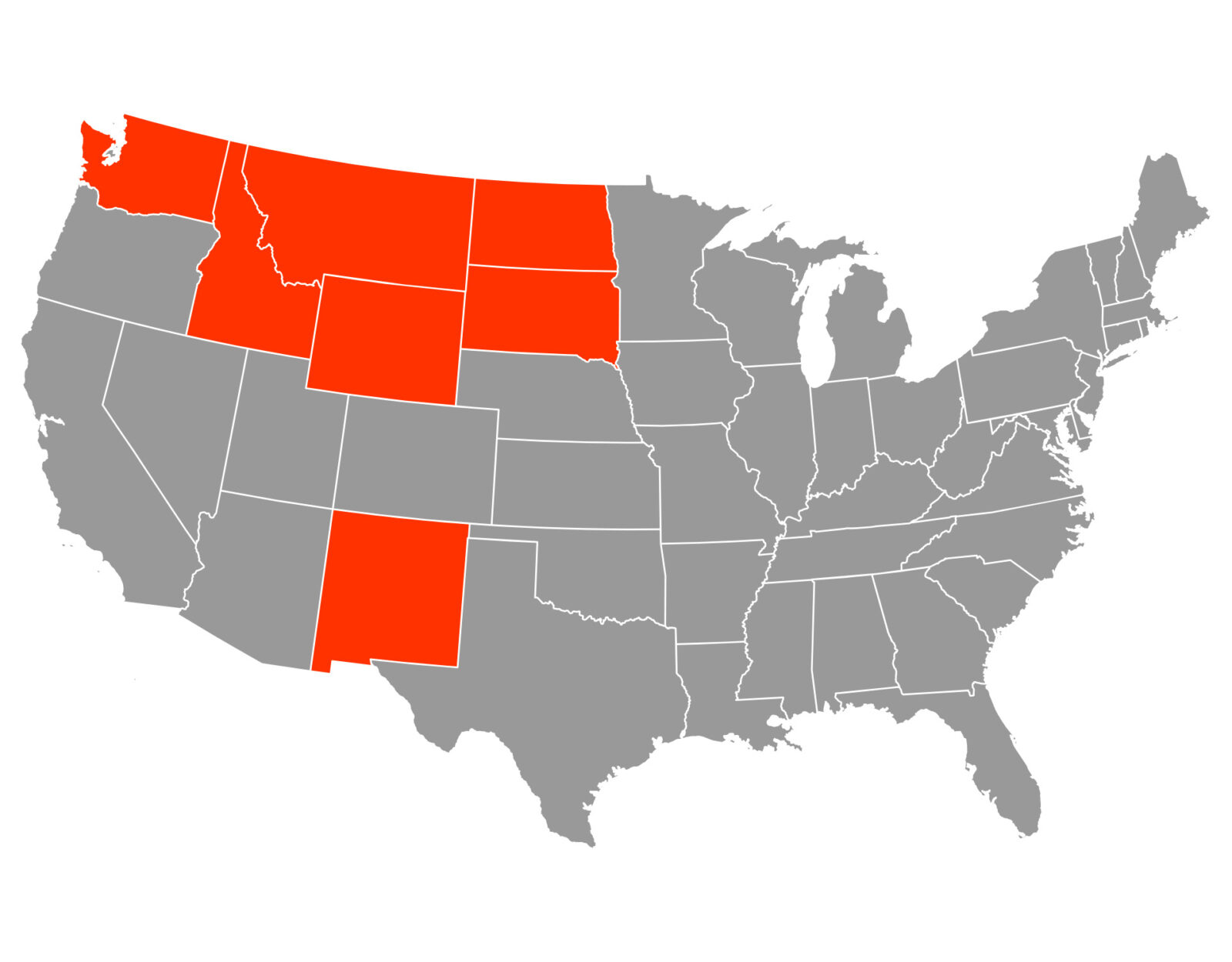
Where To Hunt Merriam’s
See the best Merriam’s turkey hunting states and get local intel.
Idaho
Idaho boasts an approximate 50% success rate every season, and Merriam’s represent about 90% of all turkeys in the state. Hunters can bag up to two turkeys through a general tag and one extra tag.
Local Intel: Higdon Outdoors’ Beau Brooks
“When I think of turkey hunting in Idaho I think of the panhandle of northern Idaho. It is a beautiful thick forest and turkeys use the logging roads as their highways to navigate this thick landscape. If you’re planning a trip to Idaho, look into getting a permit to hunt the various logging companies’ lands. It will unlock a lot of great turkey habitat.
“Many of the areas I have hunted turkeys in Idaho, I didn’t expect there to be birds in because they were so thick. But they are there and very vocal. Plan to navigate the public land that borders private land because the majority of the birds stick close to those borders.”
Montana
Montana has an abundance of different habitat types in which you can find turkeys. They stretch from true mountain birds in the central and western portions of the state to craggy, canyon country filled with sage further east, and what locals refer to as ‘yardbirds’ in many of the state’s small acre farm parcels throughout the state’s river bottoms.
With fewer than 30,000 turkey hunters in the state and tens of millions of public acres accessible to the public, finding solitude is doable. Opening on April 15, the first couple weeks are a weather battle. Birds are certainly gobbling but to see lows in the teens and even single digits is not uncommon.
Local Intel: Skull Bound’s Jana Waller
“There are different areas of Montana that provide vastly different experiences when it comes to turkey hunting on public lands. I live in the Bitterroot Valley just outside of Missoula where the birds tend to flock up on the river bottoms in the winter and early Spring. As the snow melts and the temperatures rise the flocks often move off the river bottoms and into the mountains, making for a more exciting typical ‘cat and mouse’ style of turkey hunt where calling and decoys actually work.
“The [Missouri River Breaks] is the only place I’ve ever turkey hunted where GLASSING plays a big role. If there aren’t any birds answering in the morning we’ll sit high on a ridge and use our binoculars. We often refer to these birds as ‘cliff divers’ because they pitch from one canyon to another. It’s not uncommon to chase the faint echos of gobbles only to find him strutting on the opposing ridge with a giant gorge in between you and the taunting Tom.
“Turkey tags are over the counter and depending on which part of the state you’d like to hunt, there are often multiple opportunities. You can get a general license good for any part of the state in both spring and fall seasons and there are often additional tags available for either sex with any weapon in the fall. Of course, always check with the current Fish, Wildlife & Parks regulations.”
New Mexico
Much of New Mexico is mountainous, which is where the Merriam’s will be found. There is a vast amount of public land available in New Mexico. Bring your hiking boots and have your Offline Maps downloaded because, whether you choose mountains or valleys, you’re likely going to have to cover some ground.
Local Intel: onX’s Lake Pickle
“The birds of the mountain can be finicky. They like to travel. You would be amazed how much ground one Merriam’s gobbler will willingly cover in one day. They also, in my experience, are often spread out over a very large expanse of ground. Success out there for me usually required a whole lot of walking and prospecting with calls that could reach high volumes, like the pot call and box call.”
North Dakota
Turkey hunting in North Dakota offers a rugged, low-pressure experience centered in the scenic Badlands and Little Missouri River breaks, where Merriam’s turkeys roam pine-covered ridges, cottonwood bottoms, and wide-open draws. Limited-entry licensing helps manage pressure, so hunters often enjoy quieter woods compared to more heavily hunted Midwestern states.
The spring turkey season is generally reserved for residents only, though non-residents can hunt on tribal land, such as the Standing Rock Sioux Tribe reservation, which offers specific licenses for non-members.
The landscape allows for classic western-style hunting—covering ground, glassing ridge lines, and working vocal gobblers across big country.
Local Intel: Legends of the Wild Host Sam Soholt
“On the eastern side of the state, you’ll find birds where you think they would live. Riparian areas along creeks and rivers, for the most part, but you’ll also find them roosting in a small patch of trees in a farmyard. Birds can be ‘pockety’ but with so much open ground, you can typically scout by covering miles in the truck and trying to put eyes on birds strutting or scratching in ag fields along shelter belts and other cover.
“Out west, you might end up chasing turkeys in big clay river breaks country, which is incredibly fun.
“But the resource is well-protected. Other than some reservation tags, non-residents cannot hunt turkeys in North Dakota. And even as a resident of the state, it is a lottery, and many of the units take a point or two to draw. However, that limitation has done a great job in creating a quality experience when in the field.
“The population of birds seems to be growing, and with mild winters and limited snow cover the last two years, birds had a great chance to survive and thrive.
South Dakota
Sharing the Black Hills region with Wyoming, turkey hunting in South Dakota is all about public land opportunities. Three-quarters of the 2.3 million acres described as the Black Hills are public lands mostly managed by the U.S. Forest Service. However, the state recently reduced the number of non-resident turkey tags, so it may be harder to grab a tag if you don’t live here.
The Merriam’s found here were introduced to the state from New Mexico in 1948, 1950, and 1951, with the introduction of a grand total of 29 birds. These birds clearly found the habitat suitable for success as South Dakota now has well-established turkey populations across much of the state.
Local Intel: Bartholow Brothers Shooting’s Foster Bartholow
“The public land Black Hills Merriam’s is a dream hunt come true. With the beautiful scenery of endless pine trees and hidden meadows, hunting the 1.2 million acres of public national forest lands can test even the greatest turkey hunters the woods have seen, but getting off the beaten trail and on foot is going to give you the best opportunity for success.
“If you’ve hunted South Dakota before, you know the weather shifts can go from t-shirt weather one day to late-season elk gear the next. My advice: bring extra layers, gloves, and two pairs of boots. If you get a snowstorm, don’t give up… we’ve seen some of the most insane gobbling and strutting action with a half-foot of snow on the ground.”
Washington
Beauty and the Birds
Washington is an underrated but highly productive turkey state with strong populations, generous spring seasons, and abundant public land access. The state holds mostly Merriam’s turkeys in eastern Washington, especially in the pine forests and foothills of the Selkirk Mountains, Huckleberry Range, and around the Colville National Forest. There are also Rio Grande birds in parts of the southeast near the Snake River breaks.
Decades of successful trap-and-transfer efforts have established stable, huntable populations, and harvest success rates in some northeastern counties routinely rank among the highest in the West. Washington’s spring season typically opens in April and runs through May, with multiple tag opportunities in some units.
Local Intel: Higdon Outdoors’ Beau Brooks
“If you’re planning to hunt turkeys here, strap on your hiking boots and download Offline Maps because some days they can be 100 yards off the road, and others they can be six miles. The largest and most condensed turkey population can be found in the northeast corner of the state on the Idaho line. This area has towering ponderosa pines mixed with agriculture and some of the most beautiful hills in the state. If you’re trying to finish a slam, you couldn’t choose a prettier place to finish it.
“Washington is also home to Rios in the southeast corner and eastern in the western half of the state. Warning to the people trying to shoot an eastern in Washington: they’re virtually nonexistent. I’ve spent my whole career looking and have never heard or seen one. WDFW has a lot of awesome turkey guides to getting started in this state, so go check out their basics to turkey hunt.”
Wyoming
With two different season start dates for different regions, you can hunt as early as April 1 in parts of Wyoming and all the way through the end of May. As another state with multiple draw opportunities, including the Black Hills, you need to apply in the month of January for certain tags, but over-the-counter tags are also offered in parts of the state.
Turkey densities seem to dwindle the further west you go in Wyoming with the entire western fifth of the state not even open to turkey hunting. You’ll want to focus your efforts near major river systems throughout the state that have an abundance of mature cottonwoods for roost sites with proximity to agriculture.
Local Intel: Hunt Club TV’s Phillip Culpepper
“I have hunted in the Black Hills area with Seven J Outfitters, and regardless of weather conditions, you are on birds. The most frustrating thing can be nasty weather, but behind bad weather is always sunshine, and more often than not, if the sun is out, a turkey is gobbling.”