Hunting Packs 101
Use insights from Exo Mtn Gear’s Mark Huelsing to choose the right hunting pack, optimize fit, and improve organization.
Choosing the Right Pack Size
Huelsing says, “We always suggest that a hunter gets the pack that is capable of offering the space needed for their longest trips knowing full well that the larger bag can still be compressed quickly and cleanly for shorter trips. That said, we advise that you do not select a bag bigger than you truly need. Most hunters will tend to fill all the space they have available, which means they often carry more than they need.”
While there is no hard-and-fast rule to determine the size you need, a starting point can be determined by assuming that you’ll need approximately 1,000 cubic inches per day. Of course, this guideline should be altered based on your specific needs—an ultralight hunter will need less space than someone who likes a cushier camp.
Getting the Right Fit
“Most of us have had bad experiences carrying packs that hurt our back, put pressure on our shoulders, caused pressure points, or created instability that made it feel like the weight was ‘pulling’ at our body,” says Huelsing. “Those negative experiences are the result of a pack that simply did not fit you well.”
While your best option for fitting a pack is always going to be a one-on-one session with an expert, other options exist. Exo’s collection of how-to videos will give you the information you need to dial in your fit, so your first step should be watching a few YouTube videos and making your initial adjustments. Then, load up your pack as if you’re heading out on a hunt. Put in a couple of miles, then ask yourself a few questions. Do you notice any pressure spots? Areas where your pack rubs or chafes? Are you feeling more sore in certain areas than you should be? Make the final adjustments, then monitor your body and how you feel to ensure that when you’re in the field, your mind is on the hunt and not on your pack.
Organizing Your Pack
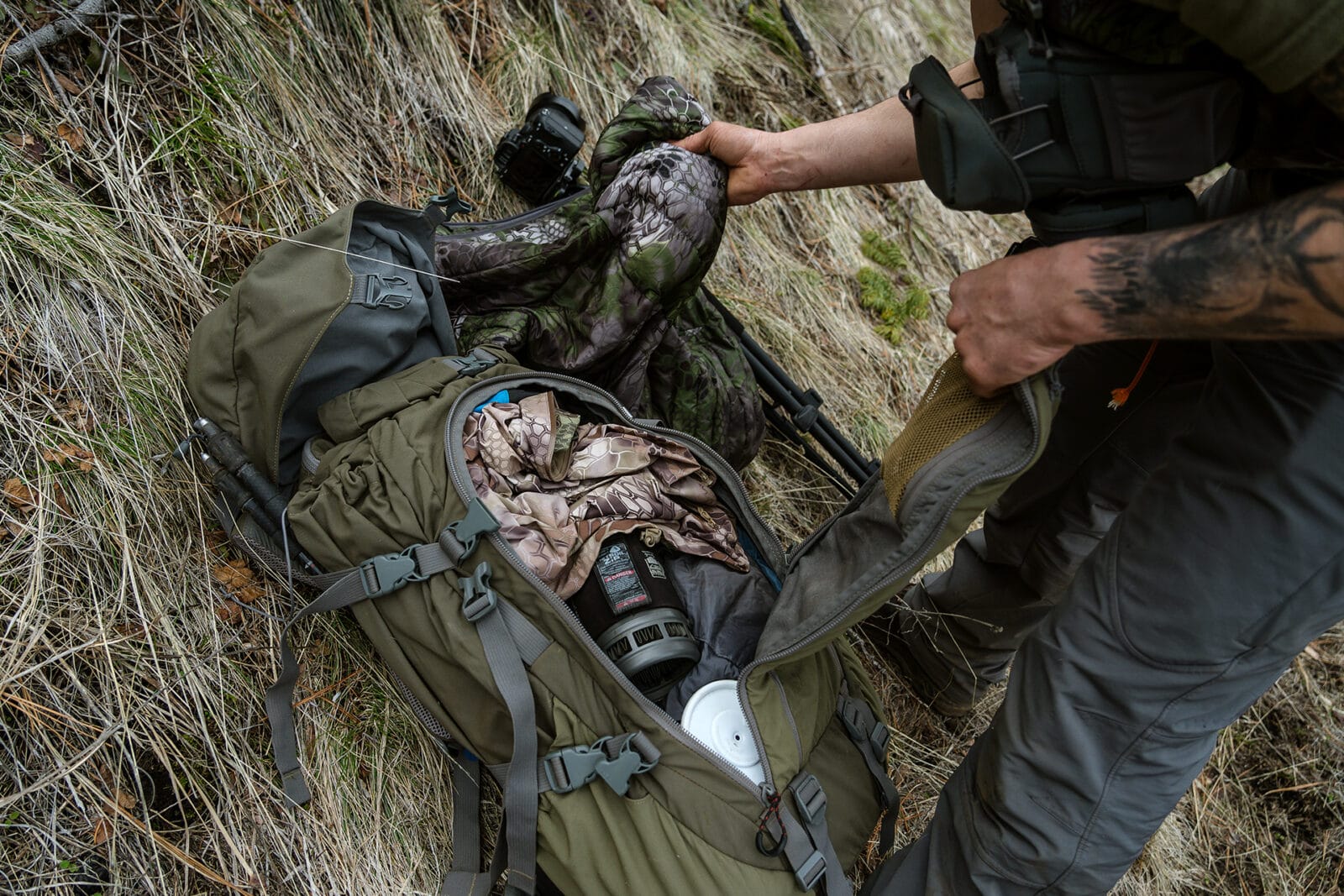
“To simplify the science,” Huelsing notes, “let’s just say that the further a weight is away from your body, the heavier that weight will feel. The weight didn’t change, but the perceived effort to carry and stabilize that weight did change.” The heaviest items you carry, then, should be placed close to your body and supported on the middle or upper section of your back.
Consider how the contents of your pack will change when you’re standing over a pile of meat that needs to be moved. Packs such as Exo’s are designed with an integrated load-shelf. This unique load-bearing system allows you to carry heavy loads of meat between the bag and the frame, keeping the densest weight on your back as close to your body as possible to lessen your perceived load.
Assess how frequently you’ll use the items you’ve decided to bring. It doesn’t make sense to dig through rarely used items to access something you might need every day. Particularly for newer backpack hunters, this will be a trial-and-error exercise. Pay attention to how convenient your packing regime is, and take notes—mental or real—to help you remember the changes you need to make before your next hunting trip.
Maintaining Your Pack
There are a few steps you’ll want to take after each hunt to ensure that your pack stays in top shape and that you learn from your experience. First, remove all of your food and trash. According to Huelsing, one of the most common pack issues Exo encounters is rodent damage resulting from packs being stored without having been fully emptied.
Equally as important, though often overlooked, is the post-hunt gear debrief. Begin every trip with a written packing list of everything you plan on bringing with you. Once you’re back home, inventory your pack and evaluate what gear was necessary and what gear wasn’t.
“I play the game of ‘three strikes and you’re out’ on specific gear items,” Huelsing says. “If I packed something on a trip three times but have never needed to use it, I ask myself if I really need to keep carrying it on future trips. Obviously, there are certain things this doesn’t apply to, my SOS communication device or a first aid kit, for example, but it is a helpful exercise for things like backups or duplicates of key items, extra clothing, and more.”
Remember to give the pack a good rinse with a hose, soak the pack in ice-cold water for several hours, then give the pack a final rinse before letting it air dry. If you have any trouble spots after the initial soak, you can do another soak with a mild detergent and/or hand wash any spots with a soft cloth.