Understanding Draw Applications
Understanding three core concepts will help you create a smart application strategy: point systems, draw procedures/tag allocations, and draw odds.
Point Systems
Point systems are a method that some states use to increase your chances of drawing a tag over time. You acquire points annually and by species to be used for your future applications. You get a new point when either:
A) You apply for a species and are unsuccessful in drawing a tag.
or
B) You have specifically applied for “points only” given a particular species.
For each species, you are awarded another point by either A or B in a given year, but not both. You lose your points for a species when you draw successfully for that species; or, if you stop applying for consecutive years, your points can expire.
There are two distinct types of points, and they work differently to increase your chances of drawing:
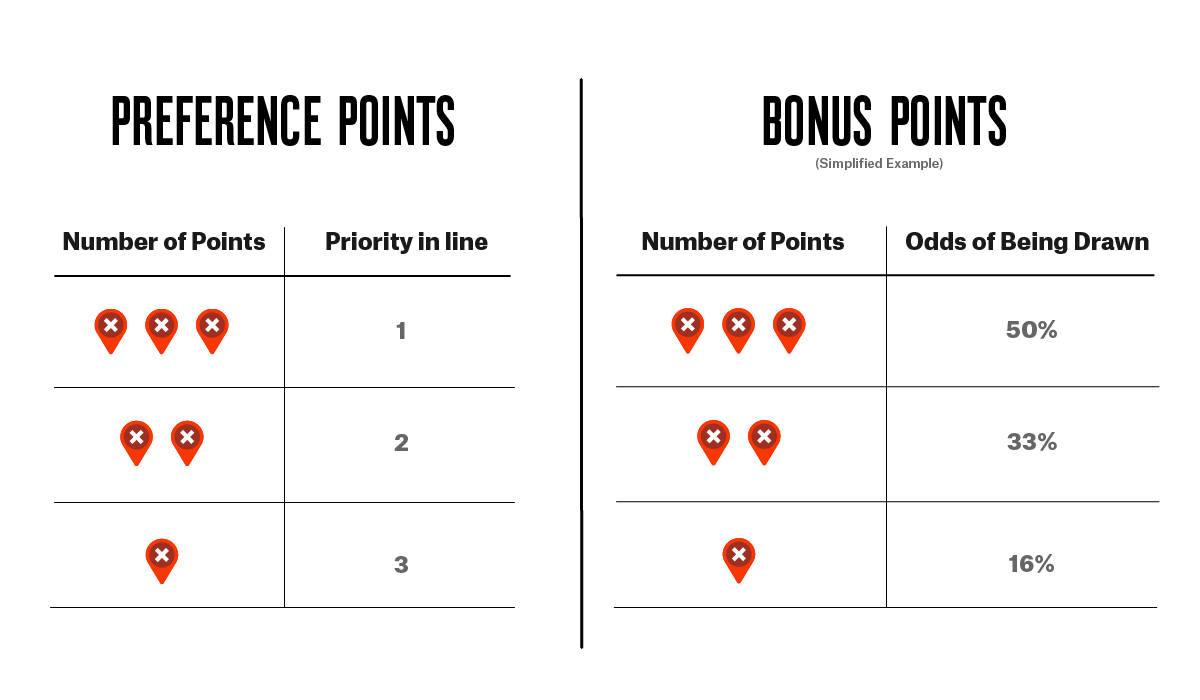
1) Preference points are used like a place in a line. If you have three points and I have two, you’re ahead of me in line and will draw before I do if we both apply for the same hunt. The person with more points gets preference—think of preference points as “first in, first out.”
2) Bonus points are like raffle tickets. The more bonus points you have, the greater your chances of drawing. If you have 10 bonus points and I have three, I can still draw a specific hunt before you if my “number” is drawn.
With bonus points, some states will mathematically square your total to give you that many more chances in the drawing (Montana and Nevada, for example). If you have three bonus points in Nevada, you’ll get nine (three times three) extra “chances” to draw. This method gives a mathematical advantage to applicants with the most bonus points, but still does not guarantee success for high point holders.
Not every state uses a point system. New Mexico and Idaho are examples where hunt tag drawings are completely random. In a random drawing, every applicant—regardless of how long they have been applying for—has the same chance to draw for a given hunt as every other applicant in their pool (resident and nonresident “pools,” for example).
Tag Allocations/Drawing Procedures
Regardless of a particular state’s point system, the overall “randomness” of their drawing is the next important thing to understand. On a three-step scale of randomness we have:
- Least random (preference point rules).
- Random but with extra weight for longevity (bonus point rules).
- Completely random.
Some states take a hybrid approach when allocating tags in the drawing. They divide the total number of available tags for a given hunt and issue some of these tags differently with respect to our three-step random scale.
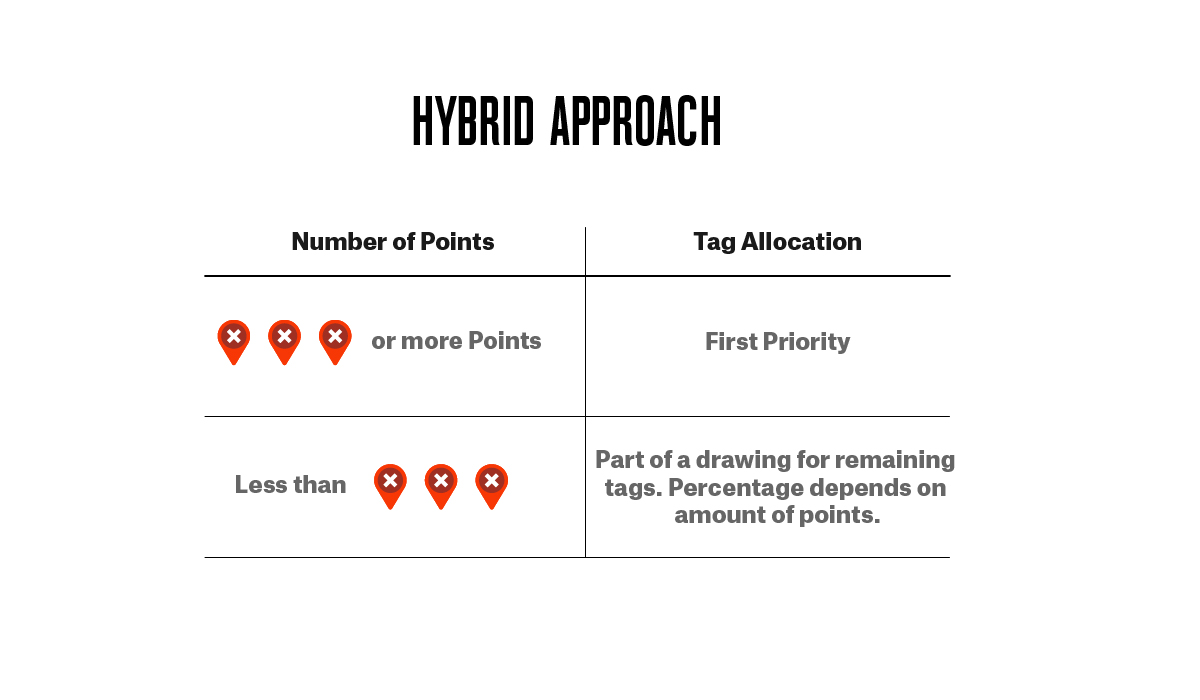
Arizona is a good example of a hybrid approach. Traditionally, you will see Arizona referred to as a bonus point state, but in reality, they have a hybrid approach. For every individual hunt code, 20% of the total number of tags for each hunt will be awarded to the applicants with the most bonus points. So for that 20% of tags, they effectively treat your bonus points as preference points (your place in line). The remaining 80% of tags are issued in a random drawing according to traditional bonus point rules (raffle ticket drawing).
Arizona’s approach makes it a slightly less random drawing overall, but also gives the applicants with higher point totals another path to drawing successfully. That is exactly what hybrid tag allocations attempt to do: distribute chances so there is some appeal to all applicants regardless of point total.
In general, if you have few points, more random is better.
The other important aspect of each state’s drawing procedure is how they evaluate the hunt choices on your application. Most states will allow you to apply for more than one hunt per species, but how they evaluate those choices can vary by state.
Some only evaluate your first choice before moving on to the next application, and second, third, and fourth choices are only possible to draw after everyone’s first choice has been considered. In these cases, your only hope to draw with second choice and beyond is for hunts in lower demand (antlerless opportunities, for example).
In other states, they evaluate multiple choices on your application before moving on. In Nevada, for example, your first five hunt choices are evaluated before advancing to the next application in the drawing. This has an impact on drawing odds; therefore, in these states, your application strategy will be different. How you use your choices in this scenario requires more thought than simply choosing a single hunt per species.
Each state’s draw procedures will also define how group applications are evaluated with respect to the point totals of each group member. In some cases, applying as a group can reduce your overall chances, while in others, it can be used to your individual advantage.
Draw Odds
Applying for draw hunts on an annual basis is a costly endeavor, so having a reasonable plan that meets your personal hunt goals and budget is important. The biggest key to realistic expectations is understanding your chances of drawing when you apply.
Calculating actual draw odds can be complex when you factor in all of the details above. In some instances, the only way to do it with accuracy is via computer simulation—and with actual applicant data from the respective state wildlife agencies.
onX’s Hunt Research Tools is designed to help you understand draw odds and more.