

Ready to explore this trail?
View Trail Map in AppPath Type
Loop
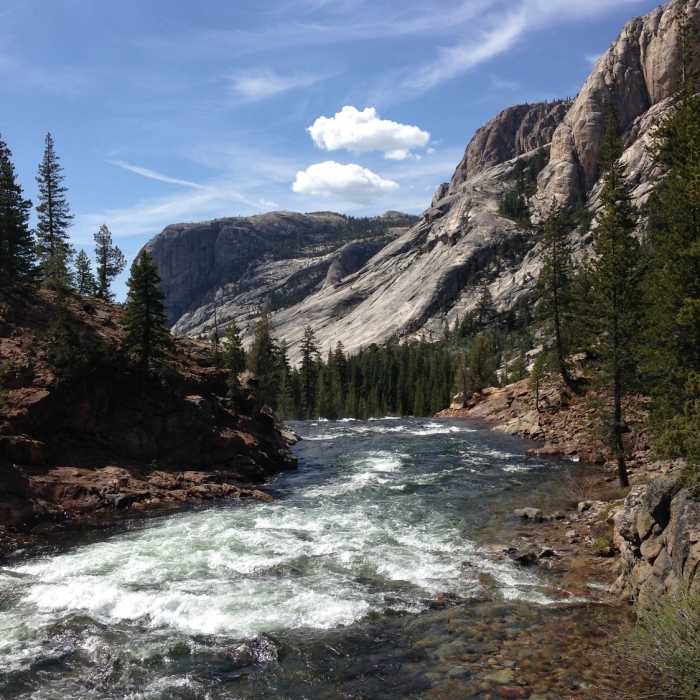
Standing directly in front of the Tuolumne Meadows store, gaze across the meadow that eagerly beckons for exploration. One can't help but notice the well-traveled path that has been hewn into the landscape. Take this flat trail through the meadow as it will veer to the left for the first 1.3 miles. From here, continue straight instead of taking the right that leads to the stables. In 0.4 miles there will be an option to continue straight in order to go to Young Lakes. Make sure you save that for another day and instead follow the signs to Glen Aulin High Sierra Camp. The next 4 miles are a gradual downhill that present some of the most picturesque views in the park. The trail provides the hiker a series of cascading waterfalls and views that are too perfect for words. The composition of the footpath thus far will primarily be a loose, sandy substance that is gently sprinkled over the granite, which can be very slippery at times. There is also heavy mule traffic to the High Sierra Camps.As you head further out, enjoy the last remnant of civilization and quite possibly, the last human encounter you'll have the rest of the day. Realize that from this point, one is totally self-supported as you ascend the Pacific Crest Trail (PCT) that leads northwards out of Glen Aulin. After climbing for a bit, the trail will open up into a beautiful meadow that eventually becomes Cold Canyon. As the trail begins to descend, one is filled with a sense of majestic awe as the treeline on the left will often give way to majestic views. After 7 miles on the Pacific Crest Trail (PCT) there will be a river crossing that comes from McCabe Lakes. Be aware that the river may be flowing, even late in the year. In one mile the trail will split and one must take the left fork and follow the Pacific Crest Trail (PCT) as you DO NOT want to go into Virginia Canyon. For the next 5.8 miles follow the trail exactly (without cutting switchbacks). There is plenty of tree cover to shade you as you make the climb up to Miller Lake on this difficult trail that is interspersed with some technical rock. If you think this section of trail was tough, the next 7.5 miles causes one to question their sanity as a descent into Matterhorn Canyon is required. This is directly followed by the grueling and painstaking slog up Benson Pass. It is here where one is totally exposed as the sun, and progress can feel slow. The integrity of the trail here is poor, and the loose sand is not user-friendly.From the top of Benson Pass, the descent to Smedberg Lake is much appreciated as it is not terribly technical. After a dip in the cool waters it is time to get back on the pony and struggle on around Volunteer Peak. It is here where you can forlornly wave goodbye to the well manicured Pacific Crest Trail (PCT). To cut off a half mile take the trail to the right and continue south through Rodgers Canyon. From here it is all downhill to the Grand Canyon of the Tuolumne...figuratively and literally. Although navigable through Rodgers Canyon, the trail becomes a nightmare going down into Pate Valley as it's overgrown with weeds and prickers and one wonders if this trail sees any use at all. The switchbacks that lead into the canyon leave visitors exposed to the merciless rays of the sun and you'll want to bring you own sun protection with you here. Make sure you keep an eye on the trail (and use the Mobile App) as sometimes it is hard to distinguish between animal trails. From the Grand Canyon of the Tuolumne you have 14 miles to Glen Aulin. This section is composed of technical rock and enormous effort is required to climb up to Glen Aulin. However, the beauty of this section is surpassed by none as the canyon is filled with beautiful flowers and the roar of the Tuolumne.
Descending from Pate Valley into the luscious expanse of the Grand Canyon of the Tuolumne it becomes quite obvious that these deep walls have their own story to tell. In fact, there are even pictographs scratched into the side of the canyon. These drawings could have been constructed by the Paiute tribe as they were known to have frequented the area.
No Condition Reports
Contributors