Learn the fundamentals of building a spread ducks want to land in and how to break strategy down by water type.
How To Set Up a Duck Decoy Spread
Tip: The first step is actually not about your decoys at all. It’s about your hide. Make sure you’re concealed before you worry about your spread.
Start With Wind Direction and the Landing Zone
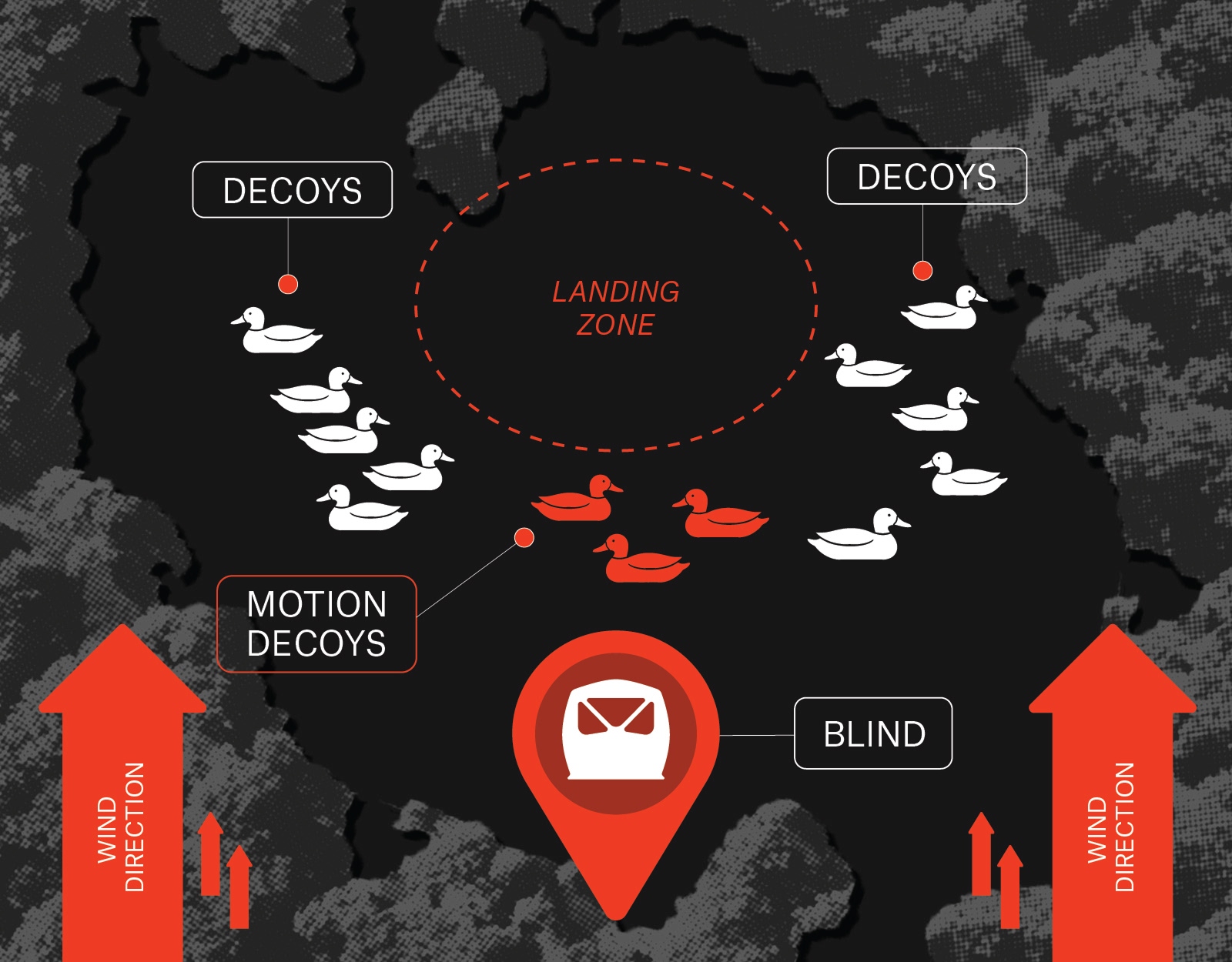
Ducks land into the wind, turning to fly against it as they drop into the landing zone. Set up so approaching birds have to fly upwind toward your decoys, with the wind in their faces, not coming in from behind them.
Build your landing hole, or kill hole, around three things, in order: wind, sun, and vegetation. In a perfect setup, wind and sun both come from behind you: sun at your back keeps it out of your eyes, and wind at your back means incoming ducks will fly toward you, into the wind, for a straight-on shot. When that lines up, place large groups of decoys to the left and right of the landing zone, then add a small pod of just three to five decoys in the middle.
For ducks, that middle pod gets a spinner (when and where legal), a motorized decoy with spinning wings that mimics birds coming in to land. Skip the spinner if geese are part of the mix.
When wind and sun do not cooperate, take a side shot instead of shooting into the sun. For a side shot, push the decoys to one side in a concave shape, with a handful placed right in the kill hole in front of the hunters.
Choose How Many Decoys You’ll Bring
There is no single right number, but a few ranges hold up across water types:
- Tight ponds and potholes: Six to 12 decoys
- Medium water: 18 to 36 decoys
- Big water or fields: Four dozen or more
Duck Decoy Diagrams by Water Type
Flooded Timber Decoy Spreads
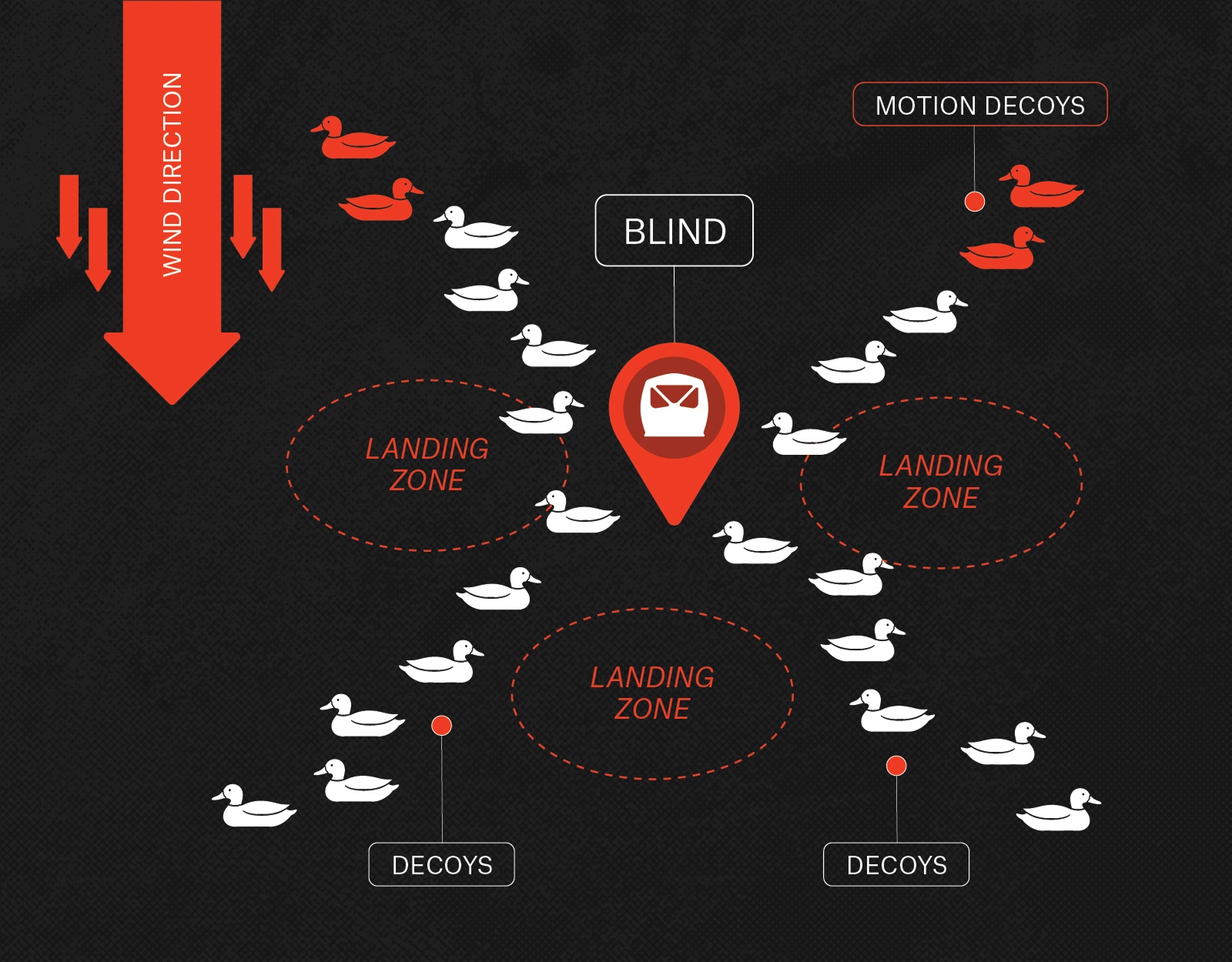
Put most of your decoys upwind of the landing hole, then add a smaller group, around six decoys, downwind.
Mallards and wood ducks flood into bottomland timber almost as soon as heavy rain fills it, and sunny mornings tend to be the best window to hunt it.
Put most of your decoys upwind of the landing hole, then add a smaller group, around six decoys, downwind. Birds bounce between the two groups instead of sliding downwind and landing out of range. Keep the groups loose, three to six decoys per cluster, with roughly eight to 12 feet between groups. Run a single jerk rig, a line-and-anchor rig you pull by hand to create ripples, near the center and upwind of the kill hole.
That is the setup for birds that are ready to commit. When it turns into a true traffic situation, with ducks working back and forth without settling anywhere, go the opposite direction: more decoys, not fewer. Run 10 dozen decoys minimum—even up to 30 dozen with 15 or more motion decoys mixed in.
Big Water Decoy Spreads
Run a J-hook or X-shape spread so you can adjust to shifting wind throughout the day.
Big, visible groups of decoys pull ducks across long distances on open water, but by midseason, pressured big-water ducks tend to favor the edges of a raft over the middle of it.
Run a J-hook or X-shape spread so you can adjust to shifting wind throughout the day. Plan on four dozen decoys or more, with a few different types of motion staggered along the upwind leg. Set your blind with the sun in mind as much as the wind. A squinting hunter is a hunter who misses.
Duck Decoy Spreads for Ponds
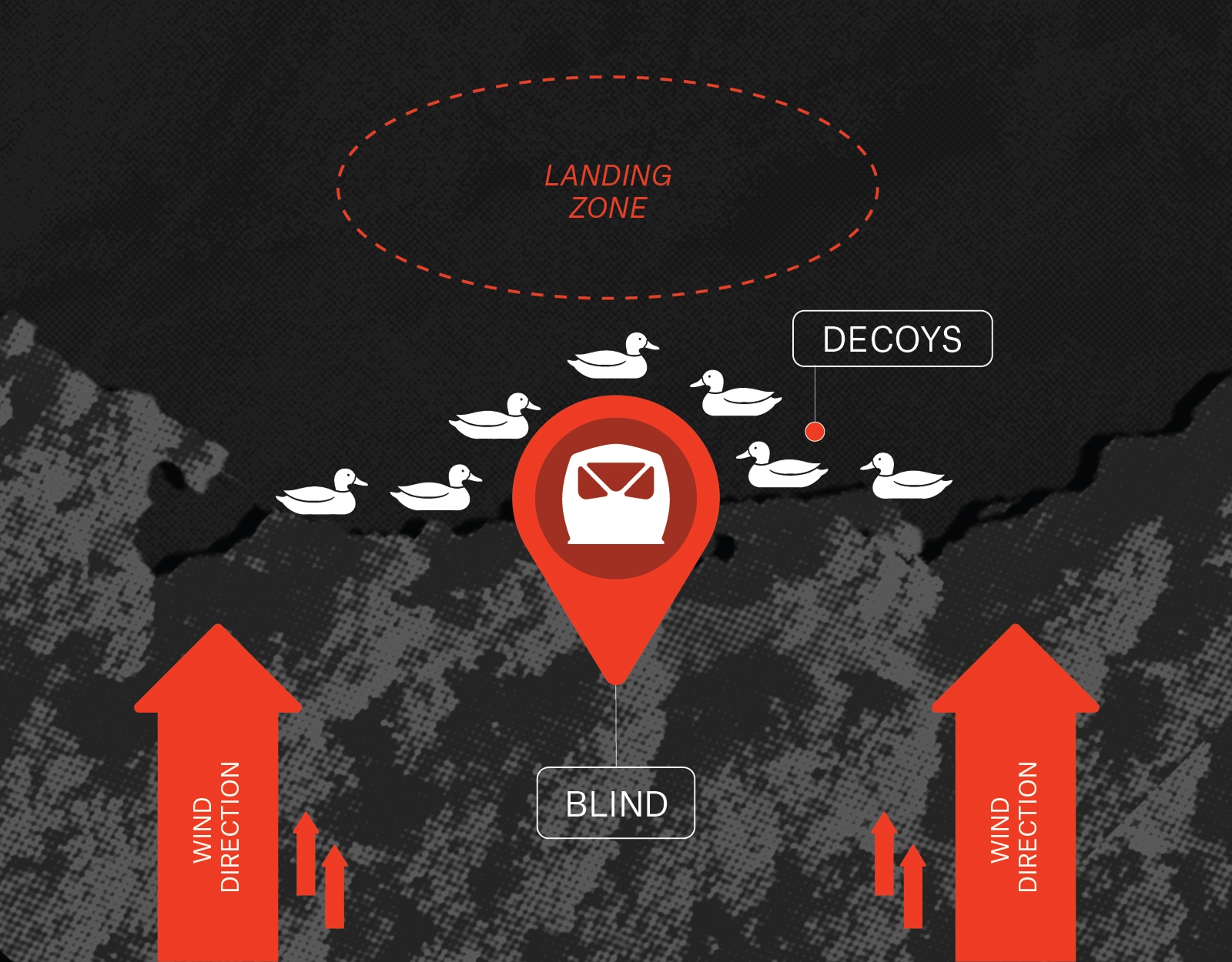
Run six to 12 decoys tight to the bank near the blind, and leave most of the water open as a clean landing lane.
If birds are piling into a pothole with no hesitation and no circling, a minimal spread of four decoys on a jerk rig can be effective.
For general numbers, run six to 12 decoys tight to the bank near the blind, and leave most of the water open as a clean landing lane. Cut motion back, or drop it, on pressured, late-season potholes. A slightly bigger, higher-quality spread can still out-hunt a minimalist one when the pond is genuinely loaded with birds and pressure is low.
Duck Decoy Spreads for Rivers
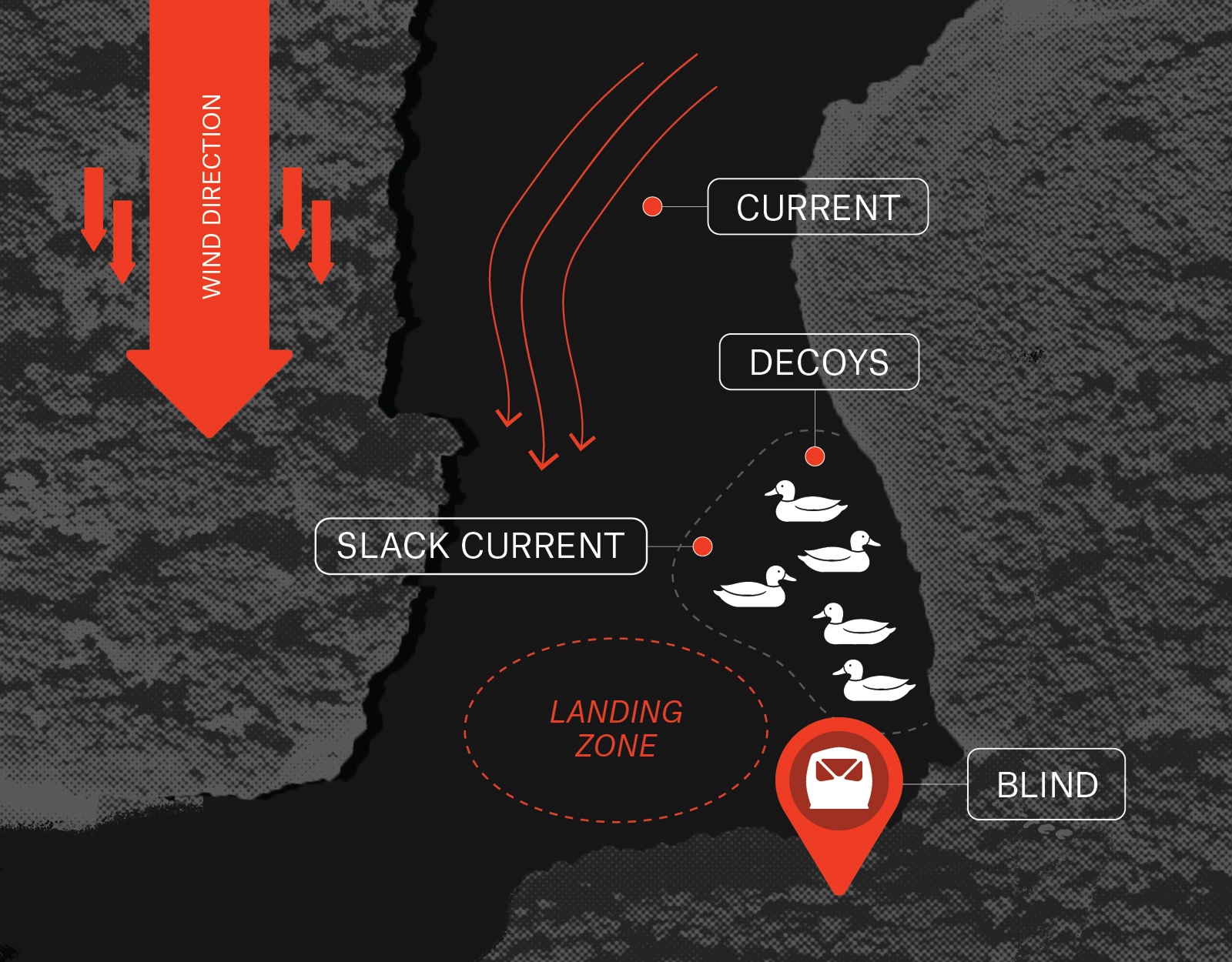
Set decoys along a calm eddy behind a bend, sandbar, or point. Leave an open pocket on the downstream side and position the blind for a crosswind shot.
When birds are bouncing back and forth from a field to a river, bring as many decoys as you can. The goal is to convince a river full of moving birds that your stretch is safe and comfortable to sit down on.
For the hide, look for a stand of trees right on the river’s edge to disappear into.
General strategy: set decoys along a calm eddy behind a bend, sandbar, or point, since that is where ducks naturally loaf on rivers. Leave an open pocket on the downstream side and position the blind for a crosswind shot rather than fighting the current’s sightline.
Adjust Your Duck Decoy Spread as Hunting Pressure Changes
Ducks in December are not behaviorally the same birds they were in October. Research tracking GPS-tagged mallards found that as hunting pressure builds through a season, ducks shift toward a “safe by day, feed by night” pattern: they return to feeding areas later in the evening, leave earlier in the morning, and largely stop exploring new water once they have settled into a routine. The birds hitting your spread late season have already learned the local hunting schedule.
That points to a three-stage approach:
- Early season, naive migrators: Run a bigger spread with full motion. These birds have not learned to be wary yet.
- Mid-season, arriving migrators: Trim to a moderate spread with selective motion. Some of these birds have already seen decoys elsewhere.
- Late season, educated and pressured birds: Go small, realistic, and tucked into secluded water, with motion cut back or off.
Separate research on wetland disturbance backs this up: waterfowl sanctuary use roughly triples during periods of low-to-moderate disturbance and still rose by about half during high-disturbance stretches. The exact spot ducks want to be shifts with disturbance, not just water type, so treat it as a moving target through the season instead of a spot you find once and hunt the same way through January.