Pre-Season Prep for Dogs
With help from Brandon Moss and Shawn Wayment, DVM, learn about canine conditioning and emergency field care.
Conditioning and Field Care Advice from Brandon Moss
Always Carry Needle-Nose Pliers
Many things can happen to a bird dog in the field. Snakes, cuts, porcupines, and pulled muscles are just a few examples of what could go astray when bird hunting. When hunting a new area, it is important to find out what risk factors lie ahead. Some areas might have a high population of porcupines. Having the necessary equipment to handle this situation could be the difference between going to the vet and being able to handle it yourself.
One of the most important tools a person can take with them in the field is a pair of needle-nose pliers or a multi-tool. Cactus in the paws can be impossible to pull out without these tools. I like to have a couple of tools in my vest just in case one gets lost or if two people want to work on one dog when a porcupine situation occurs.
Ramp Up Exercise Levels
You also must be aware of the physical well-being of your dog. Sore or worn-out pads, overheating, old joints, and pulled muscles can sneak up on a dog quickly. The risk of these things happening can be reduced with proper exercise.
I like to start my exercise program a couple of months before the season starts. Typically, I will run a dog shorter distances every other day for a couple of weeks. Gradually, I will lengthen the distance and time we are out.
After a couple of weeks, I will run them consecutive days in a row. We’ll do two and three days in a row at the longer distance. Once the season starts, I will hunt them more days in a row as needed. I truly think the only way to get a dog ready for multiple all-day hunts is by hunting them. Exercise does not take away all risks, but it helps reduce them.
Usually, preseason exercise programs take place in the summer. I get my dogs out in the early morning before the heat starts to get to them. As the summer goes on, I make sure they finish working at a temperature close to what they will be hunting in.
Prevent Overheating
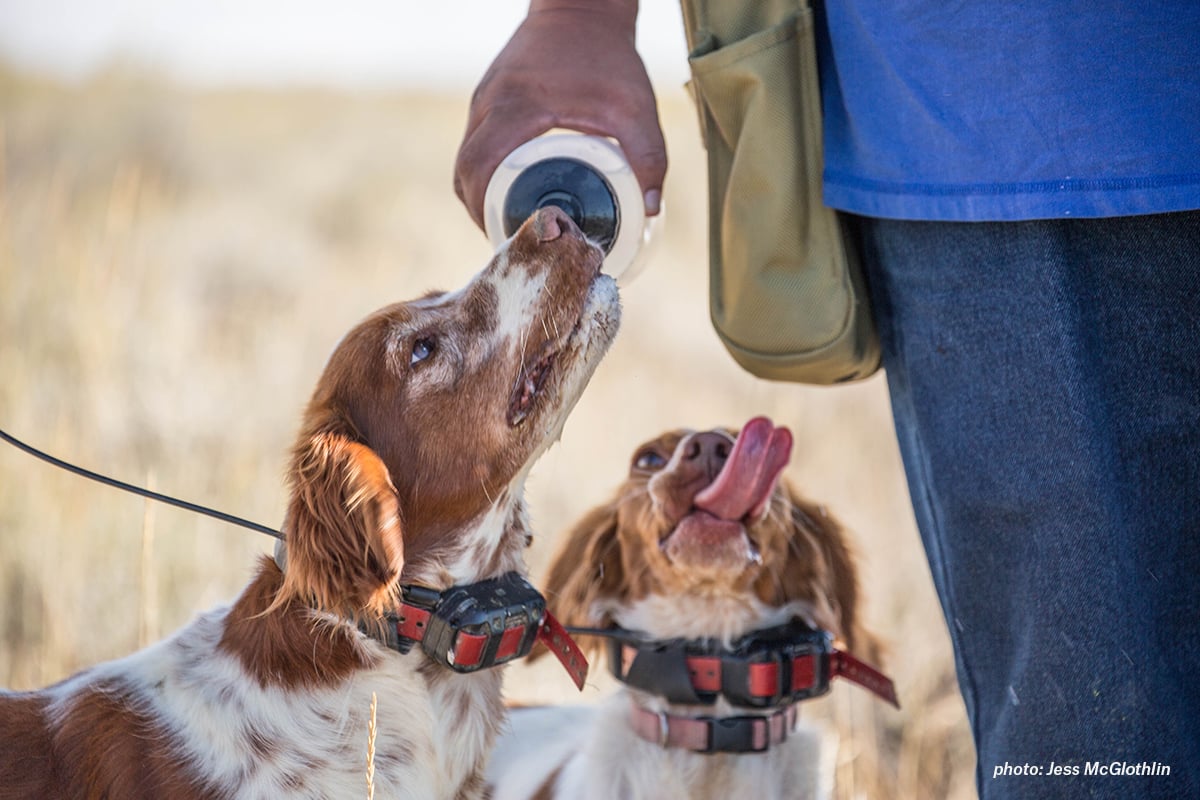
Overheating a dog is a risk many people don’t think too much about. I like to find my dogs water they can wade and lie in. ALWAYS carry water for your dog with you.
My rule of thumb, as is the case for many hunters and trainers, is that the dogs come first. They are watered first and fed first—their well-being comes before mine and the hunt. Having a healthy, happy dog is the best way to enjoy your hunting season.
7 Tips from Shawn Wayment, DVM
1. Know Where the Nearest Vet Is
The best advice I can give bird dog owners is to have a good first aid kit and to know where the nearest veterinarian is from where they’ll be hunting or trialing.
The onX Hunt App offers us the ability to drop a Waypoint at any location, so why not mark the nearest vet clinic in the area you are hunting? This can save you time in an emergency.
2. Save Animal Poison Control’s Number
I also suggest that dog owners have Animal Poison Control’s number programmed into their cell phone in case their dog ingests something harmful—(888) 426-4435.
3. Understand Your Skill Level
Please know your limitations in emergency dog care, because any prolonged attempt for treatment in the field can delay the valuable time it takes to get to the nearest veterinary clinic. Use your best judgment and always err on the side of your dog’s best interest. Have wounds checked as soon as you can by your veterinarian.
4. Be Prepared for Lacerations
Lacerations are the most common injury that I see in field dogs. The most important thing is for you to control bleeding. I carry loads of bulky bandage material in my first aid kit, but you can control hemorrhage with towels or shirts and duct tape. Apply direct pressure to the wound and wrap it tightly with duct tape (duct tape should only be applied temporarily until you can get the dog to a vet).
Minor skin lacerations or tears that aren’t deep into the muscle layers can be cleaned with ½ strength hydrogen peroxide and water or ½ strength betadine solution and water and then stapled. If the laceration extends into the deeper muscle layers, the muscle layers must be sutured as well. I have taught several of my clients over the years how to suture the subcutaneous layers. It’s not incorrect to cleanse the wound and then staple the skin even if the muscle layers below are lacerated—the skin is a great bandage to protect further debris from collecting in the wound before you can get to your veterinarian for further care.
5. Inspect Their Eyes
Always check your bird dogs’ eyes after running them. It only takes a few seconds. The most common thing I see is weed seeds or debris that gets lodged underneath the nictitans or 3rd eyelid. Rinse the eyes out generously with saline solution from the inside or the middle of the eye outward. The way I look under the 3rd eyelid is to stand the dog on the tailgate, gently push the dog’s eyeball inward which raises the 3rd eyelid, and then take a cotton tip applicator and roll the 3rd eyelid outward.
6. Carry Hydrogen Peroxide
I carry hydrogen peroxide in my first aid kit not for cleaning wounds but for causing a dog to vomit if needed. The most important emergency measure in a dog exposed to an oral toxin is to decontaminate them immediately. I’ve had to do this to all three of my bird dogs in the field at one time or another, including when one of them came back with a block of rat bait in his mouth. I feed them a cup of food and then give a tablespoon of peroxide and wait five minutes. If nothing happens, I repeat the tablespoon again and then wait and repeat as necessary. Though the aftermath is not pleasant, it always works.
7. Familiarize Yourself With Traps and Bring Wirecutters
Learn how to open the common snares or traps that trappers use before your dog steps into one. I carry a set of heavy-duty wire cutters in my hunting vest while hunting the grasslands because of local trappers who have equal rights to use public lands. I only disturb their traps if it is necessary to protect my dogs.