2026 Wyoming Application Details
Putting a 2026 Wyoming hunt on the books? Learn the latest from Huntin’ Fool.
Key Updates for 2026
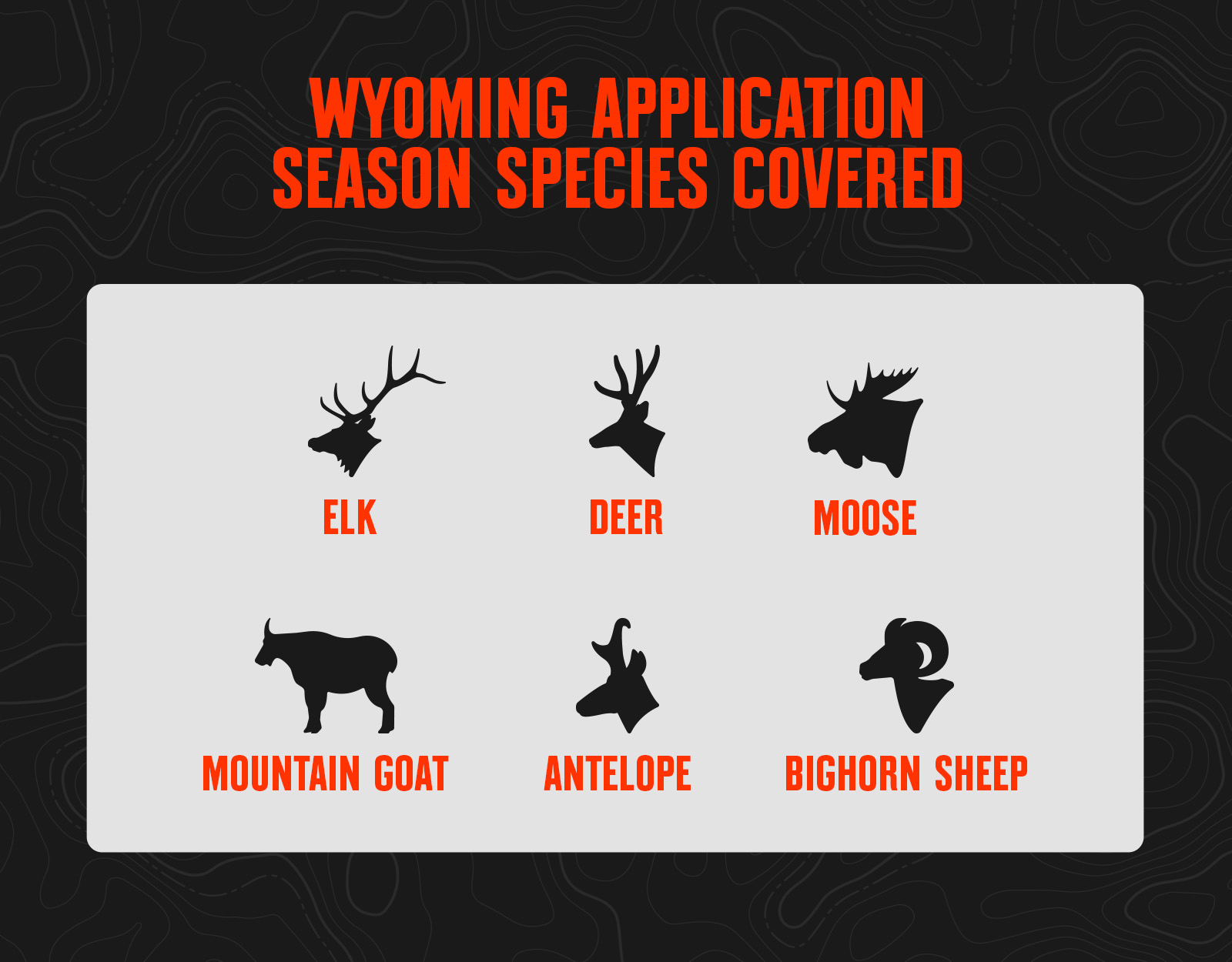
At the April 22, 2026, commission meeting, the Wyoming Game & Fish Department (WGFD) made the following changes to 2026-27 hunting seasons:
Antelope
- The 2022-23 winterkill is still fresh on people’s minds, but the herds are recovering, and more opportunity is being restored.
- Approved a net increase of 2,650 licenses statewide. The Laramie region saw the largest increase, with 400 any-antelope licenses and 625 doe/fawn licenses added.
- Lander Region: Area 62 goes back to the split type 1/type 2 structure from 2022, where type 2 licenses are restricted to the eastern portion of the hunt area.
Deer
Wyoming Range
- For general licenses in hunt areas 138, 139, 140, 142, 143, 144, 145, 149–156:
- Season dates are now Sept 15 – Oct 2.
- 4-point-or-better antler point restriction stays in place.
- Area 130’s general license season is Oct 1-6 with the 4-point-or-better antler point restriction in place.
- Region H non-resident licenses stay at 350.
- Region B non-resident licenses dropped from 800 to 700.
- Region 146 was dissolved, and regions F, H, and L experienced boundary changes.
Lander Region
- Created a brand new license type in area 87: A type 2 for 3-point-or-less bucks (25 licenses). It’s a novel concept designed for older low-antlered bucks in a herd with chronically high buck ratios.
Sheridan Region
- New general any-whitetail season in hunt area 21.
- New 15-day general whitetail season in hunt area 18.
- Antler point restrictions continuing in select mule deer areas for one more year.
Casper Region
- Area 65 opener shifts from October 15 to October 20, running through October 31 (to better align with neighboring areas).
- Black Hills general license now valid for any whitetail deer on private land (previously more restricted).
Cody Region
- Some whitetail license reductions due to EHD outbreaks last year, particularly area 127 type 8—cut from 100 to 50.
- Area 130 doe/fawn licenses (type 7) eliminated.
Elk
- Grand Teton hunt area 75: 40 more permits added (20 type 4, 20 type 6). Season runs November 14–December 6. Area 79 stays closed.
- Hunt areas 84 and 85 (Jackson region): Season dates remain what they were in 2025.
- Hunt areas 89–91: The full month of September for special archery seasons remains.
- Sheridan Region Area 38: Back to 400 any-bull licenses. It was cut to 100 in 2025 because of wildfire-related carryovers. That situation has been resolved, so it’s back to normal.
- Lander Region: Biggest overall license increase of any region.
- In terms of type 9 archery-only licenses, no changes were made, but the department plans to conduct a statewide archery survey before next year’s season-setting.
Cost Overview
Wyoming charges a non-refundable application fee of $5 for residents and $15 for non-residents. There is also a non-refundable 2.5% processing fee.
From there, Wyoming hunting license fees vary depending on residency, species, sex, and license type (e.g. youth, special, landowner), and range from a couple of dollars for certain resident licenses to upwards of $6,000+ for non-resident licenses.
For any non-residents just beginning their research, to give a sense of pricing, most license fees fall in the hundreds of dollars. For example, non-resident antelope is currently $326, and non-resident elk is $692. A full list of hunting license fees is available on the Wyoming Game and Fish website. Unlike the application fee, Wyoming’s hunting license fees are refundable if you don’t draw a tag.
If you successfully draw, in addition to the relevant hunting license, you’ll also need a $21.50 conservation stamp. And, archery hunters need an archery permit (exception: type 9 archery-only tags), which costs $72 for adult non-residents and $16 for adult residents.
Application Dates
WYOMING DEADLINES
Non-Resident Elk
Moose, Sheep, Bison, & Mtn. Goat
Deer, Antelope, & Resident Elk
Leftover Draw
Points Only
The deadline to modify or withdraw your non-resident elk application is May 8, 2026.
Wyoming Draw Process Basics
- There is no point system for Wyoming residents applying for elk, deer, and antelope; tags are issued via a random draw.
- For elk, deer, and antelope, Wyoming uses a preference point system for non-residents. In Wyoming’s draw, preference point drawing accounts for 75% of available licenses in each hunt area. The remaining 25% go to a random draw, so it’s worth applying even if you haven’t been building points for years.
- Preference points are like a place in line—first in, first out. The applicants with the most preference points draw before applicants with fewer points.
- Non-residents buy species-specific preference points during an application window in the late summer; you do not buy points at the time of your tag application.
- You can’t buy preference points for a species if you successfully drew your first choice for that species in the same year.
- If you draw your first choice for your species, your preference points are purged back to zero.
- If non-residents fail to apply for or buy a preference point for a particular species for two consecutive years, they lose all accumulated preference points for that species.