2026 New Mexico Application Details
If you’re planning to hunt New Mexico this year, get the need-to-know details from Huntin’ Fool.
Cost Overview
Hunting license and species costs for New Mexico big game tags include:
- New Mexico hunting license (resident $29/non-resident $94).
- Non-refundable application fee per species (resident $7/non-resident $13).
- Species fee (for New Mexico, you pay this upfront at the time of your application and are refunded if unsuccessful in drawing a tag.).
- Habitat stamp.
New Mexico offers active duty military members the ability to apply for several “Military Only” hunts, and there is a 50% discount for all licenses and stamps for resident, active duty military, or honorably discharged veterans.
Application Dates
2026 NEW MEXICO DEADLINES
Black Bear
Bighorn Sheep, Elk, Deer, Antelope, & Exotics
How New Mexico’s Draw Process Works
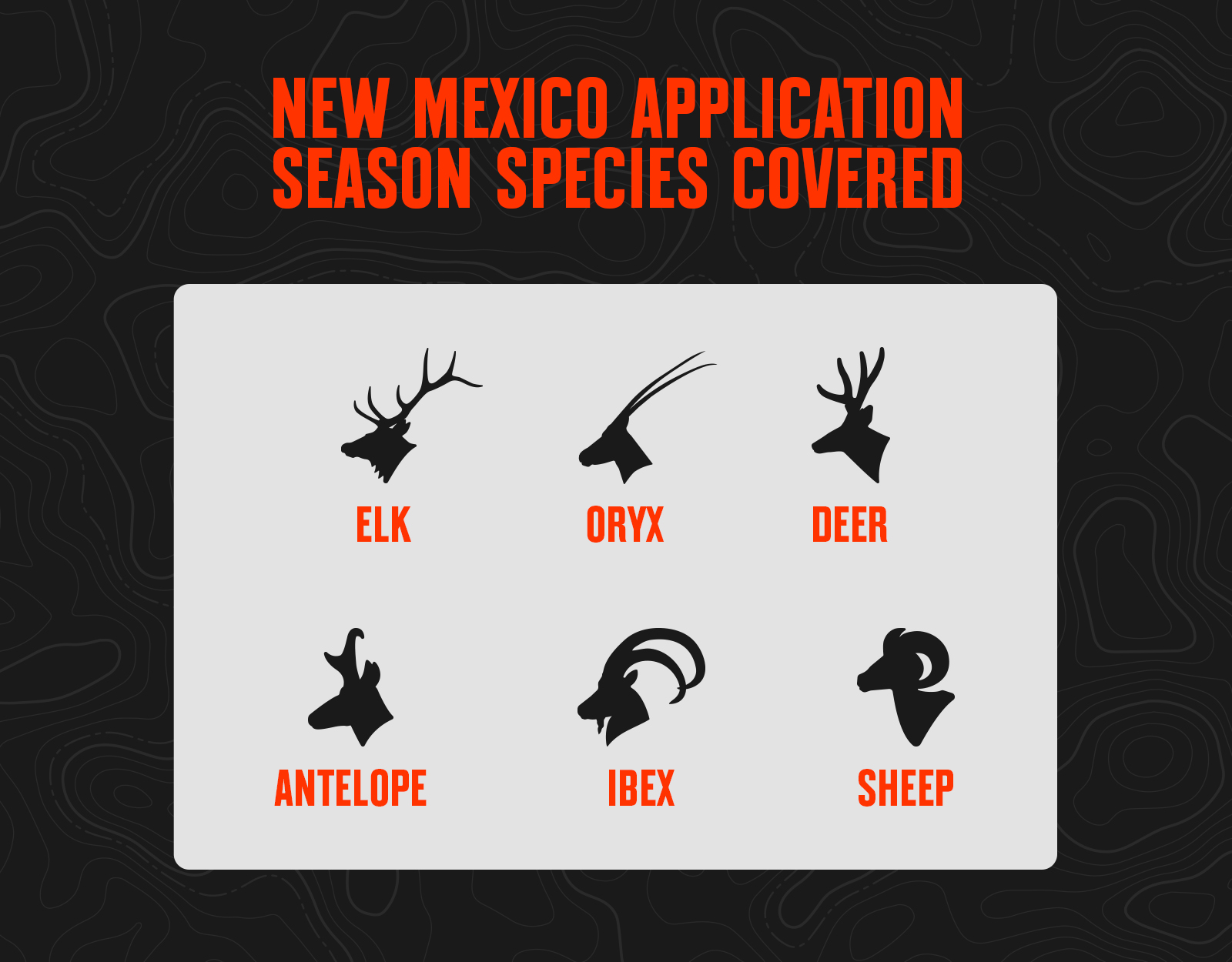
For nonresident hunters, New Mexico primarily presents as an elk and deer state. While non-residents can apply for antelope and bighorn sheep tags, the draw odds are generally poor for these two species. The Land of Enchantment also offers public hunts for three exotic species: oryx, ibex, and Barbary sheep.
Applicants are given three regular, limited-entry application choices when applying for any big game species. When an applicant is drawn, all three choices are considered before the next applicant is drawn. An additional fourth or fifth choice may be offered, but these application choices do not pertain to regular hunt choices; rather, they apply to leftover tags or population management tags.
Point System
- New Mexico does not have any type of point system; all tags are issued via a random draw.
- All applicants have the same chance to draw in their respective application type (Resident, Nonresident, Outfitter).
License Allocation
- A minimum of 84% of the total number of tags available for a given hunt are allocated to residents.
- A maximum of 10% of the total number of tags available are allocated to applicants who have contracted with a licensed New Mexico guide or outfitter (and use their outfitter’s ID number on the application).
- A maximum of 6% of the total number of tags available for a given hunt are allocated to nonresidents.
Draw Odds
- For each application, New Mexico considers your first three hunt choices before moving to the next application, which makes calculating your true draw odds rather complex.
- The odds Hunt Research Tools lists are for a single applicant, Choice #1.
- Generally, the draw odds are better in the outfitter draw pool. But it is unlikely for an outfitted applicant to draw a hunt code with six or fewer available tags or for a non-resident to draw a hunt code with 12 or fewer available tags.
Other New Mexico-Specific Considerations
- Because your first three hunt choices are evaluated on your application before moving on to the next application, the way you order your three choices can help optimize your draw chances. Order them from hardest-to-draw to easiest-to-draw to maximize your opportunity to draw choice one or two.
- Although New Mexico is not known for trophy mule deer, there are decent draw odds for hunts scattered throughout the state. If you are new to western hunting, these hunts offer a chance for a limited entry tag in areas that aren’t typically overrun with other hunters.
- New Mexico has an extensive private landowner tag system for elk (through the EPLUS program) and antelope (over-the-counter license accompanied by written landowner permission), where tags can be purchased from landowners (generally expensive, but avoids the public draw).
- Scopes are not allowed on muzzleloader hunts—open sights only. This diminishes the effectiveness of a muzzleloader as a long-range weapon, and may shift the demand for popular muzzleloader hunts.