Ready to explore this trail?
View Trail Map in AppRegional Classic
A must do route for the area handpicked by local experts.
This route is not possible until the River Trail and Bright Angel Trail below Havasupai Gardens are re-opened (scheduled for May 15, 2025). They are closed due to construction of the new Transcanyon Waterline. Check the national park website for current updates.
Path Type
Point to Point
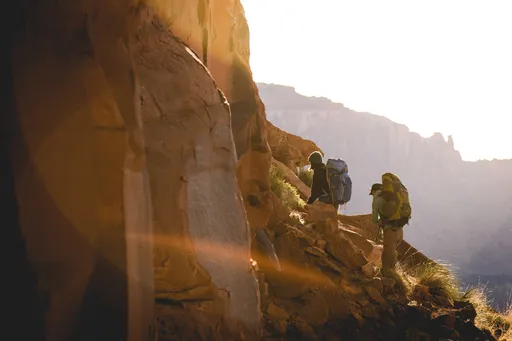
To make this a loop, you could hike or bike along the rim trail, but most people utilize the park's free shuttle. There is no public parking at South Kaibab Trailhead, so park near the Bright Angel trailhead and catch an early bus (see the national park website for schedules) to the South Kaibab trailhead. Leaving the rim behind on South Kaibab Trail, the hike doesn't take long to delve into the switchbacks. Soon enough the terrain levels out where the Toroweap Formation meets the Cococino Sandstone. The trail tightens to embrace the earth's every contour on a narrow shelf, then finds a high overlook, called Ooh Ahh Point. These first eight-tenths of a mile see the most visitors, but having only lost eight hundred feet, you'll have to venture much lower to catch a glimpse of the river.Beyond Ooh Ahh Point, sightings of other visitors taper off as another batch of switchbacks bring the trail even deeper through the years into the Hermit Shale. After one-half mile, the strain levels briefly at Cedar Ridge before meeting with a sharp ridgeline atop the Supai Group, then pulls away to wrap O'Neill Butte. Leveling again at mile 2.8, the trail reaches Skeleton Point, a spot morbidly named for the occasional mule trains who might topple over the edge. Finally reaching the massive cliffs of the 240 million year old Redwall Limestone, expertly carved switchbacks called the Red and Whites delve deeper by way of a rare weak spot, then swing north into the expansive Bright Angel Shale, and the trail's last rest area at the Tipoff. Having truly found the desert now, the sparse vegetation thins out with only scattered blackbrush. In the winter, snow seldom falls at this low elevation. Meeting with the Tonto Trail, then passing by the emergency phone which most likely gives the Tipoff its name, the trail drops towards the lower edge of the Bright Angel Shale. The first glimpse of the river comes at the lip of the inner canyon in the Tapeats Sandstone. With careful eyes, waves and fossils can be spotted in the coarse red-stained sand from an ancient sea that long ago churned against these walls. Entering into the Vishnu Basement rocks--the oldest exposed layers of the Grand Canyon--tight, steep switchbacks work through the Precambrian years. After 1.2 miles, a short tunnel gains access to the Black Suspension Bridge - and the river at last! From down here, you can hardly see any higher than the inner gorge of Vishnu Schist. From the Silver Bridge, the route traces the river for 1.2 miles. In full sun, with nothing but dark rock to reflect the sun's every ray, this is the most brutal part of the journey back. But pulling into the depths of the Bright Angel Canyon, respite can be found in the deep shadows it casts. The next mile follows Pipe Creek at an easy grade. But to find access to the higher elevations, 0.5 miles of switchbacks, known as Devil's Corkscrew, ascend the Vishnu Basement rocks of the inner canyon. But the climb isn't nearly over yet. The switchbacks loosen, and over another half mile in callous heat, the trail wraps west to meet with Garden Creek, and an unexpected oasis. Leveling, the trail widening, the hardest, hottest part of the day comes to an end as you leave the "Death Zone" behind. Running water and falls cascade down creek, and the trail grows busier with campers lucky enough to score a permit for a night under these stars. Surrounded by trees, and shielded under the shadow cast by the canyon's eastern walls, the trail follows Garden Creek towards the Havasupai Gardens Campground. Now into the upper canyon, at an elevation of 3,500 feet, the trail nears the Bright Angel Shale once again. Another set of switchbacks brings you through the Muav Limestone, to the lip of the Redwall Limestone, where it levels at the 3-mile resthouse. The switchbacks loosen, and over 1.5 miles, the trail reclaims the Supai Group and the Hermit Shale to find the 1.5-mile resthouse. From here, the final 1.5 miles climb a little over 1,100 feet to break through the Coconino Sandstone and find the rim once again.
Ancient inhabitants of the Grand Canyon established the original routes of these trails, and they have been built up for more traffic in recent times. The Havasupai People have long used the upper part of the Bright Angel Trail because they used to live seasonally along Garden Creek. When they were forced out by the park service in the early 20th century, the trail was extended to the river by entrepreneur Ralph Cameron. Back then, you had to pay a dollar to access the trail, and Cameron charged extra to use the outhouses and water. When the park service couldn't convince Cameron to turn over ownership of the Bright Angel Trail, they built the South Kaibab Trail using a different route to the east.
No Condition Reports
Contributors