


Ready to explore this trail?
View Trail Map in AppPath Type
Point to Point
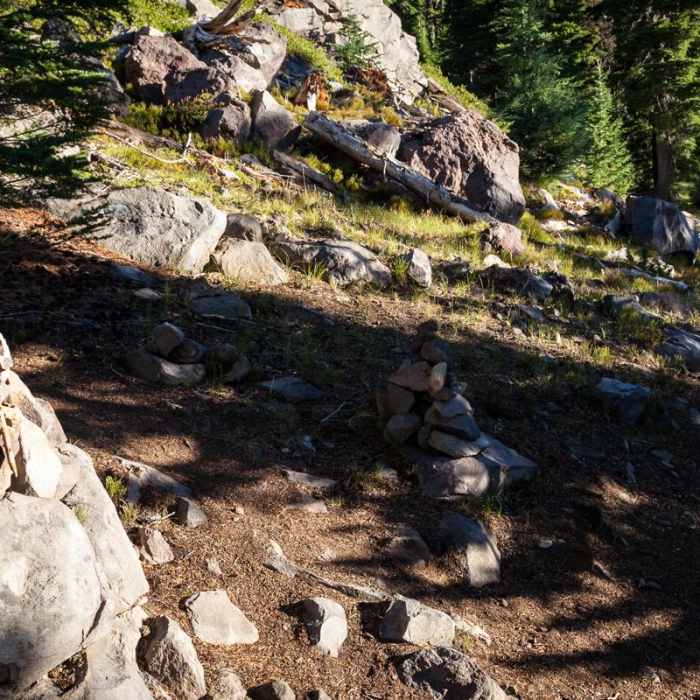
Seen from a distance, Diamond Peakas bulge is a prime illustration of what you might imagine a shield volcano should look like: the jagged edges become somewhat smoothed, and the silhouette sits lens-like, as if a fraction from a swollen basaltic andesite bubble was locked in mid-rupture above the Odell-Crescent-Summit Lake chain. Probably less than 100,000 years ago, a pyroclastic cone slowly began to form from a vent that is now Diamond Peakas north summit. Later and somewhat more quickly, a southern vent opened and gradually allowed the formation of the southern cone, which we now recognize as Diamond Peakas summit. Glaciers then did their work, scouring and shaping the sides with deep, broad canyons over thousands of years and sloughing some of the material off into moraines that would cup Odell and Crescent Lake below. While getting to the top of Diamond Peak takes some fortitude and light preparation in good weather, there are no technical sections to climb, and no special gear is needed beyond a good pair of boots. One of the most popular and accessible routes to Diamond Peakas summit uses the Pacific Crest Trail as it winds north from Summit Lake almost directly to the volcanoas southern flank. The distance and elevation gain on this route make Diamond Peak a challenging hike, but one that is easily accomplished as a day trip. The stretch of the PCT leading up to Diamond Peak is a beautiful walk through Douglas firs and lodgepole pines, so youall get only a few views on this PCT section of the hike. After the first few miles you will reach the intersection with the Rockpile Lake Trail that leads to both Marie and Rockpile Lakes. While both of these lakes are beautiful, close, and well worth seeing, it is wise to make them digestifs; see them if you have the time and energy after your main course, the summit. When you reach your first incredible view south over Summit Lake, youall know you are near the summit trail junction. This trail leaves the PCT just 25 yards or so from the viewpoint, and it is marked with cairns and sticks in lieu of an official sign. Wayfinding to the summit is fairly straightforward, though you will need to find cairns from time to time as the trail works across the larger scree fields. The route is very exposed and steep across the volcanic rock, so donat forget the water dish and perhaps some booties if you are hiking with a dog. After some short but grueling sections youall hit a false summit that signals the worst of the grade is behind you, as the route from there is more of a ridge crossing. The views from the summit are stunning in all directions, but the highlights include the sequence of Cascades to the north and the lakes that form a 180-degree arc around the mountainas eastern base. Youall have to move around a bit to catch Mount Yoran, which is immediately beneath Diamond Peakas north summit. The list of major Cascades begins with Broken Top and proceeds to the South and Middle Sisters in the Three Sisters Wilderness, Mount Washingtion, Three Fingered Jack, Mount Jefferson, and Mount Hood. Youall also see Waldo Lake in the northern foreground, with Odell Lake sitting south and east of Waldo, Crescent Lake south of that, while Summit Lake sits in the southern foreground. Returning by the same route, reward yourself with that visit to Marie and Rockpile Lakes. They really are close and well worth the extra effort. Each has a selection of backcountry campsites along its shores, and each is small enough to feel like a personal piece of the wilderness. Finally, Summit Lake is an ideal spot to take a plunge that washes away the trail dust. If you swim in the right spot, youall be able to float beneath a fantastic view of the peak you just climbed.
No Condition Reports
Contributors