Ready to explore this trail?
View Trail Map in AppWilderness permits are not required, but you need a campfire permit if you plan to have a campfire. Pets are allowed so long as they are under control and do not harass the wildlife.
Path Type
Loop
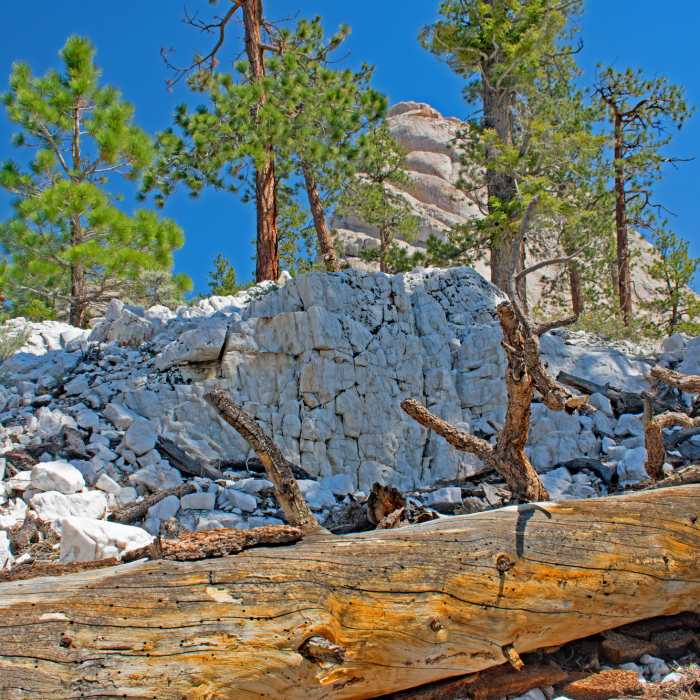
Big Meadow Trail starts with a 150-foot climb over a ridge to reach the upper section of South Manter Creek. It follows the creek and then makes a short, steep climb over a ridge that is covered with small and large rock formations, the largest of which is Taylor Dome. The trail follows Taylor Creek down for a little over 2 miles, until it crosses the creek at the end of Road 24S32-Church. Taylor Meadow is private land surrounded by a barb-wire fence. The trail is supposed to continue along Taylor Creek, passing on the north side of the meadow; however, I didn't see that section. It could be one of the many trail sections that have not been maintained in the last few years. Instead, I followed Road 24S32-Church and then went off-trail around the south side of the meadow and worked my way over to Woodpecker Trail #34E08 and Road 24S13-Taylor.Woodpecker Trail climbs 1000 feet to a pass just to the right of "Church Dome," the most famous formation in Domeland. This rock climber's paradise is a set of formations that would be better named "Church Spires." Climbers have given names to at least 12 of these formations. From the far side of the pass, the sheer rock faces at the top of the ridge are even more impressive. From there the trail drops rapidly at first, and then gradually descends towards Manter Meadow, crossing over several low glacial moraines. We reach the deep green Manter Meadow, the largest meadow within the wilderness, at the junction with the South Manter Trail-34E37. The Woodpecker Trail skirts the meadow on the east side and crosses Manter Creek at the junction with the Manter Creek Trail-35E12. Along the meadow's narrow northern extension, the trail passes a fire circle and a metal frame previously used for a large forest service tent. A short distance farther, it passes the junction with the North Manter Trail-34E14 and crosses over a low ridge. The creek below has good water until after the snow melt. The trail follows North Manter Creek past the junction with the Domeland Trail-34E15 and climbs up to the saddle that leads towards Trout Creek. Along the way there are good views of numerous rock formations, including several well-known to climbers: Fist, Knuckles, and Bart Dome.From near the high point on the Woodpecker Trail, it is a fairly easy to make a steep, off-trail scramble down to the Domeland Trail-34E15, assuming a good map and navigational skills. You should reach the Domeland Trail shortly before it leaves Tibbets Creek. The Domeland Trail climbs 100 feet to a striking saddle between Bart Dome and a set of unnamed domes. Just before the saddle, there is a remarkable waterfall-like pile of white crystal rock about 10 feet high and 30-50 feet wide. After dropping about 200 feet from the saddle, you'll see "the golf ball," a 7-foot tall rock that resembles a golf ball on a narrow tee. This marks the end of the maintained trail. We leave the trail here and hike off-trail along a relatively flat ridge leading to points overlooking Radiant Dome, North Domes, and Stegosaurus Fin. Try to go as level as possible, straight out from the saddle. The ridge drops only 350 feet in 2.6 miles. Hike out as far as you want or climb one of the small domes on the ridge for a better view, or make a short, moderate descent to the base of any of the domes that you chose. To return, just head back to the saddle between Bart Dome and the unnamed domes. Once back on the Domeland Trail, take it back to the Woodpecker Trail and continue back to the junction with North Manter Trail. This trail stays well to the west of the meadow, passing an old cabin and a spring to reach the junction with the Cabin Spur Trail. Follow that trail along Manter Creek. It drops about 130 feet to the edge of the meadow and then climbs to the junction with the South Manter Trail. This shady trail follows South Manter Creek, climbing about 700 feet in 2 miles. The South Manter Trailhead is only 0.25 miles below, and our starting point is only about 100 yards from there.
The Domeland Wilderness was created by the federal Wilderness Act in 1964, with additions in 1984 and 1994 so that it now has a total of 133,720 acres. The original portion of the Wilderness contains most of its many granite domes and geological formations. It is managed by the Sequoia National Forest and the Bureau of Land Management.The area north and east of Manter Meadow was heavily burned by the Manter Fire in 2000. The brush has returned, but, the taller trees have not, leaving many lonely burned trunks.The wild and scenic South Fork of the Kern crosses the wilderness. South of Rockhouse Meadow, it drops through deep and essentially inaccessible gorge. The South Fork, Fish Creek, and Trout Creek are excellent for fishing, but this often requires strenuous off-trail hiking. The river and these two creeks can be dangerous, to impossible, to cross until after the snow melt.
No Condition Reports
Manter Meadow Hike
Manter Meadow Hike
Manter Meadow Loop
Manter Meadow Loop
Whiskey Flat Out-and-Back
Whiskey Flat Out-and-Back
Woodpecker Trail
Woodpecker Trail
Kern River Upper to Rincon Trail
Kern River Upper to Rincon Trail
Domeland Wilderness via Pacific Crest Trail
Domeland Wilderness via Pacific Crest Trail
Contributors