

Ready to explore this trail?
View Trail Map in AppThe trailhead is generally closed 2-3 miles below the lower trailhead (where this rxh starts). The land manager requests dogs be leashed. The semi-technical ridge is probably not a great idea for dogs, but they can easily do the standard route.
Path Type
Loop
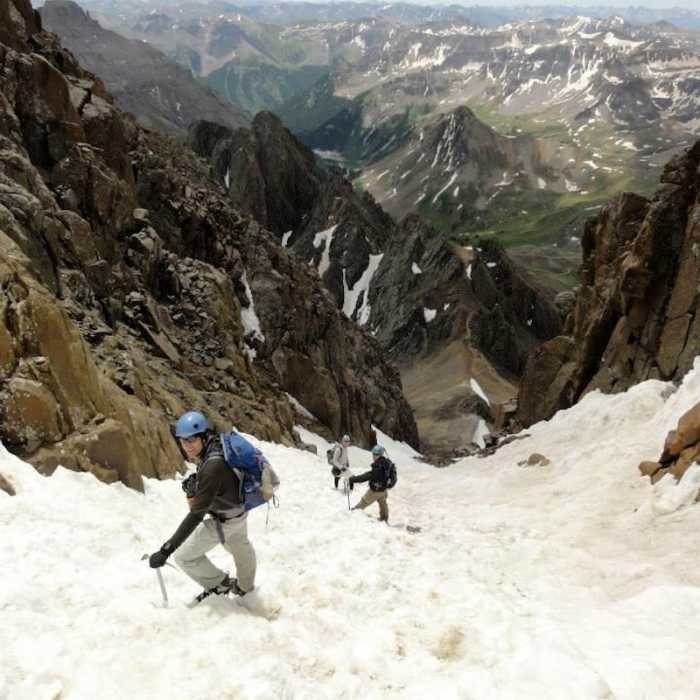
The road to Yankee Boy Basin is rough. Subarus and similar cars can make it about 0.9 miles to a lower trailhead with restroom. There are numerous pull-offs in this area. After this, a true off-road vehicle (Jeep, Xterra, FJ, etc.) is required. The upper trailhead is around 12,400 ft and is just under a mile from here (see map). From the lower trailhead, hike up the 4WD road. While there are a few switchbacks here and there, the grade is low and rocks on the trail are easily avoided. Come to a flat area at 12,300 ft, angling to the right to reach the upper trailhead. Hike by Texans and their Jeeps, and continue northwest from the parking lot on Blue Lakes Trail. After a quarter mile of walking along a small talus trail, come to a junction. Turn left to stay on Blue Lakes Trail and climb up the southwest ridge (turning right on Mt. Sneffels Trail brings you up the gully, which you'll descend). Follow the clear trail from here to reach Blue Lakes Pass at 13,000 ft. Turn right on the pass up the Southwest Ridge. In about 100 meters come to a set of rock pinnacles. Hike on some talus to the left of these rock formations. From here, angle to the left up a short gully. Climb about 150' on loose talus. Just before the top of the gully, hang a right and enter another gully, scrambling on some more large talus. Come to the top of this gully at 13,400 ft. At this point, you're still to the left of ridge proper. Pass through a notch at 13,500 ft and drop a small amount along a narrow and exposed trail onto the right side of the ridge. Hug the ridge and angle up a gully to the left, coming to another notch to your right. Finally, reach ridge proper at 13,700 ft. Up to this point, route finding can be difficult. Simply put, hike up talus gullies and never get more than 50-100 ft from ridge proper. If the going gets truly difficult, you're off route. From ridge proper at 13,700 ft, the summit is visible. Scramble along some loose rocks for 100-200 ft or so before reaching grippy, conglomerate rock. This is the best part of the climb, and the remainder of scrambling to the summit is a pleasure. Reach the top at 14,150 ft, and enjoy. The way down is less awesome. From the summit, head SE down some excellent rock. Your goal is to descend a gully and reach a saddle at 13,500 ft. Walk off of the summit block and into a narrow gully, reaching a V-notch in the rock around 14,000 ft. Pop through this and angle to the right down a rocky gully. The gully gets progressively wider as you descend, and route finding from here is easy - it's basically a funnel. This area is well-shaded and often holds snow into July. Come to the saddle at 13,500 ft. Be careful on the way down: rocks are loose and snow is slippery. From the saddle, hike down a comically steep gully of loose gravel and dirt. You'll probably be wondering why there aren't switchbacks here...it's a true ankle buster. After about 600 ft of descent, come to the bottom of the gully. Follow the Mt. Sneffels Trail under 0.5 miles back to the junction where you turned left earlier to reach Blue Lakes Pass. From here, it's just over a mile back to the lower trailhead, all on familiar ground. If time permits, an exploration of Ouray is worth it.
Due perhaps to its striking appearance and proximity to Ouray, Mt. Sneffels boasts a rich mountaineering history. First summited in 1874, its couloirs have become popular for mountaineers of varied prowess. Its name comes from the Iceland volcano Snaefell, which figured prominently in Jules Verne's classic novel "Journey to the Center of the Earth."
No Condition Reports
Contributors