Ready to explore this trail?
View Trail Map in AppThis is bear country. Check with the Rangers before heading out. In August 2015, a sow grizzly with cubs killed a park employee rxhing alone on this trail without bear spray.
Path Type
Loop
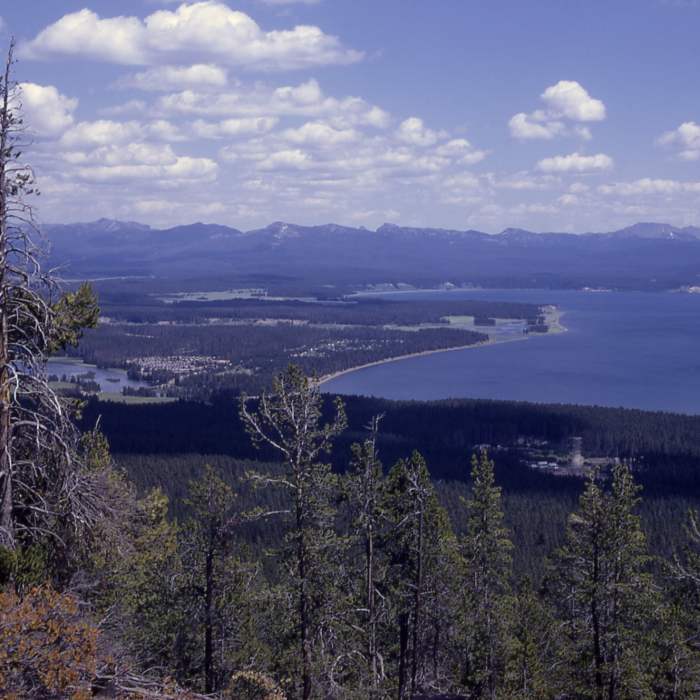
The trail briefly parallels the highway south then veers west (right) and enters the lodgepole forest. Enjoy making your way along the shaded path, and take a few moments to appreciate your surroundings.At the 0.9-mile mark, a trail junction is reached. Both trails lead to the top of Elephant Back. Follow the left trail as it uses five switchbacks to steeply climb 600 feet in the next 0.8 miles. Elephant Back was named by F.V. Hayden in 1871 for its rounded form and almost vertical sides that he believed resembled the back of an elephant. From the observation point at the top (the 1.8-mile mark of the trail) you get a commanding view of Yellowstone Lake. The wooden benches here make an excellent picnic spot. Early explorers were amazed that a lake of such huge dimensions (135 square miles of surface area) could lie at such a high elevation above sea level (7,733'). Today we know that it is the largest lake for its elevation above sea level anywhere in North America.The lake contains 3 major islands;Stevenson, Frank, and Dot. James Stevenson, a prominent member of the 1871 Hayden Survey, assembled a 12-foot sailboat that he used to reach the island later named in his honor. His craft, which he christened the "Anna" after the daughter of an influential congressman, was the first known vessel to ply the lake's waters.The rugged Absaroka Mountains (pronounced "AB-sar-O-ka" or "ab-SAR-o-ka") tower above the lake to the east. The high ridge that they form comprises the eastern boundary of Yellowstone. Early maps show these mountains as the "Yellowstone Range," but they were later officially named for the Crow Indians who inhabited this region. "Absaroka" (which means "children of the large beaked bird" in the Crow's native tongue) is the Crow Indians' name for themselves. When you have finished soaking up the view, continue south along the trail. It quickly loops back to the right (north) then winds its way down the mountain and rejoins the main trail at the 3-mile mark. Turn left (SE) and follow it the last 0.9 miles back to the trailhead.Thanks to guidebook author, Tom Carter, for sharing this trail description. To learn more about visiting Yellowstone, check out his book, Day Hiking Yellowstone.
No Condition Reports
Contributors