Ready to explore this trail?
View Trail Map in AppIf it's raining or threatening to rain, you may want to consider another trail due to the fear of flooding in the canyon. The canyon is narrow in several places with some scrambling required over slippery rocks, which could be tricky if it's raining.
Path Type
There and Back
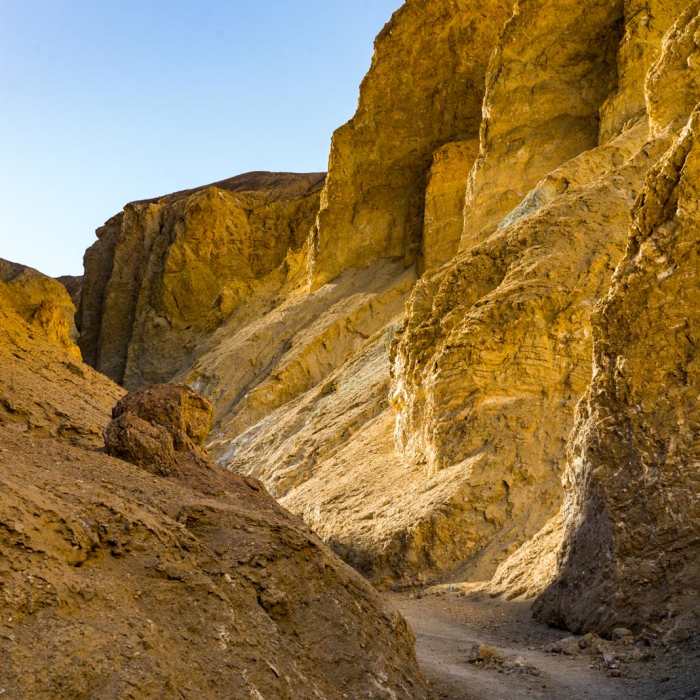
The Desolation Canyon Trail is located at the end of Desolation Canyon Road, approximately 3.7 miles south of CA Highway 190 on Badwater Road on the left hand side. Take the .5 mile long gravel road to a roundabout where cars can park. As the trail leaves the parking area, there is a narrow stake in the ground that indicates where the trail leads into a giant gravel wash. One unique feature of this trail is that it actually starts below sea level. Around 50 feet below sea level, to be exact. Working its way through the wash, the mountains and hills on each side of the canyon start to close in on the trail. The trail is well worn into the wash as people have been up into the canyon before you. Various different rock types can be observed in the hills in the area. Working its way into the canyon, there is a hill on the left that can be climbed that looks down on the trail. On either side of the trail, you might encounter a side canyon that you can explore before returning to the trails. There are also gravel washes that show what it looks like when wind and rain move gravel downhill.At roughly 1 mile, there is an example of what it looks like when a gravel wash works its way onto the trail. A gravel wash has begun to fill the trail with gravel and sand, although its easy to navigate along the side and bypass the obstacle. As the trail continues uphill, an 8 foot dry fall must be overcome to continue on the trail. It does require climbing and scrambling to overcome, but is perfectly doable for those with moderate fitness. On the return trip, it might require sliding down or climbing back down. The trail continues for another .1 miles before another dry fall, roughly 6 feet tall, must be climbed in order to proceed. Again, remember that this must be descended on the return trip, so sliding or climbing back down will be required. Both dry falls have natural ledges and handholds to help traverse them. The trail continues to ascend through the canyon. Several side canyons are encountered along this portion of the trail that offer the opportunity for exploration. The walls in the canyon in this section are various colors that reflect different minerals found in the rocks. Hematite, Limonite, Chlorite, and Nontronite are just some of the minerals found throughout the canyon. At 1.5 miles, a side canyon goes off to the left while the main trail stays to the right. Shortly after, another canyon intersection is encountered at 1.6 miles and again, the main trail stays to the right. At this point, the trail climbs steeply (over 20% grade for roughly .1 mile) out of the canyon. The gravel is looser through this portion of the trail compared to the canyon floor, but it makes for relatively easy travel uphill, despite the steep grade.When the trail reaches the ridgeline, expansive views of Artist Drive and Death Valley stretch out before you. You can explore the ridgeline above the canyon, which allows you to look into the canyons that you have been making your way through. On the other side of the ridge, Artist Drive can be seen winding its way through the hills. The Badwater Basin and salt flats can be seen in the distance to the south. Exploring the ridge line a little further, views of the Furnace Creek area stretch out before you, as well as Death Valley beyond that. The Panamint Range, including Telescope Peak, can be seen across the valley. Once you have taken in all the views, reapplied sunscreen, and grabbed a snack, follow the trail back to your car, possibly exploring side canyons on your way back.As with all expeditions in Death Valley, make sure you have plenty of water and sunscreen, as well as a hat of some sort, to help protect you from the effects of the sun and heat. In the morning, travel through the canyon is mostly shaded and pleasant, but as the day progresses, the sun finds its way into the narrows and there is no shade when the sun is directly overhead.
All Clear
All Clear
All Clear
All Clear
Looking for more condition reports?
Contributors