Ready to explore this trail?
View Trail Map in AppPath Type
Loop
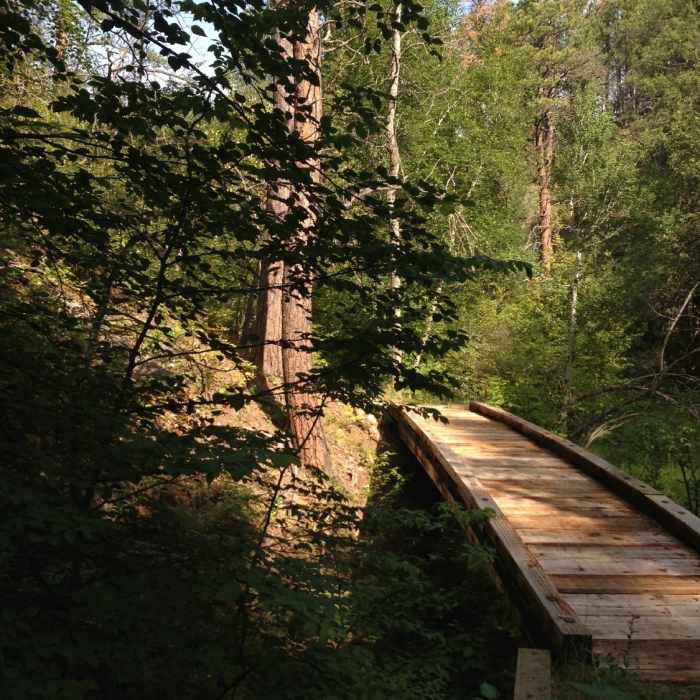
Start at the trailhead and go uphill through a few gates along an old access road. There is a small stream that will be followed for the first several miles. The trail winds along steep hillsides and the occasional cliff with small pools of water for cooling oneself. The plants grow thickly and the smell of the wildflowers is amazing.Cross the stream several times on bridges or log crossings. Go through another gate before reaching a pond and the junction with the loop portion of the trail. Stay left and uphill as you follow the old road bed turned singletrack. Be sure to look up and take in some grand views of the hills and forest with soft pine needle covered trail.Near the apex of the loop, a clearing is reached with a section of trail that is difficult to follow. There appears to be an old road that heads left at this point, but going straight across the clearing is the correct path. The intersection may be marked with logs that direct the trail in that direction.Continue on the loop heading downhill with some rock outcroppings overhead. Come back towards the out and back section with views into the gulch. At the end of the loop, head back downhill to the trailhead.
Far from the boreal (northern) forest of the upper Great Lakes region and Canada, is a small unique community know as Dugout Gulch Botanical Area. Relic boreal plants find refuge in the moist, cool gulches. These survivors are referred to as boreal disjuncts.The boreal forests of Canada once extended as far south as Nebraska. With their retreat at the end of the Ice Age, boreal plants gave way to species adapted to periods of drought and heat. Only where life sustaining moisture averages about 24 inches per year and temperatures remain relatively cool, can these survivors be found.
No Condition Reports
Contributors