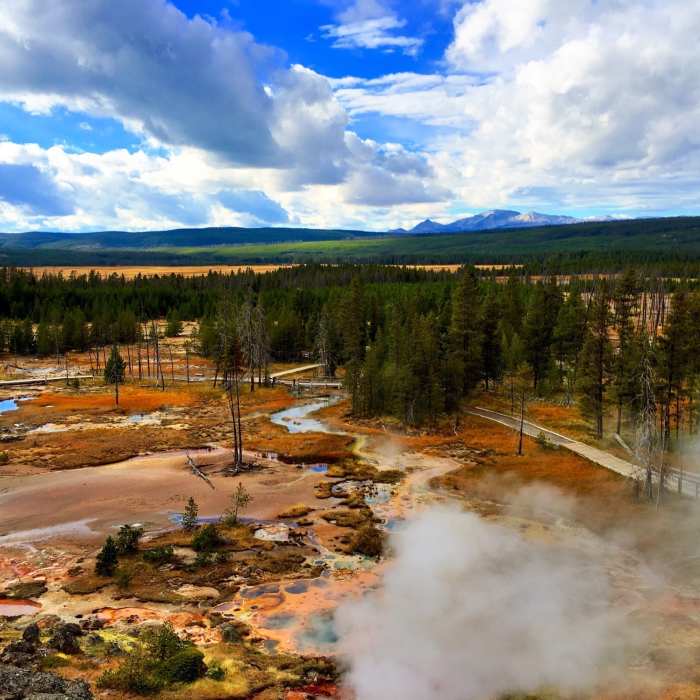
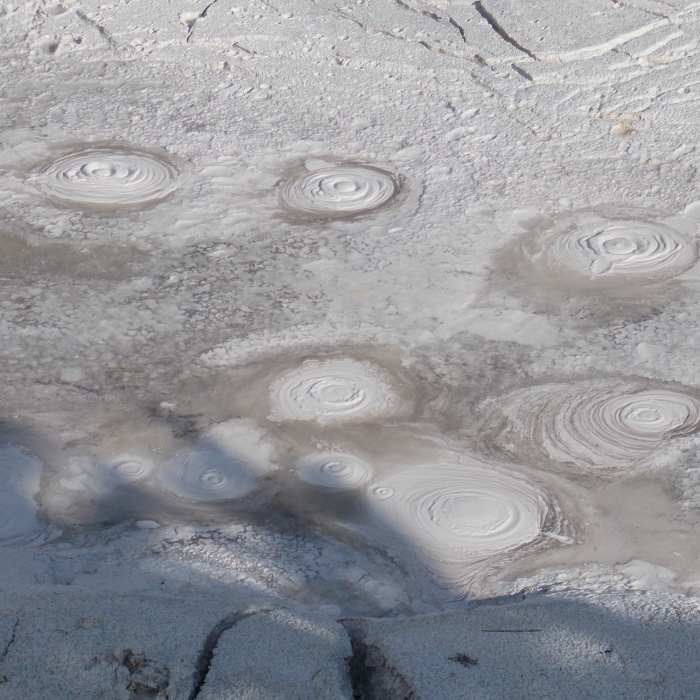
A nice trail with great views and interesting mudpots and hot springs to see.
0.7
mi
Distance
100
ft
Gain
easy
Difficulty
Family FriendlyHot SpringViews
Access Issues
Geyser basin boardwalks protect you and preserve delicate formations. You must stay on boardwalks. Pools may be near or above the boiling temperature and can cause severe, possibly even fatal, burns.
From the parking area, the wide path heads south through a lodgepole pine forest rejuvenating after the 1988 fires. Lodgepoles have an unusual way of coping with fire. Besides their annual seed cones, they produce a special "serotinous cone," which only opens at temperatures that exceed 113deg F. Following the 1988 fires, up to a million seeds per acre were found on the ground. Some seeds survived the appetites of birds and rodents to produce an abundance of lodgepole saplings. In some places they grew so thick they're called "dog-hair" forest. Paintpot Hill ahead on the horizon is such a place; notice the thick, green blanket of trees that covers it.
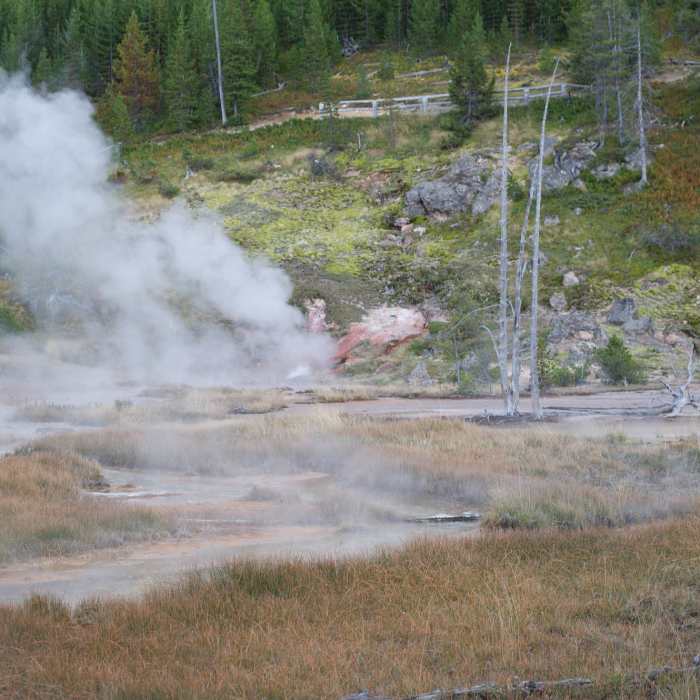
As you continue, notice also the dead trees on the left with white bottoms that look as if they are wearing white anklet socks. These "bobby socks" trees were not killed by fire, but rather drowned by thermal runoff water. The trees soaked up the mineral-laden water, and when the water evaporated, the minerals were left behind, turning the lower portion of the trees white.
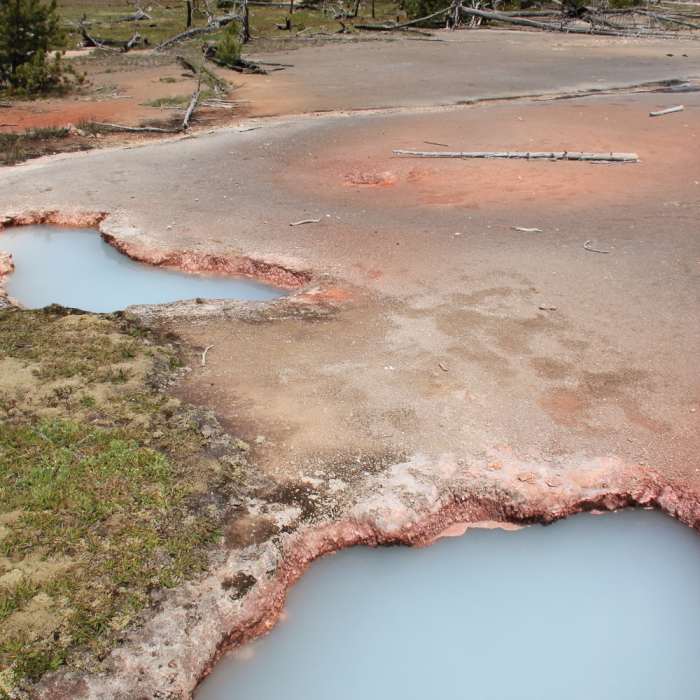
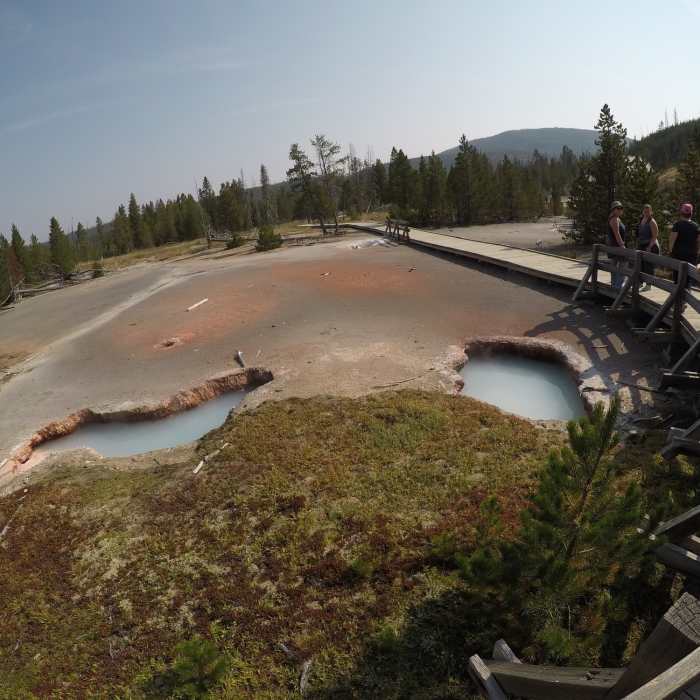
At the junction, follow the boardwalk to the left. Notice the hot springs near the bottom of the hill. Most of the time, they have a good water supply. As you climb up the hill water is more limited and the pools are filled with mud. In early summer, the mudpots are thin and watery from abundant rain and snow. By late summer they are quite thick. The mud is composed of clay minerals and fine particles of silica. In this area the rock is rhyolite, which is composed primarily of quartz and feldspar. Acids in the steam and water break down the feldspar into a clay mineral called kaolinite. Iron oxide stains the white mud into a colorful array of pastels. This effect reminded early Yellowstone geologists of an artist's palette, hence the name "Artists' Paintpots."
From the top of the hill, one gets a great view of the surrounding area including Mount Holmes, that dominates the skyline to the north.
Soon, the trail loops back to the right and continues down to the parking area.
Thanks to guidebook author, Tom Carter, for sharing this trail description. To learn more about visiting Yellowstone, check out his book, Day Hiking Yellowstone.